Abstract
Purple false brome grass (Brachypodium distachyon) has recently emerged as a model system for temperate grasses and is also a potential model plant to investigate plant interactions with economically important pathogens such as rust fungi. We determined the host status of five Brachypodium species to three isolates of Puccinia brachypodii, the prevalent rust species on Brachypodium sylvaticum in nature, and to one isolate each of three formae speciales of the stripe rust fungus P. striiformis. Two P. striiformis isolates produced sporulating lesions, both in only one of the tested interactions, suggesting a marginal host status of B. distachyon. P. brachypodii formed sporulating uredinia on the five Brachypodium species tested, and a range of reactions was observed. Surprisingly, the B. sylvaticum-derived rust isolates were more frequently pathogenic to B. distachyon than to their original host species. The B. distachyon diploid inbred lines, developed and distributed as reference material to the Brachypodium research community, include susceptible and resistant genotypes to at least three of the four P. brachypodii isolates tested. This creates the opportunity to use B. distachyon/P. brachypodii as a model pathosystem. In one B. distachyon accession, heavy infection by the loose smut fungus Ustilago bromivora occurred. That pathogen could also serve as a model pathogen of Brachypodium.
Abstract from the paper’s OpenAlex record, shown for indexing and research. Copyright remains with the authors or the publisher. Read at the source ↗
The text the model read, with the source record’s inline markup (italics, sub- and superscripts) rendered and its character entities decoded; quote offsets refer to the raw text.
Claims 5
Claim · model-written summary
Two P. striiformis isolates sporulated in only one tested interaction each, suggesting marginal host status of B. distachyon.
- Taxon
- B. distachyon
 Brachypodium distachyone0
- Interactor
- P. striiformis
 Puccinia striiformise0pathogen
- Outcome
- sporulating lesionse0
Organisms pictured · Representative pictures of the matched species, not figures from the paper.


Verbatim
e0“Two P. striiformis isolates produced sporulating lesions, both in only one of the tested interactions, suggesting a marginal host status of B. distachyon”
Claim · model-written summary
P. brachypodii formed sporulating uredinia on all five tested Brachypodium species, with varied reactions.
- Taxon
- BrachypodiumBrachypodiume0
- Interactor
- P. brachypodii
 Puccinia brachypodiie0pathogen
- Outcome
- sporulating urediniae0
Organisms pictured · Representative pictures of the matched species, not figures from the paper.

Verbatim
e0“P. brachypodii formed sporulating uredinia on the five Brachypodium species tested, and a range of reactions was observed”
Claim · model-written summary
B. sylvaticum derived isolates were more often pathogenic to B. distachyon than to B. sylvaticum.
- Taxon
- B. distachyonBrachypodium distachyone0
- Interactor
- rust isolatese0pathogen
- Outcome
- more frequently pathogenice0
- Comparator
- B. sylvaticume0
Organisms pictured · Representative pictures of the matched species, not figures from the paper.
Verbatim
e0“the B. sylvaticum-derived rust isolates were more frequently pathogenic to B. distachyon than to their original host species”
Claim · model-written summary
B. distachyon inbred lines include resistant and susceptible genotypes to at least three of four tested P. brachypodii isolates.
- Taxon
- B. distachyonBrachypodium distachyone0
- Material
- diploid inbred linese0
- Interactor
- P. brachypodiiPuccinia brachypodiie0pathogen
- Outcome
- susceptible and resistant genotypese0
Organisms pictured · Representative pictures of the matched species, not figures from the paper.
Verbatim
e0“The B. distachyon diploid inbred lines, developed and distributed as reference material to the Brachypodium research community, include susceptible and resistant genotypes to at least three of the four P. brachypodii isolates tested”
Claim · model-written summary
Heavy Ustilago bromivora infection occurred in one B. distachyon accession.
- Taxon
- B. distachyonBrachypodium distachyone0
- Material
- B. distachyon accessione0
- Interactor
- Ustilago bromivora
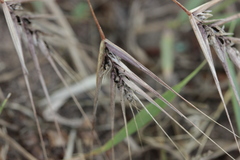 Ustilago bromivorae0pathogen
- Outcome
- heavy infectione0
Organisms pictured · Representative pictures of the matched species, not figures from the paper.
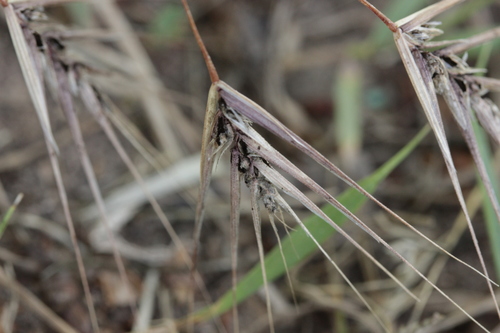
Verbatim
e0“In one B. distachyon accession, heavy infection by the loose smut fungus Ustilago bromivora occurred”