Abstract
ABSTRACT The experiment investigated the effect of intercropping plantains with 2,500, 5,000 and 10,000 melons/ha on delayed weeding for 3, 5 and 7 months respectively after planting. The yield of melons decreased with increased population. Intercropping plantains with 5,000 melons/ha suppressed weed growth for 7 months and significantly enhanced plantain establishment growth and yield. At 2,500 melons/ha, weeding could be delayed for only 3 months after planting beyond which weed competition reduced plantain growth and yield. Planting melons at high density checked weed growth for 7 months but reduced plantain establishment, retarded the growth and reduced the yield.
Abstract from the paper’s OpenAlex record, shown for indexing and research. Copyright remains with the authors or the publisher. Read at the source ↗
The text the model read, with the source record’s inline markup (italics, sub- and superscripts) rendered and its character entities decoded; quote offsets refer to the raw text.
Claims 7
Claim · model-written summary
Melon yield decreased as melon population increased.
- Taxon
- Egusi Melon
 Citrullus mucosospermust0
- Treatment
- increased populatione0
- Outcome
- yield of melonse0
- Direction
- decreasede0
Organisms pictured · Representative pictures of the matched species, not figures from the paper.
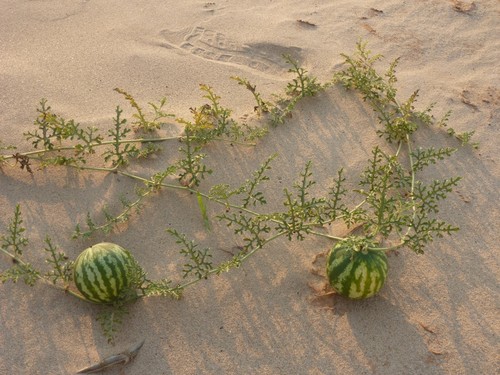
Verbatim
t0“Egusi Melon (Colocynthis citrullusL.)”
e0“The yield of melons decreased with increased population.”
Claim · model-written summary
Intercropping 5,000 melons/ha suppressed weed growth for 7 months.
- Taxon
- plantainsMusa ABB Groupe0
- Treatment
- Intercropping plantains with 5,000 melons/hae0
- Interactor
- weede0weed
- Outcome
- weed growthe0
- Direction
- suppressede0
- Value
- 7 monthse0
Not reportedComparator
Verbatim
t0“Plantains (Musa AAB)”
e0“Intercropping plantains with 5,000 melons/ha suppressed weed growth for 7 months”
Claim · model-written summary
Intercropping 5,000 melons/ha significantly enhanced plantain establishment growth and yield.
- Taxon
- plantainsMusa ABB Groupe0
- Treatment
- Intercropping plantains with 5,000 melons/hae0
- Outcome
- plantain establishment growth and yielde0
- Direction
- enhancede0
Not reportedComparator
Verbatim
e0“Intercropping plantains with 5,000 melons/ha suppressed weed growth for 7 months and significantly enhanced plantain establishment growth and yield.”
Claim · model-written summary
At 2,500 melons/ha, weeding could be delayed for only 3 months.
- Taxon
- melons
 Cucumis meloe0
- Treatment
- 2,500 melons/hae0
- Outcome
- weeding could be delayed for only 3 monthse0
Organisms pictured · Representative pictures of the matched species, not figures from the paper.

Verbatim
e0“At 2,500 melons/ha, weeding could be delayed for only 3 months after planting”
Claim · model-written summary
Weed competition beyond 3 months at 2,500 melons/ha reduced plantain growth and yield.
Verbatim
e0“At 2,500 melons/ha, weeding could be delayed for only 3 months after planting beyond which weed competition reduced plantain growth and yield.”
Claim · model-written summary
High density melon planting checked weed growth for 7 months.
- Taxon
- melonsCucumis meloe0
- Treatment
- Planting melons at high densitye0
- Interactor
- weede0weed
- Outcome
- weed growthe0
- Direction
- checkede0
- Value
- 7 monthse0
Not reportedComparator
Organisms pictured · Representative pictures of the matched species, not figures from the paper.
Verbatim
e0“Planting melons at high density checked weed growth for 7 months”
Claim · model-written summary
High density melon planting reduced plantain establishment, growth and yield.
- Taxon
- plantainMusa ABB Groupt0
- Treatment
- Planting melons at high densitye0
- Outcome
- plantain establishment, retarded the growth and reduced the yielde0
- Direction
- reducede0
Not reportedComparator
Verbatim
t0“Plantains (Musa AAB)”
e0“Planting melons at high density checked weed growth for 7 months but reduced plantain establishment, retarded the growth and reduced the yield.”
The same questions in other papers
intercropping · yield · Musa x paradisiaca (banana)Results differ
4 papers in the same direction as this paper · 1 in the opposite direction
- no effect
- positive
- positive
2 papers more in this group
See all 6 papers →Claims are grouped by organism, treatment and what was measured or targeted. A paper counts as positive when any of its claims in the group is positive.