Abstract
Context: Cumin (Cuminum cyminum L.) as a member of the Apiaceae family is one of the most important medicinal plants in the world.Objective: An experiment was conducted for evaluation of callus induction optimization in cumin accessions (Shahdad, Koohbanan, Badrood and Afghanistan).Materials and methods: Factorial experiment based on completely randomized design (CRD) with three replications was conducted on MS medium supplemented with different concentrations of 2,4-D (0, 0.5, 1 and 2 mg/l) plus 0.1 mg/l Kinetin in different explants (Root, Shoot, Leaf, Embryo and Seed) of cumin accessions. In this experiment the evaluated traits include days to callus induction (DCI), callus induction percentage (CIP) and callus growth rate (CGR).Results: Statistical analysis showed that seed (as the latest) and root (as the earliest) explants require to 54 and 11 days in order to callus induction initiation respectively. Results showed that accession, explant, accession × explant and 2,4-D × explant interactions were statistically significant effects (P<0.01) on callus induction percentage and callus growth rate traits. Furthermore, 2,4-D had a high significant effect on callus induction percentage.Conclusion:According to results of this study, root explant is an appropriate explant for large production of callus in some accessions of Cuminum cyminum. Also, Koohbanan accession produced callus in minimum time and Afghanistan accession produced high percentage of callus.
Abstract from the paper’s OpenAlex record, shown for indexing and research. Copyright remains with the authors or the publisher. Read at the source ↗
The text the model read, with the source record’s inline markup (italics, sub- and superscripts) rendered and its character entities decoded; quote offsets refer to the raw text.
Claims 10
Claim · model-written summary
Seed explants required 54 days for callus initiation, the latest explant.
- Taxon
- Cumin
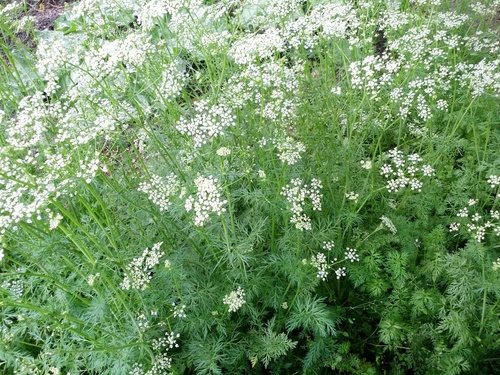
 Cuminum cyminumt0
- Organ / stage
- seede0
- Outcome
- callus induction initiatione0
- Direction
- lateste0
- Value
- 54e0
Organisms pictured · Representative pictures of the matched species, not figures from the paper.
Verbatim
e0“seed (as the latest) and root (as the earliest) explants require to 54 and 11 days in order to callus induction initiation respectively.”
t0“Cumin (Cuminum cyminum)”
Claim · model-written summary
Root explants required 11 days for callus initiation, the earliest explant.
- Taxon
- CuminCuminum cyminumt0
- Organ / stage
- roote0
- Outcome
- callus induction initiatione0
- Direction
- earlieste0
- Value
- 11 dayse0
Organisms pictured · Representative pictures of the matched species, not figures from the paper.
Verbatim
e0“seed (as the latest) and root (as the earliest) explants require to 54 and 11 days in order to callus induction initiation respectively.”
t0“Cumin (Cuminum cyminum)”
Claim · model-written summary
Accession significantly affected callus induction percentage and growth rate.
- Taxon
- CuminCuminum cyminumt0
- Material
- accessione0
- Outcome
- callus induction percentage and callus growth ratee0
- Value
- P<0.01e0
Not reportedDirection
Organisms pictured · Representative pictures of the matched species, not figures from the paper.
Verbatim
e0“accession, explant, accession × explant and 2,4-D × explant interactions were statistically significant effects (P<0.01) on callus induction percentage and callus growth rate traits.”
t0“Cumin (Cuminum cyminum)”
Claim · model-written summary
Explant significantly affected callus induction percentage and growth rate.
- Taxon
- CuminCuminum cyminumt0
- Organ / stage
- explante0
- Outcome
- callus induction percentage and callus growth ratee0
- Value
- P<0.01e0
Not reportedDirection
Organisms pictured · Representative pictures of the matched species, not figures from the paper.
Verbatim
e0“accession, explant, accession × explant and 2,4-D × explant interactions were statistically significant effects (P<0.01) on callus induction percentage and callus growth rate traits.”
t0“Cumin (Cuminum cyminum)”
Claim · model-written summary
The accession-by-explant interaction significantly affected callus induction percentage and growth rate.
- Taxon
- CuminCuminum cyminumt0
- Material
- accessione0
- Organ / stage
- explante0
- Outcome
- callus induction percentage and callus growth ratee0
- Value
- P<0.01e0
Not reportedDirection
Organisms pictured · Representative pictures of the matched species, not figures from the paper.
Verbatim
e0“accession, explant, accession × explant and 2,4-D × explant interactions were statistically significant effects (P<0.01) on callus induction percentage and callus growth rate traits.”
t0“Cumin (Cuminum cyminum)”
Claim · model-written summary
The 2,4-D-by-explant interaction significantly affected callus induction percentage and growth rate.
- Taxon
- CuminCuminum cyminumt0
- Organ / stage
- explante0
- Treatment
- 2,4-De0
- Outcome
- callus induction percentage and callus growth ratee0
- Value
- P<0.01e0
Not reportedDirection
Organisms pictured · Representative pictures of the matched species, not figures from the paper.
Verbatim
e0“2,4-D × explant interactions were statistically significant effects (P<0.01) on callus induction percentage and callus growth rate traits.”
t0“Cumin (Cuminum cyminum)”
Claim · model-written summary
2,4-D significantly affected callus induction percentage.
- Taxon
- CuminCuminum cyminumt0
- Treatment
- 2,4-De0
- Outcome
- callus induction percentagee0
Not reportedComparatorDirection
Organisms pictured · Representative pictures of the matched species, not figures from the paper.
Verbatim
e0“2,4-D had a high significant effect on callus induction percentage.”
t0“Cumin (Cuminum cyminum)”
Claim · model-written summary
Root explant was recommended for mass callus production in some cumin accessions.
- Taxon
- Cuminum cyminumCuminum cyminume0
- Outcome
- root explant is an appropriate explant for large production of calluse0
Organisms pictured · Representative pictures of the matched species, not figures from the paper.
Verbatim
e0“root explant is an appropriate explant for large production of callus in some accessions of Cuminum cyminum.”
Claim · model-written summary
Koohbanan accession formed callus in minimum time.
- Taxon
- CuminCuminum cyminumt0
- Material
- Koohbanan accessione0
- Outcome
- calluse0
- Direction
- minimum timee0
Organisms pictured · Representative pictures of the matched species, not figures from the paper.
Verbatim
e0“Koohbanan accession produced callus in minimum time”
t0“Cumin (Cuminum cyminum)”
Claim · model-written summary
Afghanistan accession produced a high percentage of callus.
- Taxon
- CuminCuminum cyminumt0
- Material
- Afghanistan accessione0
- Outcome
- percentage of calluse0
- Direction
- highe0
Organisms pictured · Representative pictures of the matched species, not figures from the paper.
Verbatim
e0“Afghanistan accession produced high percentage of callus.”
t0“Cumin (Cuminum cyminum)”