Abstract
Diurnal courses in gas exchange, photochemical efficiency and water relations were monitored during two late summers in three groups of adult Quercus robur L. trees, planted along an urbanization gradient that correlated positively with the degree of die-back exhibited by the trees. Leaf carbon:nitrogen ratios, proline and polyphenol levels were monitored to explain why the intermediate group of trees were more severely infested (p ≤ 0.01) with Asterolecanium quercicola (Bouché). All three groups of trees showed a significant correlation of net photosynthesis with photon flux density (PPFD), but A correlated more positively with the pre-dawn leaf water potential ψpd of the moderately (trees of group b, i.e. at the edge of town) and severely (trees of group c, i.e. urban) water-stressed trees. A of the rural trees and stomatal conductance (g) of the three groups of trees showed little correlation ψpd values. Possibly due to the long-term effect of stress, g, as reflected by changes in the transpiration rate (E), showed a significantly (p ≤ 0.01) higher sensitivity to relative ambient humidity (RH) in the trees of groups b and c. Photochemically, a close coupling was found to exist between A, ψpd, RH, the time needed to reach the maximum fluorescence level, i.e. FTm, and S, i.e. the complementary area normalized to the variable fluorescence, indicating that the trees were also affected at this level of organization. Proline accumulation occurred in the trees of group c but not in the trees of group b, as opposed to the polyphenolic concentrations which were significantly (p ≤ 0.05) higher in the trees of group b than in the trees of group c. A possible explanation for the higher infestation of A. quercicola on the trees in group b is given in terms of their host specificity and changes in these trees' nitrogen levels.
Abstract from the paper’s OpenAlex record; open copy licensed cc-by. Read at the source ↗
The text the model read, with the source record’s inline markup (italics, sub- and superscripts) rendered and its character entities decoded; quote offsets refer to the raw text.
Claims 9
Claim · model-written summary
The intermediate group of Quercus robur trees was more severely infested with Asterolecanium quercicola.
- Taxon
- Quercus robur
 Quercus robure0
- Interactor
- Asterolecanium quercicola
 Asterodiaspis quercicolae1pest
- Outcome
- infestede1
- Direction
- more severelye1
- Qualifier
- p ≤ 0.01e1
Organisms pictured · Representative pictures of the matched species, not figures from the paper.

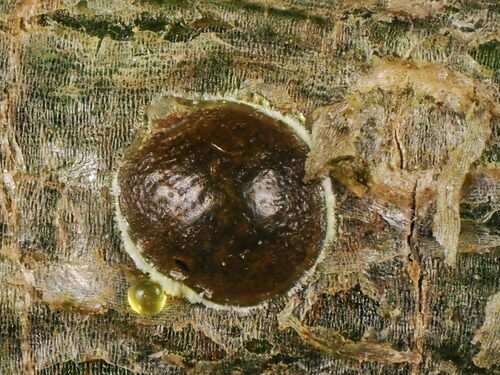
Verbatim
e0“three groups of adult Quercus robur L. trees”
e1“the intermediate group of trees were more severely infested (p ≤ 0.01) with Asterolecanium quercicola”
Claim · model-written summary
Net photosynthesis of Quercus robur showed a significant correlation with photon flux density in all three groups.
- Taxon
- Quercus roburQuercus robure0
- Treatment
- photon flux density (PPFD)e1
- Outcome
- net photosynthesise1
- Direction
- significant correlatione1
Organisms pictured · Representative pictures of the matched species, not figures from the paper.
Verbatim
e0“three groups of adult Quercus robur L. trees”
e1“All three groups of trees showed a significant correlation of net photosynthesis with photon flux density (PPFD)”
Claim · model-written summary
Net photosynthesis correlated more positively with pre-dawn leaf water potential in moderately and severely water-stressed Quercus robur trees.
- Taxon
- Quercus roburQuercus robure0
- Treatment
- water-stressede1
- Outcome
- Ae1
- Direction
- more positivelye1
- Qualifier
- pre-dawn leaf water potential ψpde1
Organisms pictured · Representative pictures of the matched species, not figures from the paper.
Verbatim
e0“three groups of adult Quercus robur L. trees”
e1“A correlated more positively with the pre-dawn leaf water potential ψpd of the moderately (trees of group b, i.e. at the edge of town) and severely (trees of group c, i.e. urban) water-stressed trees”
Claim · model-written summary
Stomatal conductance of Quercus robur showed little correlation with ψpd values.
- Taxon
- Quercus roburQuercus robure0
- Outcome
- stomatal conductance (g)e1
- Direction
- little correlatione1
- Comparator
- ψpd valuese1
Organisms pictured · Representative pictures of the matched species, not figures from the paper.
Verbatim
e0“three groups of adult Quercus robur L. trees”
e1“stomatal conductance (g) of the three groups of trees showed little correlation ψpd values”
Claim · model-written summary
Stomatal conductance of Quercus robur in groups b and c showed a significantly higher sensitivity to relative ambient humidity.
- Taxon
- Quercus roburQuercus robure0
- Treatment
- relative ambient humidity (RH)e1
- Outcome
- sensitivitye1
- Direction
- highere1
- Qualifier
- p ≤ 0.01e1
Organisms pictured · Representative pictures of the matched species, not figures from the paper.
Verbatim
e0“three groups of adult Quercus robur L. trees”
e1“g, as reflected by changes in the transpiration rate (E), showed a significantly (p ≤ 0.01) higher sensitivity to relative ambient humidity (RH) in the trees of groups b and c”
Claim · model-written summary
A close coupling exists between net photosynthesis, ψpd, RH, FTm and S in Quercus robur.
- Taxon
- Quercus roburQuercus robure0
- Treatment
- ψpde1
- Outcome
- close couplinge1
- Direction
- close couplinge1
- Qualifier
- between A, ψpd, RHe1
Organisms pictured · Representative pictures of the matched species, not figures from the paper.
Verbatim
e0“three groups of adult Quercus robur L. trees”
e1“a close coupling was found to exist between A, ψpd, RH”
Claim · model-written summary
Proline accumulated in group c Quercus robur trees but not in group b trees.
- Taxon
- Quercus roburQuercus robure0
- Compound
- Prolinee1
- Outcome
- Proline accumulatione1
- Direction
- occurrede1
- Comparator
- trees of group be1
Organisms pictured · Representative pictures of the matched species, not figures from the paper.
Verbatim
e0“three groups of adult Quercus robur L. trees”
e1“Proline accumulation occurred in the trees of group c but not in the trees of group b”
Claim · model-written summary
Polyphenolic concentrations were significantly higher in group b than in group c Quercus robur trees.
- Taxon
- Quercus roburQuercus robure0
- Compound
- polyphenolice1
- Outcome
- polyphenolic concentrationse1
- Direction
- highere1
- Qualifier
- p ≤ 0.05e1
- Comparator
- trees of group ce1
Organisms pictured · Representative pictures of the matched species, not figures from the paper.
Verbatim
e0“three groups of adult Quercus robur L. trees”
e1“the polyphenolic concentrations which were significantly (p ≤ 0.05) higher in the trees of group b than in the trees of group c”
Claim · model-written summary
The higher infestation of group b trees may be explained by host specificity and changes in nitrogen levels.
- Taxon
- Quercus roburQuercus robure0
- Interactor
- A. quercicolaAsterodiaspis quercicolae1pest
- Outcome
- higher infestatione1
- Qualifier
- host specificity and changes in these trees' nitrogen levelse1
Organisms pictured · Representative pictures of the matched species, not figures from the paper.
Verbatim
e0“three groups of adult Quercus robur L. trees”
e1“A possible explanation for the higher infestation of A. quercicola on the trees in group b is given in terms of their host specificity and changes in these trees' nitrogen levels”