Abstract
Linkage information is needed for marker-assisted selection in squash and pumpkin breeding programs involving Cucurbita ecuadorensis, a source of resistance to many diseases. a mapping population was produced by backcrossing an inter-specific cross of C. maxima x C. ecuadorensis to C. maxima. One hundred raPD primers were used to survey the parental polymorphism, and 42 of these found to be polymorphic between the parents were used for construction of a linkage map. the 42 primers generated 122 distinct and reproducible bands for 55 plants of the BC F 1 population. a linkage map consisting of 102 markers on 22 linkage groups was produced with an approximate length of approximately 1195.2 cM. the segregation of most of these markers did not deviate from the expected 1:1 ratio. Some terminal markers on several linkage groups displayed significant deviation from a 1:1 ratio. Only two linkage groups (12 and 22) had a majority of markers that exhibited significant segregation distortion. a total of 20 raPDs remained unmapped, and nine of these displayed highly distorted (P< 0.01) segregation ratios, suggesting that they were not single sequences segregating genetically. Thus this first linkage map for C. maxima appears to give good coverage of the genome. Predominant normal segregation of most markers suggests significant homology between C. maxima and C. ecuadorensis genome, and that much of the useful traits of C. ecuadorensis could be introgressed into C. maxima.
Abstract from the paper’s OpenAlex record, shown for indexing and research. Copyright remains with the authors or the publisher. Read at the source ↗
The text the model read, with the source record’s inline markup (italics, sub- and superscripts) rendered and its character entities decoded; quote offsets refer to the raw text.
Claims 12
Claim · model-written summary
Forty-two RAPD primers were polymorphic between the parents.
- Taxon
- Cucurbita maxima
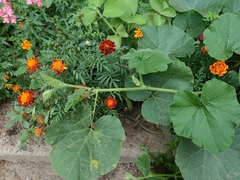 Cucurbita maximat0
- Outcome
- polymorphic between the parentse0
- Value
- 42e0
Organisms pictured · Representative pictures of the matched species, not figures from the paper.

Verbatim
e0“One hundred raPD primers were used to survey the parental polymorphism, and 42 of these found to be polymorphic between the parents were used for construction of a linkage map.”
t0“Cucurbita maxima”
Claim · model-written summary
The 42 primers generated 122 reproducible bands in 55 BC F 1 plants.
- Taxon
- Cucurbita maximaCucurbita maximat0
- Material
- BC F 1 populatione0
- Outcome
- distinct and reproducible bandse0
- Value
- 122e0
Organisms pictured · Representative pictures of the matched species, not figures from the paper.
Verbatim
e0“the 42 primers generated 122 distinct and reproducible bands for 55 plants of the BC F 1 population.”
t0“Cucurbita maxima”
Claim · model-written summary
The map contained 102 markers on 22 linkage groups.
- Taxon
- Cucurbita maximaCucurbita maximat0
- Outcome
- linkage mape0
- Value
- 102 markerse0
Organisms pictured · Representative pictures of the matched species, not figures from the paper.
Verbatim
e0“a linkage map consisting of 102 markers on 22 linkage groups was produced with an approximate length of approximately 1195.2 cM.”
t0“Cucurbita maxima”
Claim · model-written summary
The linkage map spanned approximately 1195.2 cM.
- Taxon
- Cucurbita maximaCucurbita maximat0
- Outcome
- linkage mape0
- Value
- 1195.2 cMe0
Organisms pictured · Representative pictures of the matched species, not figures from the paper.
Verbatim
e0“a linkage map consisting of 102 markers on 22 linkage groups was produced with an approximate length of approximately 1195.2 cM.”
t0“Cucurbita maxima”
Claim · model-written summary
Most markers did not deviate from the expected 1:1 segregation ratio.
- Taxon
- Cucurbita maximaCucurbita maximat0
- Outcome
- segregation of most of these markerse0
- Comparator
- expected 1:1 ratioe0
Organisms pictured · Representative pictures of the matched species, not figures from the paper.
Verbatim
e0“the segregation of most of these markers did not deviate from the expected 1:1 ratio.”
t0“Cucurbita maxima”
Claim · model-written summary
Some terminal markers had significant segregation distortion.
- Taxon
- Cucurbita maximaCucurbita maximat0
- Material
- terminal markerse0
- Outcome
- deviation from a 1:1 ratioe0
Organisms pictured · Representative pictures of the matched species, not figures from the paper.
Verbatim
e0“Some terminal markers on several linkage groups displayed significant deviation from a 1:1 ratio.”
t0“Cucurbita maxima”
Claim · model-written summary
Linkage groups 12 and 22 each had a majority of distorted markers.
- Taxon
- Cucurbita maximaCucurbita maximat0
- Outcome
- segregation distortione0
- Value
- two linkage groupse0
Organisms pictured · Representative pictures of the matched species, not figures from the paper.
Verbatim
e0“Only two linkage groups (12 and 22) had a majority of markers that exhibited significant segregation distortion.”
t0“Cucurbita maxima”
Claim · model-written summary
Twenty RAPDs remained unmapped.
- Taxon
- Cucurbita maximaCucurbita maximat0
- Outcome
- remained unmappede0
- Value
- 20 raPDse0
Organisms pictured · Representative pictures of the matched species, not figures from the paper.
Verbatim
e0“a total of 20 raPDs remained unmapped”
t0“Cucurbita maxima”
Claim · model-written summary
Nine unmapped RAPDs had highly distorted segregation ratios.
- Taxon
- Cucurbita maximaCucurbita maximat0
- Outcome
- segregation ratiose0
- Value
- ninee0
- Qualifier
- P< 0.01e0
Organisms pictured · Representative pictures of the matched species, not figures from the paper.
Verbatim
e0“nine of these displayed highly distorted (P< 0.01) segregation ratios”
t0“Cucurbita maxima”
Claim · model-written summary
The authors infer the first map gives good genome coverage.
- Taxon
- C. maximaCucurbita maximae0
- Outcome
- good coverage of the genomee0
- Value
- firste0
Organisms pictured · Representative pictures of the matched species, not figures from the paper.
Verbatim
e0“Thus this first linkage map for C. maxima appears to give good coverage of the genome.”
Claim · model-written summary
Predominantly normal marker segregation suggests significant homology between the two genomes.
- Taxon
- C. maximaCucurbita maximae0
- Outcome
- homology between C. maxima and C. ecuadorensis genomee0
- Comparator
- C. ecuadorensise0
Not reportedDirection
Organisms pictured · Representative pictures of the matched species, not figures from the paper.
Verbatim
e0“Predominant normal segregation of most markers suggests significant homology between C. maxima and C. ecuadorensis genome”
Claim · model-written summary
The authors suggest useful C. ecuadorensis traits could be introgressed into C. maxima.
- Taxon
- C. maximaCucurbita maximae0
- Outcome
- useful traits of C. ecuadorensis could be introgressed into C. maximae0
Organisms pictured · Representative pictures of the matched species, not figures from the paper.
Verbatim
e0“and that much of the useful traits of C. ecuadorensis could be introgressed into C. maxima.”