Claim · model-written summary
The 42 primers generated 122 reproducible bands in 55 BC F 1 plants.
- Taxon
- Cucurbita maxima
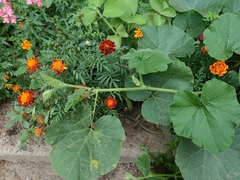 Cucurbita maximat0
- Material
- BC F 1 populatione0
- Outcome
- distinct and reproducible bandse0
- Value
- 122e0
Not reportedGeneCompoundOrgan / stageInteractorInteractor roleSecond interactorSecond interactor roleTreatmentComparatorSettingDirectionQualifier
Organisms pictured · Representative pictures of the matched species, not figures from the paper.

Verbatim
e0“the 42 primers generated 122 distinct and reproducible bands for 55 plants of the BC F 1 population.”
t0“Cucurbita maxima”
Title
A linkage map for Cucurbita maxima based on randomly amplified polymorphic DNA (RAPD) markers
Anurudh Kumar Singh; Rakesh Singh; N. F. Weeden; et al. Indian Journal of Horticulture 2011
Other claims from this paper (11)
- Observation Forty-two RAPD primers were polymorphic between the parents.
- Method / resource The map contained 102 markers on 22 linkage groups.
- Method / resource The linkage map spanned approximately 1195.2 cM.
- Observation Most markers did not deviate from the expected 1:1 segregation ratio.
- Observation Some terminal markers had significant segregation distortion.
- Observation Linkage groups 12 and 22 each had a majority of distorted markers.
- Observation Twenty RAPDs remained unmapped.
- Observation Nine unmapped RAPDs had highly distorted segregation ratios.
- Method / resource The authors infer the first map gives good genome coverage.
- Association Predominantly normal marker segregation suggests significant homology between the two genomes.
- Recommendation The authors suggest useful C. ecuadorensis traits could be introgressed into C. maxima.