Abstract
With Piper nigrum, Mangifera indica and Clausena lansium as the donators, this paper studied their potential allelopathic effects on the germination and growth of Zea mays, Glycine max, Cucurbita moschata, Arachis hypogaea, Raphanus sativus, Echinochloa crusgalli, Digitaria sanguinalis and Stylosanthes guianensis. The results showed that the aqueous extracts of these donators could inhibit the germination and growth of Z. mays, G. max, C. moschata, E. crus-galli and D. sanguinalis at high concentration, but stimulate them at low concentration. In rhizosphere soil of P. nigrum and M. indica, the germination and growth of Z. mays L was stimulated, while A. hypogaea was inhibited. The aqueous extracts of the donators were extracted by ethyl acetate and n-butanol, respectively, and the inhibitory activity of both aqueous and n-butanol fractions from P. nigrum and M. indica on Z. mays, R. sativus and S. guianensis was stronger than that of ethyl acetate fraction, indicating that P. nigrum and M. indica contained the allelochemicals with high polarity.
Abstract from the paper’s OpenAlex record, shown for indexing and research. Copyright remains with the authors or the publisher. Read at the source ↗
The text the model read, with the source record’s inline markup (italics, sub- and superscripts) rendered and its character entities decoded; quote offsets refer to the raw text.
Claims 6
Claim · model-written summary
At high concentration donor aqueous extracts inhibited germination and growth of Z. mays.
- Treatment
- aqueous extracts of these donatorse0
- Outcome
- germination and growthe0
- Direction
- inhibite0
- Qualifier
- high concentratione0
 Zea mays
Not reportedComparator
Organisms pictured · Representative pictures of the matched species, not figures from the paper.

Verbatim
e0“aqueous extracts of these donators could inhibit the germination and growth of Z. mays, G. max, C. moschata, E. crus-galli and D. sanguinalis at high concentration”
Claim · model-written summary
At low concentration the extracts stimulated those recipient plants.
Not reportedComparator
Organisms pictured · Representative pictures of the matched species, not figures from the paper.
Verbatim
e0“but stimulate them at low concentration”
e1“Z. mays, G. max, C. moschata, E. crus-galli and D. sanguinalis at high concentration”
Claim · model-written summary
P. nigrum and M. indica rhizosphere soil stimulated Z. mays germination and growth.
- Treatment
- rhizosphere soil of P. nigrum and M. indicae0
- Outcome
- germination and growthe0
- Direction
- stimulatede0
Not reportedComparator
Organisms pictured · Representative pictures of the matched species, not figures from the paper.
Verbatim
e0“In rhizosphere soil of P. nigrum and M. indica, the germination and growth of Z. mays L was stimulated”
Claim · model-written summary
The rhizosphere soil inhibited A. hypogaea.
- Taxon
- A. hypogaea
 Arachis hypogaeae0
- Outcome
- A. hypogaea was inhibitede0
- Direction
- inhibitede0
Not reportedTreatmentComparator
Organisms pictured · Representative pictures of the matched species, not figures from the paper.

Verbatim
e0“while A. hypogaea was inhibited”
Claim · model-written summary
Aqueous and n-butanol fractions from P. nigrum and M. indica had stronger inhibition than ethyl acetate fraction.
- Treatment
- aqueous and n-butanol fractionse0
- Outcome
- inhibitory activitye0
- Direction
- strongere0
- Comparator
- ethyl acetate fractione0
Organisms pictured · Representative pictures of the matched species, not figures from the paper.
Verbatim
e0“inhibitory activity of both aqueous and n-butanol fractions from P. nigrum and M. indica on Z. mays, R. sativus and S. guianensis was stronger than that of ethyl acetate fraction”
Claim · model-written summary
The donors were inferred to contain high-polarity allelochemicals.
- Taxon
- P. nigrum
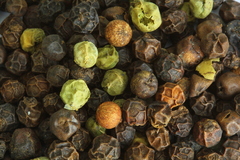 Piper nigrume0
- Compound
- allelochemicalse0
- Outcome
- contained the allelochemicals with high polaritye0
Organisms pictured · Representative pictures of the matched species, not figures from the paper.

Verbatim
e0“P. nigrum and M. indica contained the allelochemicals with high polarity”
The same questions in other papers
donor · growth · Zea mays (maize)Positive and negative results
1 in the opposite direction
- positive
Mangifera indica · growth · Zea mays (maize)Positive and negative results
1 in the opposite direction
- negative
Piper nigrum · growth · Zea mays (maize)Results agree
1 paper in the same direction as this paper
- positive
botanical · growth · Zea mays (maize)Positive and negative results
141 papers in the same direction as this paper · 198 in the opposite direction
- positive
- positive
- positive
336 papers more in this group
See all 340 papers →Claims are grouped by organism, treatment and what was measured or targeted. A paper counts as positive when any of its claims in the group is positive.