Abstract
Pollen morphology of 38 taxa of Loranthaceae from China, and of eight taxa from Indonesia and Australia was examined under light microscope (LM) and scanning electron microscope (SEM). Based on exine ornamentation characteristics, Loranthaceae can be subdivided into two groups that are consistent with the two tribes in the family: Elytrantheae and Lorantheae. In the tribe Elytrantheae, pollen grains with 3_syncolpate aperture and exine of blunt_tipped spines and striate ornamentation may represent the primitive type while those with diplocolporate and diplosyndemicolpate apertures are of derived nature. In the tribe Lorantheae, pollen grains with isopolarity, 3_syncolpate apertures, and granulate exine ornamentation may represent the primitive type, while those with heteropolarity, parasyndemicolpate_syndemicolpate, 3_colpate and colpate_brevicolpate or porate apertures, scabrate and indistinctly granulate ornamentation represent the derived state. Pollen data suggest three basic groups in the tribe Lorantheae according to the aperture and ornamentation characteristics: Group I is composed of Dendrophtho , Scurrula , Taxillus , and Tolypanthus ; Group II and Group III contain only Helixanthera and Loranthus respectively. Group I is relatively primitive in terms of pollen morphology. Among genera in Group I, there are only insignificant differences in pollen morphology between Taxillus and Scurrula , two genera with a close relationship; both Group II and Group III are relatively derived in terms of pollen morphology.
Abstract from the paper’s OpenAlex record, shown for indexing and research. Copyright remains with the authors or the publisher. Read at the source ↗
The text the model read, with the source record’s inline markup (italics, sub- and superscripts) rendered and its character entities decoded; quote offsets refer to the raw text.
Claims 12
Claim · model-written summary
Exine features divided Loranthaceae into groups consistent with Elytrantheae and Lorantheae.
- Taxon
- LoranthaceaeLoranthaceaee0
- Outcome
- two groupse0
- Value
- two groupse0
Verbatim
e0“Loranthaceae can be subdivided into two groups that are consistent with the two tribes in the family: Elytrantheae and Lorantheae.”
Claim · model-written summary
Elytrantheae pollen with 3_syncolpate apertures and blunt-tipped spiny, striate exine may be primitive.
- Taxon
- ElytrantheaeElytrantheaee0
- Organ / stage
- pollen grainse0
- Outcome
- primitive typee0
- Qualifier
- 3_syncolpate aperture and exine of blunt_tipped spines and striate ornamentatione0
Verbatim
e0“In the tribe Elytrantheae, pollen grains with 3_syncolpate aperture and exine of blunt_tipped spines and striate ornamentation may represent the primitive type”
Claim · model-written summary
Elytrantheae pollen with diplocolporate or diplosyndemicolpate apertures was considered derived.
- Taxon
- ElytrantheaeElytrantheaee1
- Outcome
- derived naturee0
- Qualifier
- diplocolporate and diplosyndemicolpate aperturese0
Verbatim
e0“those with diplocolporate and diplosyndemicolpate apertures are of derived nature”
t0“Loranthaceae”
e1“Loranthaceae can be subdivided into two groups that are consistent with the two tribes in the family: Elytrantheae and Lorantheae.”
Claim · model-written summary
Lorantheae pollen with isopolarity, 3_syncolpate apertures and granulate exine may be primitive.
- Taxon
- LorantheaeLorantheaee0
- Outcome
- primitive typee0
- Qualifier
- isopolarity, 3_syncolpate apertures, and granulate exine ornamentatione0
Verbatim
e0“In the tribe Lorantheae, pollen grains with isopolarity, 3_syncolpate apertures, and granulate exine ornamentation may represent the primitive type”
Claim · model-written summary
Lorantheae pollen with heteropolarity, alternate apertures and scabrate or indistinct granulate ornamentation was considered derived.
- Taxon
- LorantheaeLorantheaee1
- Outcome
- derived statee0
- Qualifier
- heteropolarity, parasyndemicolpate_syndemicolpate, 3_colpate and colpate_brevicolpate or porate apertures, scabrate and indistinctly granulate ornamentatione0
Verbatim
e0“those with heteropolarity, parasyndemicolpate_syndemicolpate, 3_colpate and colpate_brevicolpate or porate apertures, scabrate and indistinctly granulate ornamentation represent the derived state”
t0“Loranthaceae”
e1“Loranthaceae can be subdivided into two groups that are consistent with the two tribes in the family: Elytrantheae and Lorantheae.”
Claim · model-written summary
Group I of Lorantheae comprised Dendrophtho, Scurrula, Taxillus and Tolypanthus.
- Taxon
- LorantheaeLorantheaee1
- Outcome
- Group Ie0
- Qualifier
- Dendrophtho , Scurrula , Taxillus , and Tolypanthuse0
Verbatim
e0“Group I is composed of Dendrophtho , Scurrula , Taxillus , and Tolypanthus”
t0“Loranthaceae”
e1“Loranthaceae can be subdivided into two groups that are consistent with the two tribes in the family: Elytrantheae and Lorantheae.”
Claim · model-written summary
Group II contained only Helixanthera.
- Taxon
- Helixanthera
 Helixantherae0
- Outcome
- Group IIe0
Organisms pictured · Representative pictures of the matched species, not figures from the paper.

Verbatim
e0“Group II and Group III contain only Helixanthera and Loranthus respectively.”
Claim · model-written summary
Group III contained only Loranthus.
- Outcome
- Group IIIe0
Verbatim
e0“Group II and Group III contain only Helixanthera and Loranthus respectively.”
Claim · model-written summary
Group I was relatively primitive in pollen morphology.
- Taxon
- LorantheaeLorantheaee1
- Outcome
- relatively primitive in terms of pollen morphologye0
Verbatim
e0“Group I is relatively primitive in terms of pollen morphology.”
t0“Loranthaceae”
e1“Loranthaceae can be subdivided into two groups that are consistent with the two tribes in the family: Elytrantheae and Lorantheae.”
Claim · model-written summary
Taxillus and Scurrula had insignificant pollen morphological differences.
 Taxillus
Organisms pictured · Representative pictures of the matched species, not figures from the paper.
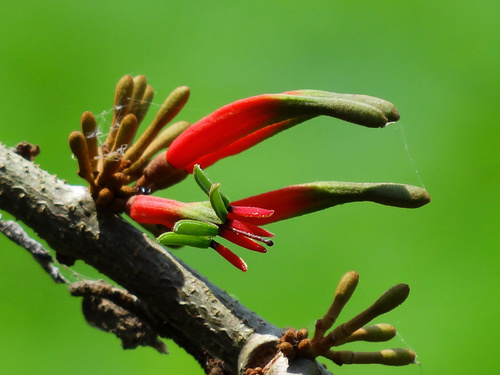
Verbatim
e0“there are only insignificant differences in pollen morphology between Taxillus and Scurrula”
Claim · model-written summary
Group II was relatively derived in pollen morphology.
- Taxon
- HelixantheraHelixantherae1
- Outcome
- relatively derived in terms of pollen morphologye0
Organisms pictured · Representative pictures of the matched species, not figures from the paper.
Verbatim
e0“both Group II and Group III are relatively derived in terms of pollen morphology.”
t0“Loranthaceae”
e1“Group II and Group III contain only Helixanthera and Loranthus respectively.”
Claim · model-written summary
Group III was relatively derived in pollen morphology.
- Outcome
- relatively derived in terms of pollen morphologye0
Verbatim
e0“both Group II and Group III are relatively derived in terms of pollen morphology.”
t0“Loranthaceae”
e1“Group II and Group III contain only Helixanthera and Loranthus respectively.”