Abstract
As an important plant vegetative reproduction strategy,root sprout might influence forest regeneration and succession in a large scale.In this study,we analyzed the root sprout trees and their relationships with mother trees based on the investigated data of all the free standing trees≥1cm DBH(diameter at 1.3mabove ground)in Chawan 1hm2 forest plot(Chawan plot)in Gutianshan National Nature Reserve,Zhejiang Province.The results showed that 68species(67.3%of the total species)had the sprout phenomenon,belonging to 48 genera,26families.Lithocarpus glaber,Castanopsis eyrei and Schima superba had the stronger capability of sprout in canopy layer.Corylopsis glandulifera,Eurya muricataand Camellia checkiangoleosa had the stronger capability of sprout in sub-canopy layer and Eurya rubiginosa Var.attenuata,Vibernum erosumand Rhododendron simsii had the stronger capability of sprout in shrub layer.The result of correlation analysis between the dominant root sprout trees and their mother trees showed that species importance value in each vertical layer didn't change obviously whether root sprouts were included or not.Besides,the root sprouting capability of species increased fromⅠtoⅢgrowth stages in canopy layer,and the species increased fromⅠtoⅡgrowth stages in sub-canopy and shrub layer.Furthermore,the distribution situation of the dominant root sprout trees was largely similar to the corresponding mother trees in Chawan plot and many species owned root sprouts were spatially clustered.
Abstract from the paper’s OpenAlex record, shown for indexing and research. Copyright remains with the authors or the publisher.
The text the model read, with the source record’s inline markup (italics, sub- and superscripts) rendered and its character entities decoded; quote offsets refer to the raw text.
Claims 15
Claim · model-written summary
Root sprouting occurred in 68 species, 67.3% of the total.
- Taxon
- Castanopsis eyrei
 Castanopsis eyreit0
- Outcome
- sprout phenomenone0
- Value
- 68species(67.3%of the total species)e0
- Qualifier
- 48 genera,26familiese0
Organisms pictured · Representative pictures of the matched species, not figures from the paper.

Verbatim
e0“68species(67.3%of the total species)had the sprout phenomenon,belonging to 48 genera,26families”
t0“Castanopsis eyrei”
Claim · model-written summary
Lithocarpus glaber had strong sprouting in the canopy.
- Taxon
- Lithocarpus glaber
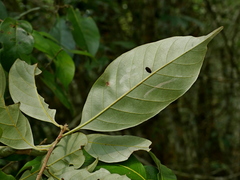 Lithocarpus glabere0
- Outcome
- stronger capability of sproute0
- Setting
- canopy layere0
Organisms pictured · Representative pictures of the matched species, not figures from the paper.
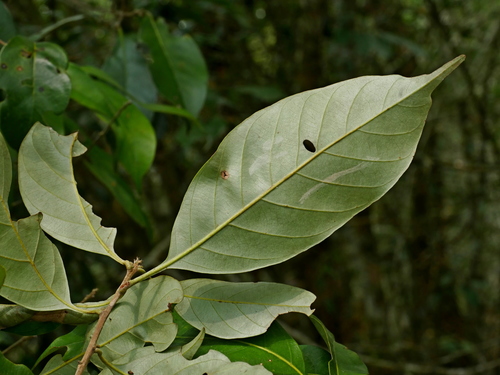
Verbatim
e0“Lithocarpus glaber,Castanopsis eyrei and Schima superba had the stronger capability of sprout in canopy layer”
Claim · model-written summary
Castanopsis eyrei had strong sprouting in the canopy.
- Taxon
- Castanopsis eyreiCastanopsis eyreie0
- Outcome
- stronger capability of sproute0
- Setting
- canopy layere0
Organisms pictured · Representative pictures of the matched species, not figures from the paper.
Verbatim
e0“Lithocarpus glaber,Castanopsis eyrei and Schima superba had the stronger capability of sprout in canopy layer”
Claim · model-written summary
Schima superba had strong sprouting in the canopy.
- Taxon
- Schima superba
 Schima superbae0
- Outcome
- stronger capability of sproute0
- Setting
- canopy layere0
Organisms pictured · Representative pictures of the matched species, not figures from the paper.

Verbatim
e0“Lithocarpus glaber,Castanopsis eyrei and Schima superba had the stronger capability of sprout in canopy layer”
Claim · model-written summary
Corylopsis glandulifera had strong sprouting in the sub-canopy.
- Taxon
- Corylopsis glandulifera
 Corylopsis glanduliferae0
- Outcome
- stronger capability of sproute0
- Setting
- sub-canopy layere0
Organisms pictured · Representative pictures of the matched species, not figures from the paper.

Verbatim
e0“Corylopsis glandulifera,Eurya muricataand Camellia checkiangoleosa had the stronger capability of sprout in sub-canopy layer”
Claim · model-written summary
Eurya muricata had strong sprouting in the sub-canopy.
- Taxon
- Eurya muricata
 Eurya muricatae0
- Outcome
- stronger capability of sproute0
- Setting
- sub-canopy layere0
Organisms pictured · Representative pictures of the matched species, not figures from the paper.

Verbatim
e0“Corylopsis glandulifera,Eurya muricataand Camellia checkiangoleosa had the stronger capability of sprout in sub-canopy layer”
Claim · model-written summary
Camellia checkiangoleosa had strong sprouting in the sub-canopy.
Verbatim
e0“Corylopsis glandulifera,Eurya muricataand Camellia checkiangoleosa had the stronger capability of sprout in sub-canopy layer”
Claim · model-written summary
Eurya rubiginosa var. attenuata had strong sprouting in the shrub layer.
- Taxon
- Eurya rubiginosa Var.attenuataEurya rubiginosae0
- Outcome
- stronger capability of sproute0
- Setting
- shrub layere0
Verbatim
e0“Eurya rubiginosa Var.attenuata,Vibernum erosumand Rhododendron simsii had the stronger capability of sprout in shrub layer”
Claim · model-written summary
Vibernum erosum had strong sprouting in the shrub layer.
Verbatim
e0“Eurya rubiginosa Var.attenuata,Vibernum erosumand Rhododendron simsii had the stronger capability of sprout in shrub layer”
Claim · model-written summary
Rhododendron simsii had strong sprouting in the shrub layer.
- Taxon
- Rhododendron simsii
 Rhododendron simsiie0
- Outcome
- stronger capability of sproute0
- Setting
- shrub layere0
Organisms pictured · Representative pictures of the matched species, not figures from the paper.

Verbatim
e0“Eurya rubiginosa Var.attenuata,Vibernum erosumand Rhododendron simsii had the stronger capability of sprout in shrub layer”
Claim · model-written summary
Including root sprouts did not obviously change species importance values by vertical layer.
- Taxon
- Castanopsis eyreiCastanopsis eyreit0
- Outcome
- species importance valuee0
- Direction
- didn't change obviouslye0
Organisms pictured · Representative pictures of the matched species, not figures from the paper.
Verbatim
e0“species importance value in each vertical layer didn't change obviously whether root sprouts were included or not”
t0“Castanopsis eyrei”
Claim · model-written summary
Canopy species sprouting capability increased from growth stage I to III.
- Taxon
- Castanopsis eyreiCastanopsis eyreit0
- Organ / stage
- growth stagese0
- Outcome
- root sprouting capabilitye0
- Direction
- increasede0
- Setting
- canopy layere0
Organisms pictured · Representative pictures of the matched species, not figures from the paper.
Verbatim
e0“root sprouting capability of species increased fromⅠtoⅢgrowth stages in canopy layer”
t0“Castanopsis eyrei”
Claim · model-written summary
Sub-canopy and shrub species sprouting capability increased from growth stage I to II.
- Taxon
- Castanopsis eyreiCastanopsis eyreit0
- Organ / stage
- growth stagese0
- Outcome
- root sprouting capabilitye0
- Direction
- increasede0
- Setting
- sub-canopy and shrub layere0
Organisms pictured · Representative pictures of the matched species, not figures from the paper.
Verbatim
e0“root sprouting capability of species increased fromⅠtoⅢgrowth stages in canopy layer,and the species increased fromⅠtoⅡgrowth stages in sub-canopy and shrub layer”
t0“Castanopsis eyrei”
Claim · model-written summary
Dominant root sprouts had distributions similar to their mother trees.
- Taxon
- Castanopsis eyreiCastanopsis eyreit0
- Outcome
- distribution situation of the dominant root sprout treese0
- Comparator
- corresponding mother treese0
- Setting
- Chawan plote0
Organisms pictured · Representative pictures of the matched species, not figures from the paper.
Verbatim
e0“distribution situation of the dominant root sprout trees was largely similar to the corresponding mother trees in Chawan plot”
t0“Castanopsis eyrei”
Claim · model-written summary
Many root-sprouting species were spatially clustered.
- Taxon
- Castanopsis eyreiCastanopsis eyreit0
- Outcome
- spatially clusterede0
Organisms pictured · Representative pictures of the matched species, not figures from the paper.
Verbatim
e0“many species owned root sprouts were spatially clustered”
t0“Castanopsis eyrei”