Abstract
The primary phloem of young internodes of Cucurbita maxima was studied with the electron microscope. Phloem parenchyma cells are highly vacuolated and contain nuclei, endoplasmic reticulum, ribosomes, mitochondria, chloro-plasts, and occasional dictyosomes. As compared with parenchyma cells, the most distinctive features of companion cells are their extremely dense cytoplasm, low degree of vacuolation, lack of chloroplasts, and numerous sieve-element connexions. Companion cells contain plastids with few internal membranes. At maturity the enucleate sieve element is lined by a plasmalemma, one or more cistema-like layers of endoplasmic reticulum, and a membrane which apparently delimits the parietal layer of cytoplasm from a large central cavity. In OsO4−-and glutaraldehyde-fixed elements, the central cavity is traversed by numerous strands, which run from cell to cell through the pores of sieve plates and lateral sieve areas, and which are derived ontogenetically from the slime bodies of immature cells. Numerous normal-appearing mitochondria are present in the parietal layer of cytoplasm. The pores of sieve plates and lateral sieve areas are lined with cytoplasm. The ultrastructural details of young sieve elements differ little from those of other young nucleate cells. During sieve-element development, the sieve element increases in vacuolation. At the same time, slime bodies develop in the cytoplasm. With glutaraldehyde fixation, these bodies often exhibit a double-layered limiting membrane. As the sieve element continues to differentiate, the slime bodies increase in size and the parietal layer of cytoplasm becomes very narrow. Presently, the slime bodies begin to disperse and their contents fuse. This phenomenon occurs in the parietal layer of cytoplasm, while the latter is still delimited from the large central vacuole by a distinct tonoplast. The initiation of slime-body dispersal more or less coincides with perforation of the pore sites, and many pores are traversed by slime early in their development. Before slime-body dispersal, all dictyosomes and associated vesicles disappear from the cytoplasm. Eventually, the tonoplast diappears and the slime becomes distributed throughout the central cavity in the form of strands. Nuclei and ribosomes disappear before breakdown of the tonoplast. Sieve elements are connected with companion cells and parenchyma cells by plasmodesmata.
Abstract from the paper’s OpenAlex record, shown for indexing and research. Copyright remains with the authors or the publisher. Read at the source ↗
The text the model read, with the source record’s inline markup (italics, sub- and superscripts) rendered and its character entities decoded; quote offsets refer to the raw text.
Claims 19
Claim · model-written summary
In Cucurbita phloem, Phloem parenchyma cells are highly vacuolated and contain nuclei, endoplasmic reticulum, ribosomes, mitochondria, chloro-plasts, and occasional dictyosomes.
- Taxon
- Cucurbita maxima
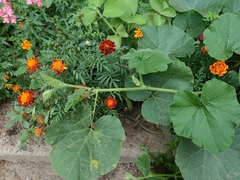 Cucurbita maximat0
- Outcome
- Phloem parenchyma cellse0
Not reportedOrgan / stageDirection
Organisms pictured · Representative pictures of the matched species, not figures from the paper.

Verbatim
e0“Phloem parenchyma cells are highly vacuolated and contain nuclei, endoplasmic reticulum, ribosomes, mitochondria, chloro-plasts, and occasional dictyosomes”
t0“young internodes of Cucurbita maxima”
Claim · model-written summary
In Cucurbita phloem, the most distinctive features of companion cells are their extremely dense cytoplasm, low degree of vacuolation, lack of chloroplasts, and numerous sieve-element connexions.
- Taxon
- Cucurbita maximaCucurbita maximat0
- Outcome
- companion cellse0
Not reportedOrgan / stageDirection
Organisms pictured · Representative pictures of the matched species, not figures from the paper.
Verbatim
e0“the most distinctive features of companion cells are their extremely dense cytoplasm, low degree of vacuolation, lack of chloroplasts, and numerous sieve-element connexions”
t0“young internodes of Cucurbita maxima”
Claim · model-written summary
In Cucurbita phloem, Companion cells contain plastids with few internal membranes.
- Taxon
- Cucurbita maximaCucurbita maximat0
- Outcome
- Companion cellse0
Not reportedOrgan / stageDirection
Organisms pictured · Representative pictures of the matched species, not figures from the paper.
Verbatim
e0“Companion cells contain plastids with few internal membranes”
t0“young internodes of Cucurbita maxima”
Claim · model-written summary
In Cucurbita phloem, At maturity the enucleate sieve element is lined by a plasmalemma, one or more cistema-like layers of endoplasmic reticulum, and a membrane which apparently delimits the parietal layer of cytoplasm from a large central cavity.
- Taxon
- Cucurbita maximaCucurbita maximat0
- Organ / stage
- sieve elemente0
- Outcome
- sieve elemente0
Not reportedDirection
Organisms pictured · Representative pictures of the matched species, not figures from the paper.
Verbatim
e0“At maturity the enucleate sieve element is lined by a plasmalemma, one or more cistema-like layers of endoplasmic reticulum, and a membrane which apparently delimits the parietal layer of cytoplasm from a large central cavity”
t0“young internodes of Cucurbita maxima”
Claim · model-written summary
In Cucurbita phloem, the central cavity is traversed by numerous strands, which run from cell to cell through the pores of sieve plates and lateral sieve areas, and which are derived ontogenetically from the slime bodies of immature cells.
- Taxon
- Cucurbita maximaCucurbita maximat0
- Outcome
- central cavitye0
Not reportedOrgan / stageDirection
Organisms pictured · Representative pictures of the matched species, not figures from the paper.
Verbatim
e0“the central cavity is traversed by numerous strands, which run from cell to cell through the pores of sieve plates and lateral sieve areas, and which are derived ontogenetically from the slime bodies of immature cells”
t0“young internodes of Cucurbita maxima”
Claim · model-written summary
In Cucurbita phloem, Numerous normal-appearing mitochondria are present in the parietal layer of cytoplasm.
- Taxon
- Cucurbita maximaCucurbita maximat0
- Outcome
- mitochondriae0
Not reportedOrgan / stageDirection
Organisms pictured · Representative pictures of the matched species, not figures from the paper.
Verbatim
e0“Numerous normal-appearing mitochondria are present in the parietal layer of cytoplasm”
t0“young internodes of Cucurbita maxima”
Claim · model-written summary
In Cucurbita phloem, The pores of sieve plates and lateral sieve areas are lined with cytoplasm.
- Taxon
- Cucurbita maximaCucurbita maximat0
- Outcome
- pores of sieve plates and lateral sieve arease0
Not reportedOrgan / stageDirection
Organisms pictured · Representative pictures of the matched species, not figures from the paper.
Verbatim
e0“The pores of sieve plates and lateral sieve areas are lined with cytoplasm”
t0“young internodes of Cucurbita maxima”
Claim · model-written summary
In Cucurbita phloem, The ultrastructural details of young sieve elements differ little from those of other young nucleate cells.
- Taxon
- Cucurbita maximaCucurbita maximat0
- Organ / stage
- sieve elemente0
- Outcome
- ultrastructural details of young sieve elementse0
Not reportedDirection
Organisms pictured · Representative pictures of the matched species, not figures from the paper.
Verbatim
e0“The ultrastructural details of young sieve elements differ little from those of other young nucleate cells”
t0“young internodes of Cucurbita maxima”
Claim · model-written summary
In Cucurbita phloem, During sieve-element development, the sieve element increases in vacuolation.
- Taxon
- Cucurbita maximaCucurbita maximat0
- Organ / stage
- sieve elemente0
- Outcome
- vacuolatione0
Not reportedDirection
Organisms pictured · Representative pictures of the matched species, not figures from the paper.
Verbatim
e0“During sieve-element development, the sieve element increases in vacuolation”
t0“young internodes of Cucurbita maxima”
Claim · model-written summary
In Cucurbita phloem, slime bodies develop in the cytoplasm.
- Taxon
- Cucurbita maximaCucurbita maximat0
- Outcome
- slime bodiese0
Not reportedOrgan / stageDirection
Organisms pictured · Representative pictures of the matched species, not figures from the paper.
Verbatim
e0“slime bodies develop in the cytoplasm”
t0“young internodes of Cucurbita maxima”
Claim · model-written summary
In Cucurbita phloem, these bodies often exhibit a double-layered limiting membrane.
- Taxon
- Cucurbita maximaCucurbita maximat0
- Outcome
- double-layered limiting membranee0
Not reportedOrgan / stageDirection
Organisms pictured · Representative pictures of the matched species, not figures from the paper.
Verbatim
e0“these bodies often exhibit a double-layered limiting membrane”
t0“young internodes of Cucurbita maxima”
Claim · model-written summary
In Cucurbita phloem, the slime bodies increase in size and the parietal layer of cytoplasm becomes very narrow.
- Taxon
- Cucurbita maximaCucurbita maximat0
- Outcome
- slime bodiese0
Not reportedOrgan / stageDirection
Organisms pictured · Representative pictures of the matched species, not figures from the paper.
Verbatim
e0“the slime bodies increase in size and the parietal layer of cytoplasm becomes very narrow”
t0“young internodes of Cucurbita maxima”
Claim · model-written summary
In Cucurbita phloem, the slime bodies begin to disperse and their contents fuse.
- Taxon
- Cucurbita maximaCucurbita maximat0
- Outcome
- slime bodiese0
Not reportedOrgan / stageDirection
Organisms pictured · Representative pictures of the matched species, not figures from the paper.
Verbatim
e0“the slime bodies begin to disperse and their contents fuse”
t0“young internodes of Cucurbita maxima”
Claim · model-written summary
In Cucurbita phloem, The initiation of slime-body dispersal more or less coincides with perforation of the pore sites.
- Taxon
- Cucurbita maximaCucurbita maximat0
- Outcome
- slime-body dispersale0
Not reportedOrgan / stageDirection
Organisms pictured · Representative pictures of the matched species, not figures from the paper.
Verbatim
e0“The initiation of slime-body dispersal more or less coincides with perforation of the pore sites”
t0“young internodes of Cucurbita maxima”
Claim · model-written summary
In Cucurbita phloem, many pores are traversed by slime early in their development.
- Taxon
- Cucurbita maximaCucurbita maximat0
- Outcome
- porese0
Not reportedOrgan / stageDirection
Organisms pictured · Representative pictures of the matched species, not figures from the paper.
Verbatim
e0“many pores are traversed by slime early in their development”
t0“young internodes of Cucurbita maxima”
Claim · model-written summary
In Cucurbita phloem, Before slime-body dispersal, all dictyosomes and associated vesicles disappear from the cytoplasm.
- Taxon
- Cucurbita maximaCucurbita maximat0
- Outcome
- dictyosomes and associated vesiclese0
Not reportedOrgan / stageDirection
Organisms pictured · Representative pictures of the matched species, not figures from the paper.
Verbatim
e0“Before slime-body dispersal, all dictyosomes and associated vesicles disappear from the cytoplasm”
t0“young internodes of Cucurbita maxima”
Claim · model-written summary
In Cucurbita phloem, the tonoplast diappears and the slime becomes distributed throughout the central cavity in the form of strands.
- Taxon
- Cucurbita maximaCucurbita maximat0
- Outcome
- slimee0
Not reportedOrgan / stageDirection
Organisms pictured · Representative pictures of the matched species, not figures from the paper.
Verbatim
e0“the tonoplast diappears and the slime becomes distributed throughout the central cavity in the form of strands”
t0“young internodes of Cucurbita maxima”
Claim · model-written summary
In Cucurbita phloem, Nuclei and ribosomes disappear before breakdown of the tonoplast.
- Taxon
- Cucurbita maximaCucurbita maximat0
- Outcome
- Nuclei and ribosomese0
Not reportedOrgan / stageDirection
Organisms pictured · Representative pictures of the matched species, not figures from the paper.
Verbatim
e0“Nuclei and ribosomes disappear before breakdown of the tonoplast”
t0“young internodes of Cucurbita maxima”
Claim · model-written summary
In Cucurbita phloem, Sieve elements are connected with companion cells and parenchyma cells by plasmodesmata.
- Taxon
- Cucurbita maximaCucurbita maximat0
- Outcome
- Sieve elementse0
Not reportedOrgan / stageDirection
Organisms pictured · Representative pictures of the matched species, not figures from the paper.
Verbatim
e0“Sieve elements are connected with companion cells and parenchyma cells by plasmodesmata”
t0“young internodes of Cucurbita maxima”