Abstract
A survey of an outbreak of fungal diseases of rice variety Phitsanulok2 (PLS91014-16-1-5-1) was conducted in Thailand during June 2014 to January 2015 using aW-random sampling pat-tern. The study revealed the incidence of several diseases including brown spot (Bipolaris oryzae), narrow brown leaf streak (Cercospora oryzae), and dirty panicle (Alternaria padwickii, C. oryzae, Curvularia lunata, Fusarium semitectum, and B. oryzae). This study evaluated the ef-ficacy of wood vinegar for control of these fungal diseases. A compleel randomized design was used, using the above variety in 3 replications. In the laboratory we found wood vinegar to be effective in inhibiting growth of representative pathogens such as C. lunata,B. oryzae,F. semi-tectum, and A. padwickii, the causal agent of dirty panicle disease. The field results confirmed the efficacy of wood vinegar under greenhouse conditions, with significantly reduced disease incidence of brown spot and dirty panicle, and significantly enhanced germination, seedling vigor,shoot height, root length, and fresh weight, when compared with the untreated control. However, seed treatment and 6 foliar sprays of wood vinegar under field conditions at Ang Thong showed no significant differences from the conventional treatment in suppression of brown spot, narrow brown leaf streak, and dirty panicle. The result demonstrates a promising alternative approach to control of key rice diseases.
Abstract from the paper’s OpenAlex record, shown for indexing and research. Copyright remains with the authors or the publisher. Read at the source ↗
The text the model read, with the source record’s inline markup (italics, sub- and superscripts) rendered and its character entities decoded; quote offsets refer to the raw text.
Claims 12
Claim · model-written summary
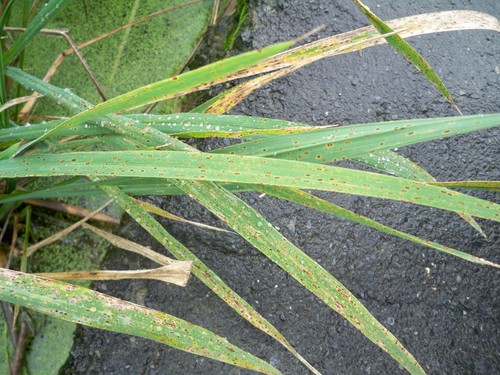
The survey identified brown spot caused by Bipolaris oryzae in rice.
- Taxon
- Paddy Ricet0
- Interactor
- Bipolaris oryzae
 Bipolaris oryzaee0pathogen
- Outcome
- brown spote0
Organisms pictured · Representative pictures of the matched species, not figures from the paper.
Verbatim
e0“brown spot (Bipolaris oryzae)”
t0“Paddy Rice”
Claim · model-written summary
The survey identified narrow brown leaf streak caused by Cercospora oryzae in rice.
- Taxon
- Paddy Ricet0
- Interactor
- Cercospora oryzaeCercospora janseanae0pathogen
- Outcome
- narrow brown leaf streake0
Verbatim
e0“narrow brown leaf streak (Cercospora oryzae)”
t0“Paddy Rice”
Claim · model-written summary
The survey identified dirty panicle disease in rice.
- Taxon
- Paddy Ricet0
- Interactor
- Alternaria padwickii
 Alternaria padwickiie0pathogen
- Second interactor
- C. oryzaee0pathogen
- Outcome
- dirty paniclee0
- Qualifier
- Curvularia lunata, Fusarium semitectum, and B. oryzaee0
Organisms pictured · Representative pictures of the matched species, not figures from the paper.

Verbatim
e0“dirty panicle (Alternaria padwickii, C. oryzae, Curvularia lunata, Fusarium semitectum, and B. oryzae)”
t0“Paddy Rice”
Claim · model-written summary
Wood vinegar inhibited C. lunata growth in the laboratory.
- Taxon
- Paddy Ricet0
- Treatment
- wood vinegare0
- Interactor
- C. lunata
 Curvularia lunatae0pathogen
- Outcome
- growth of representative pathogense0
- Direction
- inhibitinge0
Not reportedComparator
Organisms pictured · Representative pictures of the matched species, not figures from the paper.

Verbatim
e0“wood vinegar to be effective in inhibiting growth of representative pathogens such as C. lunata,B. oryzae,F. semi-tectum, and A. padwickii”
t0“Paddy Rice”
Claim · model-written summary
Wood vinegar inhibited B. oryzae growth in the laboratory.
- Taxon
- Paddy Ricet0
- Treatment
- wood vinegare0
- Interactor
- B. oryzaeBipolaris oryzaee0pathogen
- Outcome
- growth of representative pathogense0
- Direction
- inhibitinge0
Not reportedComparator
Organisms pictured · Representative pictures of the matched species, not figures from the paper.
Verbatim
e0“wood vinegar to be effective in inhibiting growth of representative pathogens such as C. lunata,B. oryzae,F. semi-tectum, and A. padwickii”
t0“Paddy Rice”
Claim · model-written summary
Wood vinegar inhibited F. semi-tectum growth in the laboratory.
- Taxon
- Paddy Ricet0
- Treatment
- wood vinegare0
- Interactor
- F. semi-tectume0pathogen
- Outcome
- growth of representative pathogense0
- Direction
- inhibitinge0
Not reportedComparator
Verbatim
e0“wood vinegar to be effective in inhibiting growth of representative pathogens such as C. lunata,B. oryzae,F. semi-tectum, and A. padwickii”
t0“Paddy Rice”
Claim · model-written summary
Wood vinegar inhibited A. padwickii growth in the laboratory.
- Taxon
- Paddy Ricet0
- Treatment
- wood vinegare0
- Interactor
- A. padwickiiAlternaria padwickiie0pathogen
- Outcome
- growth of representative pathogense0
- Direction
- inhibitinge0
Not reportedComparator
Organisms pictured · Representative pictures of the matched species, not figures from the paper.
Verbatim
e0“wood vinegar to be effective in inhibiting growth of representative pathogens such as C. lunata,B. oryzae,F. semi-tectum, and A. padwickii”
t0“Paddy Rice”
Claim · model-written summary
Wood vinegar significantly reduced brown spot incidence under greenhouse conditions.
- Taxon
- Paddy Ricet0
- Treatment
- wood vinegart1
- Interactor
- Bipolaris oryzaeBipolaris oryzaee1pathogent1
- Outcome
- disease incidence of brown spote0
- Direction
- reducede0
Not reportedComparator
Organisms pictured · Representative pictures of the matched species, not figures from the paper.
Verbatim
e0“significantly reduced disease incidence of brown spot and dirty panicle”
t0“Paddy Rice”
t1“Application of Wood Vinegar for Fungal Disease Controls in Paddy Rice”
e1“brown spot (Bipolaris oryzae)”
Claim · model-written summary
Wood vinegar significantly reduced dirty panicle incidence under greenhouse conditions.
- Taxon
- Paddy Ricet0
- Treatment
- wood vinegart1
- Outcome
- disease incidence of brown spot and dirty paniclee0
- Direction
- reducede0
Not reportedComparator
Verbatim
e0“significantly reduced disease incidence of brown spot and dirty panicle”
t0“Paddy Rice”
t1“Application of Wood Vinegar for Fungal Disease Controls in Paddy Rice”
Claim · model-written summary
Wood vinegar significantly enhanced rice germination and seedling vigor relative to untreated controls.
Verbatim
e0“significantly enhanced germination, seedling vigor,shoot height, root length, and fresh weight, when compared with the untreated control”
t0“Paddy Rice”
t1“Application of Wood Vinegar for Fungal Disease Controls in Paddy Rice”
Claim · model-written summary
Wood vinegar significantly enhanced shoot height, root length, and fresh weight relative to untreated controls.
Verbatim
e0“significantly enhanced germination, seedling vigor,shoot height, root length, and fresh weight, when compared with the untreated control”
t0“Paddy Rice”
t1“Application of Wood Vinegar for Fungal Disease Controls in Paddy Rice”
Claim · model-written summary
Field wood vinegar treatment did not differ significantly from conventional treatment in suppressing three rice diseases.
Verbatim
e0“seed treatment and 6 foliar sprays of wood vinegar under field conditions at Ang Thong showed no significant differences from the conventional treatment in suppression of brown spot, narrow brown leaf streak, and dirty panicle”
t0“Paddy Rice”
The same questions in other papers
seed treatment · control · Oryza sativa (rice)Positive and negative results
1 paper in the same direction as this paper · 18 reporting no difference from an alternative
- positive
- positive
- positive
16 papers more in this group
See all 20 papers →application · control · Oryza sativa (rice)Positive and negative results
2 papers in the same direction as this paper · 35 reporting no difference from an alternative
- positive
- positive
- positive
34 papers more in this group
See all 38 papers →Claims are grouped by organism, treatment and what was measured or targeted. A paper counts as positive when any of its claims in the group is positive.