Abstract
Downy mildew of pearl millet incited by Sclerospora graminicola (Sacc.) Schroet is the most widespread and destructive disease of pearl millet in India and other pearl millet growing area of the world. This disease is a major factor limiting full exploitation of high yield potential hybrids in India. The field trials were conducted in Department of Plant Pathology research area of CCS Haryana Agricultural University Hisar with the objective to evaluate different biological agents for the management of pearl millet downy mildew in an attempt to develop an ecofriendly management strategy. Pearl millet seeds of moderately susceptible hybrid B 2301 were treated with Bacillus pumulis, Chitosan, Chitosan + Bacillus pumulis, Trichoderma viride, Trichoderma harzianum, Pseudomonas fluorescens were sown under sick plot and observations on germination percentage, per cent disease incidence at 30 and 60 days after sowing and yield data on harvest were recorded. Among different agents tested to manage downy mildew, minimum disease incidence (9.3%) was observed in treatment of Chitosan + Bacillus pumulis with maximum germination percentage of 53.5% and grain yield (1091.7 kg/ha).
Abstract from the paper’s OpenAlex record, shown for indexing and research. Copyright remains with the authors or the publisher. Read at the source ↗
The text the model read, with the source record’s inline markup (italics, sub- and superscripts) rendered and its character entities decoded; quote offsets refer to the raw text.
Claims 3
Claim · model-written summary
Chitosan with Bacillus pumulis gave the lowest downy mildew incidence among the agents tested on pearl millet.
- Taxon
- pearl millet
 Cenchrus americanuse1
- Material
- hybrid B 2301e2
- Treatment
- Chitosan + Bacillus pumulise3
- Interactor
- Sclerospora graminicola
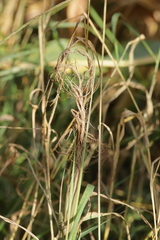 Sclerospora graminicolae1pathogen
- Second interactor
- Bacillus pumulise3biocontrol_agent
- Outcome
- disease incidencee3
- Direction
- minimume3
- Value
- 9.3%e3
- Comparator
- different agents tested to manage downy mildewe3
Organisms pictured · Representative pictures of the matched species, not figures from the paper.

Verbatim
e1“Downy mildew of pearl millet incited by Sclerospora graminicola (Sacc.) Schroet”
e2“Pearl millet seeds of moderately susceptible hybrid B 2301 were treated with Bacillus pumulis, Chitosan, Chitosan + Bacillus pumulis, Trichoderma viride, Trichoderma harzianum, Pseudomonas fluorescens were sown under sick plot”
e3“Among different agents tested to manage downy mildew, minimum disease incidence (9.3%) was observed in treatment of Chitosan + Bacillus pumulis”
Claim · model-written summary
Chitosan with Bacillus pumulis gave the highest germination percentage among the agents tested on pearl millet seed.
- Taxon
- pearl milletCenchrus americanuse2
- Material
- hybrid B 2301e2
- Treatment
- Chitosan + Bacillus pumulise3
- Outcome
- germination percentagee4
- Direction
- maximume4
- Value
- 53.5%e4
- Comparator
- different agents tested to manage downy mildewe3
Organisms pictured · Representative pictures of the matched species, not figures from the paper.
Verbatim
e2“Pearl millet seeds of moderately susceptible hybrid B 2301 were treated with Bacillus pumulis, Chitosan, Chitosan + Bacillus pumulis, Trichoderma viride, Trichoderma harzianum, Pseudomonas fluorescens were sown under sick plot”
e3“Among different agents tested to manage downy mildew, minimum disease incidence (9.3%) was observed in treatment of Chitosan + Bacillus pumulis”
e4“with maximum germination percentage of 53.5% and grain yield (1091.7 kg/ha)”
Claim · model-written summary
Chitosan with Bacillus pumulis gave the highest grain yield among the agents tested on pearl millet.
- Taxon
- pearl milletCenchrus americanuse2
- Treatment
- Chitosan + Bacillus pumulise3
- Outcome
- grain yielde4
- Direction
- higherinferrede4
- Value
- 1091.7 kg/hae4
- Comparator
- different agents tested to manage downy mildewe3
Organisms pictured · Representative pictures of the matched species, not figures from the paper.
Verbatim
e2“Pearl millet seeds of moderately susceptible hybrid B 2301 were treated with Bacillus pumulis, Chitosan, Chitosan + Bacillus pumulis, Trichoderma viride, Trichoderma harzianum, Pseudomonas fluorescens were sown under sick plot”
e3“Among different agents tested to manage downy mildew, minimum disease incidence (9.3%) was observed in treatment of Chitosan + Bacillus pumulis”
e4“with maximum germination percentage of 53.5% and grain yield (1091.7 kg/ha)”
The same questions in other papers
chitosan · yield · Cenchrus americanus (pearl millet)Results agree
1 paper in the same direction as this paper
- positive
chitosan · growth · Cenchrus americanus (pearl millet)Results agree
1 paper in the same direction as this paper
- positive
chitosan · Sclerospora graminicola · Cenchrus americanus (pearl millet)Results agree
2 papers in the same direction as this paper
- positive
- positive
Claims are grouped by organism, treatment and what was measured or targeted. A paper counts as positive when any of its claims in the group is positive.