Abstract
The potential of the mirid predator Dicyphus hesperus Knight (Heteroptera: Miridae) as a biological control agent of the sweetpotato whitefly, Bemisia tabaci Gennadius (Hemiptera: Aleyrodidae) and the potato psyllid, Bactericera cockerelli Sulcer (Hemiptera: Psyllidae) in tomato was investigated in two experiments. The first experiment focused on the study of the life history traits of D. hesperus when fed on nymphs of the potato psyllid compared with the factitious prey Ephestia kuehniella Zeller (Lepidoptera: Pyrallidae) eggs. Although reproductive and development rates were higher on E. kuehniella eggs, the predator exhibited a good intrinsic rate of natural increase (rm) when feeding on B. cockerelli nymphs (rm: B. cockerelli 0.069 ± 0.0001; E. kuehniella 0.078 ± 0.0001), thus reflecting good potential as a biocontrol agent of this pest. The second experiment focused on the efficacy of D. hesperus as a biocontrol agent of the potato psyllid and the sweetpotato whitefly in a tomato greenhouse. Prey species were offered individually or together in a series of five treatments in greenhouse cages. Results showed that the predator was able to establish and suppress populations of both pests inhabiting tomato plants when pests occurred alone or together. Thus, D. hesperus was demonstrated to be a suitable biocontrol agent of these two important pests that could be used in tomato greenhouses.
Abstract from the paper’s OpenAlex record, shown for indexing and research. Copyright remains with the authors or the publisher. Read at the source ↗
The text the model read, with the source record’s inline markup (italics, sub- and superscripts) rendered and its character entities decoded; quote offsets refer to the raw text.
Claims 5
Claim · model-written summary
Reproductive and development rates of D. hesperus were higher on E. kuehniella eggs than on potato psyllid nymphs.
- Taxon
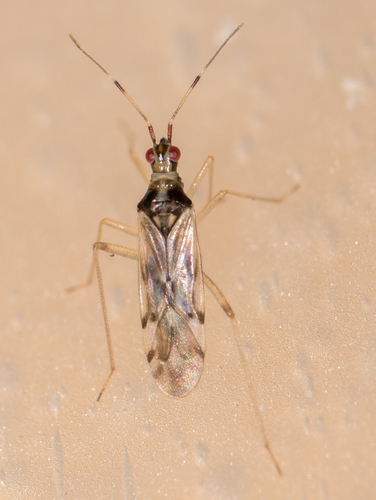
- Dicyphus hesperus
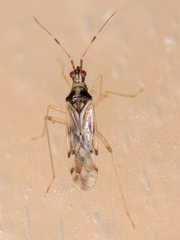 Dicyphus hesperust0
- Outcome
- reproductive and development ratese0
- Direction
- highere0
- Qualifier
- E. kuehniella eggse0
Organisms pictured · Representative pictures of the matched species, not figures from the paper.
Verbatim
t0“Dicyphus hesperus”
e0“Although reproductive and development rates were higher on E. kuehniella eggs”
Claim · model-written summary
D. hesperus fed on B. cockerelli nymphs had an intrinsic rate of natural increase (rm) of 0.069 ± 0.0001.
- Taxon
- Dicyphus hesperusDicyphus hesperust0
- Interactor
- B. cockerelli
 Bactericera cockerellie0pest
- Outcome
- intrinsic rate of natural increasee0
- Value
- 0.069 ± 0.0001e1
Organisms pictured · Representative pictures of the matched species, not figures from the paper.

Verbatim
t0“Dicyphus hesperus”
e0“the predator exhibited a good intrinsic rate of natural increase (rm) when feeding on B. cockerelli nymphs”
e1“rm: B. cockerelli 0.069 ± 0.0001; E. kuehniella 0.078 ± 0.0001”
Claim · model-written summary
D. hesperus fed on E. kuehniella eggs had an intrinsic rate of natural increase (rm) of 0.078 ± 0.0001.
- Taxon
- Dicyphus hesperusDicyphus hesperust0
- Interactor
- E. kuehniella
 Ephestia kuehniellae1other
- Outcome
- intrinsic rate of natural increasee0
- Value
- 0.078 ± 0.0001e1
Organisms pictured · Representative pictures of the matched species, not figures from the paper.

Verbatim
t0“Dicyphus hesperus”
e0“the predator exhibited a good intrinsic rate of natural increase (rm) when feeding on B. cockerelli nymphs”
e1“rm: B. cockerelli 0.069 ± 0.0001; E. kuehniella 0.078 ± 0.0001”
Claim · model-written summary
In tomato greenhouse cages the predator established and suppressed populations of both pests whether they occurred alone or together.
- Taxon
- tomato
 Solanum lycopersicume0
- Treatment
- the predatore0
- Interactor
- both pestse0pest
- Second interactor
- the predatore0biocontrol_agent
- Outcome
- populations of both pestse0
- Direction
- suppresse0
Not reportedComparator
Organisms pictured · Representative pictures of the matched species, not figures from the paper.

Verbatim
e0“the predator was able to establish and suppress populations of both pests inhabiting tomato plants when pests occurred alone or together”
Claim · model-written summary
D. hesperus is a suitable biocontrol agent of these two pests for use in tomato greenhouses.
- Taxon
- tomatoSolanum lycopersicume0
- Interactor
- D. hesperusDicyphus hesperuse0biocontrol_agent
- Outcome
- suitable biocontrol agent of these two important pestse0
- Setting
- tomato greenhousese0
Organisms pictured · Representative pictures of the matched species, not figures from the paper.
Verbatim
e0“D. hesperus was demonstrated to be a suitable biocontrol agent of these two important pests that could be used in tomato greenhouses”
The same questions in other papers
biocontrol · pest · Solanum lycopersicum (tomato)Positive and negative results
22 papers in the same direction as this paper · 2 in the opposite direction
- no effect
- no effect
- positive
21 papers more in this group
See all 25 papers →Claims are grouped by organism, treatment and what was measured or targeted. A paper counts as positive when any of its claims in the group is positive.