Abstract
This study consisted in revealing the possibility of using two ecologically safe methods to control gooseberry aphid (Aphis grossulariae Kalt.) in black currant cultivars: selection aphid resistant cultivars and the use of plant water extracts of wormwood (Artemisia absinthium L.) and tansy (Tanacetum vulgare L.) in the arid zone of Central Kazakhstan for protection against aphid. The study of the resistance of 15 black currant cultivars to gooseberry aphids in the field on the natural background of the population development (2015)(2016)(2017) has shown that the cultivars differ significantly in their level of resistance. Mila, Sophia and Zhuravushka, which were not inhabited with aphids for three seasons, proved to be highly resistant to A. glossulariae, Garmoniia and Bariton-resistant, Kanakhama, Natasha and Altaiskaia pozdniaia-medium resistant, Rita, Agata and Gerkules-low-resistant and Zabava, Prestizh, Iadrenia and Pamiati Kukharskogo-non-resistant. The efficiency of the combined action of water extracts of A. absinthium and T. vulgare was high and 2 weeks after the treatment by botanical preparations it was from 87.2 to 100%.
Abstract from the paper’s OpenAlex record; open copy licensed cc-by. Read at the source ↗
The text the model read, with the source record’s inline markup (italics, sub- and superscripts) rendered and its character entities decoded; quote offsets refer to the raw text.
Claims 7
Claim · model-written summary
The 15 black currant cultivars differed significantly in aphid resistance.
- Outcome
- level of resistancee0
Not reportedTaxon
Verbatim
e0“the cultivars differ significantly in their level of resistance”
Claim · model-written summary
Mila, Sophia and Zhuravushka were highly resistant and had no aphid habitation for three seasons.
Verbatim
e0“Mila, Sophia and Zhuravushka, which were not inhabited with aphids for three seasons, proved to be highly resistant to A. glossulariae”
t0“black currant cultivars”
Claim · model-written summary
Garmoniia and Bariton were resistant to aphids.
- Taxon
- black currantt0
- Material
- Garmoniia and Baritone0
- Interactor
- Aphis grossulariae Kalt.
 Aphis grossulariaet1pest
- Outcome
- resistante0
Organisms pictured · Representative pictures of the matched species, not figures from the paper.
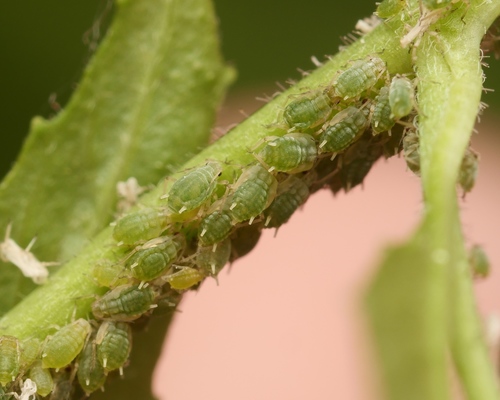
Verbatim
e0“Garmoniia and Bariton-resistant”
t0“black currant cultivars”
t1“Aphis grossulariae Kalt.”
Claim · model-written summary
Kanakhama, Natasha and Altaiskaia pozdniaia had medium aphid resistance.
Verbatim
e0“Kanakhama, Natasha and Altaiskaia pozdniaia-medium resistant”
t0“black currant cultivars”
Claim · model-written summary
Rita, Agata and Gerkules had low aphid resistance.
Verbatim
e0“Rita, Agata and Gerkules-low-resistant”
t0“black currant cultivars”
Claim · model-written summary
Zabava, Prestizh, Iadrenia and Pamiati Kukharskogo were not aphid resistant.
Verbatim
e0“Zabava, Prestizh, Iadrenia and Pamiati Kukharskogo-non-resistant”
t0“black currant cultivars”
Claim · model-written summary
Combined wormwood and tansy water extracts controlled aphids with 87.2 to 100% efficiency two weeks after treatment.
- Taxon
- Black Currantt0
- Treatment
- water extracts of A. absinthium and T. vulgaree0
- Outcome
- efficiencye0
- Direction
- highe0
- Value
- 87.2 to 100%e0
- Qualifier
- 2 weeks after the treatmente0
Not reportedComparator
Verbatim
e0“The efficiency of the combined action of water extracts of A. absinthium and T. vulgare was high and 2 weeks after the treatment by botanical preparations it was from 87.2 to 100%”
t0“Black Currant”