Abstract
The intercrop of grain sorghum with Urochloa ruziziensis allows the production of grains and biomass in the winter. Thus, the objective of this study was to identify the more adequate seeding system and seed density for Urochloa ruziziensis intercropped with sorghum between soybean crops to obtain high grain and biomass yields with these species and evaluate the performance of the subsequent soybean crop. The experiments were carried out in the winter of 2015 and in the 2015-2016 crop season in Rio Verde GO, and Santa Helena de Goiás GO, Brazil. The treatments consisted of three seeding systems (in-row, inter-row, and broadcast), and five seed densities (2, 4, 6, 8, and 10 viable seeds m-2) of U. ruziziensis intercropped with sorghum, using monocultures of sorghum and U. ruziziensis as controls. The seeding density of 8 viable seeds m-2 of U. ruziziensis using in-row seeding, and up to 10 viable seeds m-2 using inter-row, and broadcast seedings do not decrease sorghum grain yield. Increasing seeding density of U. ruziziensis increases its dry matter yield, and the total dry matter yield when intercropped with sorghum. The intercrop of sorghum with U. ruziziensis increases the soil plant coverage. The dry matter of the intercrop of sorghum with U. ruziziensis does not affect soybean grain yield.
Abstract from the paper’s OpenAlex record, shown for indexing and research. Copyright remains with the authors or the publisher. Read at the source ↗
The text the model read, with the source record’s inline markup (italics, sub- and superscripts) rendered and its character entities decoded; quote offsets refer to the raw text.
Claims 7
Claim · model-written summary
In-row sowing at 8 viable seeds m-2 of U. ruziziensis did not decrease sorghum grain yield.
- Taxon
- U. ruziziensis
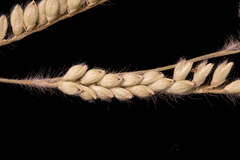 Urochloa ruziziensise0
- Treatment
- 8 viable seeds m-2 of U. ruziziensis using in-row seedinge0
- Outcome
- sorghum grain yielde0
- Direction
- do not decreasee0
Not reportedComparator
Organisms pictured · Representative pictures of the matched species, not figures from the paper.

Verbatim
e0“The seeding density of 8 viable seeds m-2 of U. ruziziensis using in-row seeding, and up to 10 viable seeds m-2 using inter-row, and broadcast seedings do not decrease sorghum grain yield”
Claim · model-written summary
Inter-row sowing up to 10 viable seeds m-2 did not decrease sorghum grain yield.
- Taxon
- Urochloa ruziziensisUrochloa ruziziensist0
- Treatment
- up to 10 viable seeds m-2 using inter-rowe0
- Outcome
- sorghum grain yielde0
- Direction
- do not decreasee0
Not reportedComparator
Organisms pictured · Representative pictures of the matched species, not figures from the paper.
Verbatim
e0“up to 10 viable seeds m-2 using inter-row, and broadcast seedings do not decrease sorghum grain yield”
t0“Urochloa ruziziensis”
Claim · model-written summary
Broadcast sowing up to 10 viable seeds m-2 did not decrease sorghum grain yield.
- Taxon
- Urochloa ruziziensisUrochloa ruziziensist0
- Treatment
- broadcast seedingse0
- Outcome
- sorghum grain yielde0
- Direction
- do not decreasee0
Not reportedComparator
Organisms pictured · Representative pictures of the matched species, not figures from the paper.
Verbatim
e0“up to 10 viable seeds m-2 using inter-row, and broadcast seedings do not decrease sorghum grain yield”
t0“Urochloa ruziziensis”
Claim · model-written summary
Increasing U. ruziziensis seeding density increased its dry matter yield.
- Taxon
- U. ruziziensisUrochloa ruziziensise0
- Treatment
- Increasing seeding densitye0
- Outcome
- dry matter yielde0
- Direction
- increasese0
Organisms pictured · Representative pictures of the matched species, not figures from the paper.
Verbatim
e0“Increasing seeding density of U. ruziziensis increases its dry matter yield”
Claim · model-written summary
Increasing U. ruziziensis seeding density increased total intercrop dry matter yield.
- Taxon
- U. ruziziensisUrochloa ruziziensise0
- Treatment
- Increasing seeding densitye0
- Outcome
- total dry matter yielde0
- Direction
- increasese0
Organisms pictured · Representative pictures of the matched species, not figures from the paper.
Verbatim
e0“Increasing seeding density of U. ruziziensis increases its dry matter yield, and the total dry matter yield when intercropped with sorghum”
Claim · model-written summary
Intercropping sorghum with U. ruziziensis increased soil plant cover.
- Taxon
- U. ruziziensisUrochloa ruziziensise0
- Treatment
- intercrop of sorghum with U. ruziziensise0
- Outcome
- soil plant coveragee0
- Direction
- increasese0
Not reportedComparator
Organisms pictured · Representative pictures of the matched species, not figures from the paper.
Verbatim
e0“The intercrop of sorghum with U. ruziziensis increases the soil plant coverage”
Claim · model-written summary
Dry matter from the sorghum and U. ruziziensis intercrop did not affect soybean grain yield.
- Taxon
- soybean
 Glycine maxe0
- Treatment
- dry matter of the intercrop of sorghum with U. ruziziensise0
- Outcome
- soybean grain yielde0
- Direction
- does not affecte0
Not reportedComparator
Organisms pictured · Representative pictures of the matched species, not figures from the paper.

Verbatim
e0“The dry matter of the intercrop of sorghum with U. ruziziensis does not affect soybean grain yield”
The same questions in other papers
Urochloa ruziziensis · yield · Glycine max (soybean)Positive and negative results
5 papers in the same direction as this paper · 7 in the opposite direction
- positive
- positive
- positive
9 papers more in this group
See all 13 papers →Sorghum · yield · Glycine max (soybean)Positive and negative results
2 papers in the same direction as this paper · 20 in the opposite direction
- positive
- positive
- positive
19 papers more in this group
See all 23 papers →intercropping · yield · Glycine max (soybean)Positive and negative results
86 papers in the same direction as this paper · 131 in the opposite direction
- positive
- positive
- positive
214 papers more in this group
See all 218 papers →Claims are grouped by organism, treatment and what was measured or targeted. A paper counts as positive when any of its claims in the group is positive.