Abstract
Wheat (Triticum estivum L.) is the major and important winter cereal food crop grown in India during Rabi season. The crop suffer from a number of devastating disease by fungi, bacteria, virus, phytoplasmas, nematodes and many other factors which educe yield and quality. The major fungal disease of wheat, spot blotch caused by Bipolaris sorokiniana is the most devastating disease in India and several other countries. The diseases affect all areal part of the plant.. Many new fungicides and biocides have been under taken to evaluate with poison food method. Out of nine fugicides in different concentrations of seven fungicides and two biocides (Neemexel and T. viride) have been revealed that the dose no. 4th (D4) have given best result to reducing mycelial growth of Bipolaris sorokiniana comparison to others. It has also found that the growth of fungus was fast up to first four days and after that it is gradually reduced. In some concentrations like, 0.12%, 0.25% growth of mycelia was stringent after fifth days of inoculation. The maximum inhibitory effect with 73.33% reduction was recorded at 0.25 % concentration of Nativo 75 WG fungicides which was statistically at per with 0.12% concentration. It was followed by 0.06% concentration with 68.88% reduction was recorded with Raxil 060 FS.
Abstract from the paper’s OpenAlex record; open copy licensed cc-by-nc-sa. Read at the source ↗
The text the model read, with the source record’s inline markup (italics, sub- and superscripts) rendered and its character entities decoded; quote offsets refer to the raw text.
Claims 5
Claim · model-written summary
Dose no. 4 (D4) gave the best reduction of Bipolaris sorokiniana mycelial growth compared with the other doses of fungicides and biocides on wheat spot blotch.
- Taxon
- Wheat
 Triticum aestivumt0
- Treatment
- dose no. 4th (D4)e2
- Interactor
- Bipolaris sorokiniana
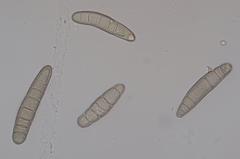 Bipolaris sorokinianat0pathogen
- Outcome
- mycelial growth of Bipolaris sorokinianae2
- Direction
- reducinge2
- Comparator
- otherse2
- Setting
- poison food methode1
Organisms pictured · Representative pictures of the matched species, not figures from the paper.

Verbatim
t0“Spot Blotch of Wheat Caused by Bipolaris sorokiniana”
e2“Out of nine fugicides in different concentrations of seven fungicides and two biocides (Neemexel and T. viride) have been revealed that the dose no. 4th (D4) have given best result to reducing mycelial growth of Bipolaris sorokiniana comparison to others”
e1“Many new fungicides and biocides have been under taken to evaluate with poison food method”
Claim · model-written summary
Nativo 75 WG fungicide at 0.25% gave the maximum inhibition of Bipolaris sorokiniana, a 73.33% reduction, statistically at par with 0.12%.
- Taxon
- WheatTriticum aestivumt0
- Treatment
- 0.25 % concentration of Nativo 75 WG fungicidese3
- Interactor
- Bipolaris sorokinianaBipolaris sorokinianat0pathogen
- Outcome
- inhibitory effecte3
- Direction
- maximume3
- Value
- 73.33%e3
- Qualifier
- statistically at per with 0.12% concentratione3
Not reportedComparator
Organisms pictured · Representative pictures of the matched species, not figures from the paper.
Verbatim
t0“Spot Blotch of Wheat Caused by Bipolaris sorokiniana”
e3“The maximum inhibitory effect with 73.33% reduction was recorded at 0.25 % concentration of Nativo 75 WG fungicides which was statistically at per with 0.12% concentration”
Claim · model-written summary
Raxil 060 FS at 0.06% concentration reduced Bipolaris sorokiniana mycelial growth by 68.88%.
- Taxon
- WheatTriticum aestivumt0
- Treatment
- Raxil 060 FSe4
- Interactor
- Bipolaris sorokinianaBipolaris sorokinianat0pathogen
- Outcome
- mycelial growthe2
- Direction
- reductione4
- Value
- 68.88%e4
- Qualifier
- 0.06% concentratione4
Not reportedComparator
Organisms pictured · Representative pictures of the matched species, not figures from the paper.
Verbatim
t0“Spot Blotch of Wheat Caused by Bipolaris sorokiniana”
e2“Out of nine fugicides in different concentrations of seven fungicides and two biocides (Neemexel and T. viride) have been revealed that the dose no. 4th (D4) have given best result to reducing mycelial growth of Bipolaris sorokiniana comparison to others”
e4“It was followed by 0.06% concentration with 68.88% reduction was recorded with Raxil 060 FS”
Claim · model-written summary
Mycelial growth of the fungus was fast for the first four days and then gradually reduced.
- Taxon
- WheatTriticum aestivumt0
- Interactor
- funguse5pathogen
- Outcome
- growth of funguse5
- Qualifier
- fast up to first four dayse5
Organisms pictured · Representative pictures of the matched species, not figures from the paper.
Verbatim
t0“Spot Blotch of Wheat Caused by Bipolaris sorokiniana”
e5“It has also found that the growth of fungus was fast up to first four days and after that it is gradually reduced”
Claim · model-written summary
Growth of mycelia was stringent at 0.12% and 0.25% concentrations after the fifth day of inoculation.
- Taxon
- WheatTriticum aestivumt0
- Treatment
- 0.12%, 0.25%e6
- Outcome
- growth of myceliae6
- Qualifier
- after fifth days of inoculatione6
Organisms pictured · Representative pictures of the matched species, not figures from the paper.
Verbatim
t0“Spot Blotch of Wheat Caused by Bipolaris sorokiniana”
e6“In some concentrations like, 0.12%, 0.25% growth of mycelia was stringent after fifth days of inoculation”
The same questions in other papers
fungicide · Bipolaris sorokiniana · Triticum aestivum (wheat)Results agree
2 papers in the same direction as this paper
- positive
- positive
Claims are grouped by organism, treatment and what was measured or targeted. A paper counts as positive when any of its claims in the group is positive.