Abstract
Wheat (Triticum aestivum) common root rot (CRR) caused by predominant fungal pathogen Bipolaris sorokiniana occurs in all wheat-growing regions worldwide and is difficult to control. In this study, the efficacy of eight fungicides against Bipolaris sorokiniana was examined in in vitro assays, and we determined that the combined application of two fungicides significantly inhibits the growth of fungal mycelium. Half of the maximal effective concentration of a mixture containing fludioxonil and difenoconazole in the ratio 1:4 was 0.0372 mg/liter, and the cotoxicity coefficient was 160.14. Under an environmentally controlled pot assay, seed treatment with the mixture of fludioxonil and difenoconazole in the 1:4 ratio demonstrated the best control efficiency at seedling and adult stages, respectively. The best synergistic mixture on seed treatment was assessed in a 2-year field experiment at Hebei, China. The best control efficacy achieved at the seedling and adult stages was 82.65% and 68.48%, respectively. Overall, the in vitro mycelial growth inhibition assay and controlled-environment and field studies indicated that the synergistic action of a mixture of fludioxonil and difenoconazole provides effective control against wheat CRR. These findings highlight the potential application of the fungicide combination for controlling CRR and reducing the selection pressure on fungal pathogens by lessening the use of various fungicides in the field.
Abstract from the paper’s OpenAlex record, shown for indexing and research. Copyright remains with the authors or the publisher. Read at the source ↗
The text the model read, with the source record’s inline markup (italics, sub- and superscripts) rendered and its character entities decoded; quote offsets refer to the raw text.
Claims 7
Claim · model-written summary
Combined fungicides significantly inhibited Bipolaris mycelial growth in vitro.
- Taxon
- Wheat
 Triticum aestivumt0
- Treatment
- combined application of two fungicidese0
- Interactor
- Bipolaris sorokiniana
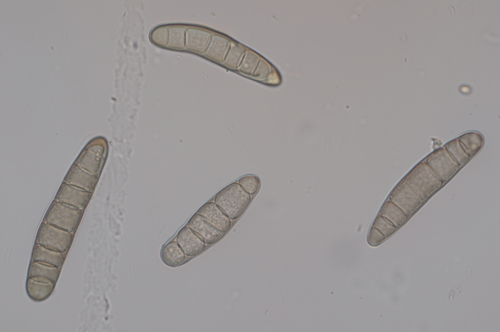
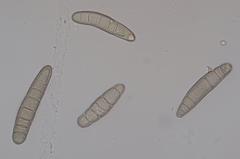 Bipolaris sorokinianat0pathogen
- Outcome
- growth of fungal myceliume0
- Direction
- inhibitse0
Not reportedComparator
Organisms pictured · Representative pictures of the matched species, not figures from the paper.

Verbatim
t0“Wheat from Common Root Rot Caused by Bipolaris sorokiniana”
e0“the combined application of two fungicides significantly inhibits the growth of fungal mycelium”
Claim · model-written summary
The 1:4 mixture had a half maximal effective concentration of 0.0372 mg/liter.
- Taxon
- WheatTriticum aestivumt0
- Treatment
- mixture containing fludioxonil and difenoconazole in the ratio 1:4e0
- Outcome
- Half of the maximal effective concentratione0
- Value
- 0.0372 mg/litere0
Not reportedComparatorDirection
Organisms pictured · Representative pictures of the matched species, not figures from the paper.
Verbatim
t0“Wheat”
e0“Half of the maximal effective concentration of a mixture containing fludioxonil and difenoconazole in the ratio 1:4 was 0.0372 mg/liter”
Claim · model-written summary
The 1:4 mixture had a cotoxicity coefficient of 160.14.
- Taxon
- WheatTriticum aestivumt0
- Outcome
- cotoxicity coefficiente0
- Value
- 160.14e0
Not reportedTreatmentComparatorDirection
Organisms pictured · Representative pictures of the matched species, not figures from the paper.
Verbatim
t0“Wheat”
e0“the cotoxicity coefficient was 160.14”
Claim · model-written summary
Seed treatment with the 1:4 mixture had the best pot control efficiency at seedling stage.
- Taxon
- WheatTriticum aestivumt0
- Organ / stage
- seedlinge0
- Treatment
- seed treatment with the mixture of fludioxonil and difenoconazole in the 1:4 ratioe0
- Outcome
- control efficiencye0
- Direction
- beste0
Not reportedComparator
Organisms pictured · Representative pictures of the matched species, not figures from the paper.
Verbatim
t0“Wheat”
e0“seed treatment with the mixture of fludioxonil and difenoconazole in the 1:4 ratio demonstrated the best control efficiency at seedling and adult stages, respectively”
Claim · model-written summary
Seed treatment with the 1:4 mixture had the best pot control efficiency at adult stage.
- Taxon
- WheatTriticum aestivumt0
- Organ / stage
- adulte0
- Treatment
- seed treatment with the mixture of fludioxonil and difenoconazole in the 1:4 ratioe0
- Outcome
- control efficiencye0
- Direction
- beste0
Not reportedComparator
Organisms pictured · Representative pictures of the matched species, not figures from the paper.
Verbatim
t0“Wheat”
e0“seed treatment with the mixture of fludioxonil and difenoconazole in the 1:4 ratio demonstrated the best control efficiency at seedling and adult stages, respectively”
Claim · model-written summary
Field control efficacy at seedling stage reached 82.65%.
- Taxon
- WheatTriticum aestivumt0
- Organ / stage
- seedlinge0
- Outcome
- control efficacye0
- Direction
- beste0
- Value
- 82.65%e0
Not reportedTreatmentComparator
Organisms pictured · Representative pictures of the matched species, not figures from the paper.
Verbatim
t0“Wheat”
e0“The best control efficacy achieved at the seedling and adult stages was 82.65% and 68.48%, respectively”
Claim · model-written summary
Field control efficacy at adult stage reached 68.48%.
- Taxon
- WheatTriticum aestivumt0
- Organ / stage
- adulte0
- Outcome
- control efficacye0
- Direction
- beste0
- Value
- 68.48%e0
Not reportedTreatmentComparator
Organisms pictured · Representative pictures of the matched species, not figures from the paper.
Verbatim
t0“Wheat”
e0“The best control efficacy achieved at the seedling and adult stages was 82.65% and 68.48%, respectively”
The same questions in other papers
fludioxonil · control · Triticum aestivum (wheat)Results agree
1 paper in the same direction as this paper
- positive
difenoconazole · control · Triticum aestivum (wheat)Results agree
3 papers in the same direction as this paper
- positive
- positive
- positive
fungicide · Bipolaris sorokiniana · Triticum aestivum (wheat)Results agree
2 papers in the same direction as this paper
- positive
- positive
seed treatment · control · Triticum aestivum (wheat)Results agree
20 papers in the same direction as this paper
- positive
- positive
- positive
17 papers more in this group
See all 21 papers →Claims are grouped by organism, treatment and what was measured or targeted. A paper counts as positive when any of its claims in the group is positive.