Abstract
A pure line of Hubbard squash was used for the investigation. In the development of the anther the pollen mother cells are formed from a single longitudinal row of cells of the primary sporogenous layer in each anther lobe. During early diakinesis a perinuclear zone is formed. From the perinuclear zone as well as from the interior of the nucleus fibers are formed which constitute the multipolar spindle. There are twenty bivalent chromosomes at the heterotypic division. Counts in root tip cell showed forty somatic chromosomes. During diakinesis a callose wall is secreted around the mother cell. When the heterotypic division has been completed a special wall composed of callose is formed just inside of the original mother cell wall. Quadripartition of the mother cell is effected by partition walls which originate on the inner surface of the special wall and grow centripetally.
Abstract from the paper’s OpenAlex record; open copy licensed other-oa. Read at the source ↗
The text the model read, with the source record’s inline markup (italics, sub- and superscripts) rendered and its character entities decoded; quote offsets refer to the raw text.
Claims 8
Claim · model-written summary
Pollen mother cells form from one longitudinal row of primary sporogenous cells per anther lobe.
- Taxon
- Cucurbita maxima
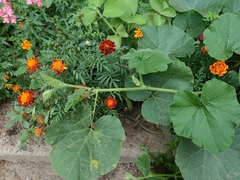 Cucurbita maximat0
- Organ / stage
- anther lobee0
- Outcome
- pollen mother cells are formed from a single longitudinal row of cellse0
Organisms pictured · Representative pictures of the matched species, not figures from the paper.

Verbatim
e0“pollen mother cells are formed from a single longitudinal row of cells of the primary sporogenous layer in each anther lobe”
t0“Cucurbita maxima”
Claim · model-written summary
A perinuclear zone forms in early diakinesis.
- Taxon
- Cucurbita maximaCucurbita maximat0
- Organ / stage
- early diakinesise0
- Outcome
- perinuclear zone is formede0
Organisms pictured · Representative pictures of the matched species, not figures from the paper.
Verbatim
e0“During early diakinesis a perinuclear zone is formed”
t0“Cucurbita maxima”
Claim · model-written summary
Fibers from the perinuclear zone and nuclear interior form the multipolar spindle.
- Taxon
- Cucurbita maximaCucurbita maximat0
- Outcome
- fibers are formed which constitute the multipolar spindlee0
Organisms pictured · Representative pictures of the matched species, not figures from the paper.
Verbatim
e0“From the perinuclear zone as well as from the interior of the nucleus fibers are formed which constitute the multipolar spindle”
t0“Cucurbita maxima”
Claim · model-written summary
Twenty bivalent chromosomes occur at heterotypic division.
- Taxon
- Cucurbita maximaCucurbita maximat0
- Outcome
- bivalent chromosomese0
- Value
- twenty bivalent chromosomese0
Organisms pictured · Representative pictures of the matched species, not figures from the paper.
Verbatim
e0“There are twenty bivalent chromosomes at the heterotypic division”
t0“Cucurbita maxima”
Claim · model-written summary
Root tip cells had forty somatic chromosomes.
- Taxon
- Cucurbita maximaCucurbita maximat0
- Organ / stage
- root tip celle0
- Outcome
- somatic chromosomese0
- Value
- forty somatic chromosomese0
Organisms pictured · Representative pictures of the matched species, not figures from the paper.
Verbatim
e0“Counts in root tip cell showed forty somatic chromosomes”
t0“Cucurbita maxima”
Claim · model-written summary
A callose wall forms around the mother cell during diakinesis.
- Taxon
- Cucurbita maximaCucurbita maximat0
- Organ / stage
- diakinesise0
- Outcome
- callose wall is secreted around the mother celle0
Organisms pictured · Representative pictures of the matched species, not figures from the paper.
Verbatim
e0“During diakinesis a callose wall is secreted around the mother cell”
t0“Cucurbita maxima”
Claim · model-written summary
A special callose wall forms inside the original wall after heterotypic division.
- Taxon
- Cucurbita maximaCucurbita maximat0
- Organ / stage
- mother cell walle0
- Outcome
- special wall composed of callose is formede0
Organisms pictured · Representative pictures of the matched species, not figures from the paper.
Verbatim
e0“When the heterotypic division has been completed a special wall composed of callose is formed just inside of the original mother cell wall”
t0“Cucurbita maxima”
Claim · model-written summary
Centripetally growing partition walls divide the mother cell into four.
- Taxon
- Cucurbita maximaCucurbita maximat0
- Outcome
- Quadripartition of the mother celle0
- Qualifier
- partition walls which originate on the inner surface of the special wall and grow centripetallye0
Organisms pictured · Representative pictures of the matched species, not figures from the paper.
Verbatim
e0“Quadripartition of the mother cell is effected by partition walls which originate on the inner surface of the special wall and grow centripetally”
t0“Cucurbita maxima”