Abstract
The Niassa National Reserve (NNR) is the most extensive conservation area in Mozambique and the third largest in Africa, encompassing 42,000 km2 of endemic miombo vegetation. Dambos wetlands occur within the wooded grassland and grassland vegetation of NNR and provide a wide range of Ecosystem Services (ES), including life support for animal species, regulation of water flow and prevention of soil erosion. It also generates income for the livelihoods of local communities by providing land for agriculture and harvesting of non-timber products. The dynamics of these ecosystems is poorly understood despite the contribution of the dambos to global biodiversity and ES. This research is the first preliminary assessment of the vegetation structure and composition of six dambos within NNR, selected using Google Earth, MODIS satellite images and an exploratory field visit. Field data collection was performed using a two-stage systematic sampling approach, along transect lines of 100 × 10 m (0.1 ha), perpendicular to the dambos' flow. Square plots of 0.25 m2 were established for grass survey within the transects where grass vegetation was measured, counted and identified. Data were analyzed with R software. The sociological position of each species was analyzed with regard to the vertical structure while for horizontal structure, the abundance, dominance, frequency and Importance Value Index (IVI) were determined. In order to understand the differences between dambos, evenness (H) and reciprocal of Simpson's heterogeneity index (Hill's N2) were calculated. Principal Coordinates Analysis (PCoA) and Cluster Analysis were also used to characterize the surveyed species communities. A total of 58 transects (5.8 ha) and 336 subplots were assessed, recording 110 woody and 73 grass species, respectively. The most common tree species were Vitex doniana, Burkea africana, Syzygium cordatum and Annona senegalensis, while for grass vegetation the most abundant species were Andropogon eucomus and Helictotrichon turgidulum. According to the IVI, the most dominant tree and shrub species were V. doniana, Pseudolachnostylis maprouneifolia, A. senegalensis and S. cordatum. Homogeneity (Hill's N2 = 18.92) and evenness (H = −4.27) were, on average, low in all dambos. Dambo 2 was the most heterogeneous (Hill's N2 = 18.21) while dambo 1 was the least heterogeneous (Hill's N2 = 5.71). Dambo 6 was most equitable (H = −1.35) whereas dambo 2 the least equitable (H = −3.72). Using species abundance and based on PCoA and cluster analysis, four main groups of dambos were identified based mainly on the water gradient, with data variation captured by the first three axes reaching almost 83%. The p-value (0.42), suggested no significant differences between species communities in the dambos, and thus, human disturbances appear not to be enough to modify dambos microenvironment. Accordingly, the results suggest that human activities, at this level, do not necessarily affect the structure and diversity of dambos in the NNR. The results also suggest that the species A. senegalensis, Combretum psidioides, Crossopteryx febrifuga, Protea nitida, P. maprouneifolia and S. cordatum can be used as indicator dambo species in NNR, with high likelihood of occurrence.
Abstract from the paper’s OpenAlex record; open copy licensed cc-by-nc-nd. Read at the source ↗
The text the model read, with the source record’s inline markup (italics, sub- and superscripts) rendered and its character entities decoded; quote offsets refer to the raw text.
Claims 15
Claim · model-written summary
Dambo vegetation in the NNR comprised 110 woody and 73 grass species across the sampled transects.
Verbatim
e0“This research is the first preliminary assessment of the vegetation structure and composition of six dambos within NNR”
e1“A total of 58 transects (5.8 ha) and 336 subplots were assessed, recording 110 woody and 73 grass species, respectively.”
Claim · model-written summary
The most common tree species in the dambos were Vitex doniana, Burkea africana, Syzygium cordatum and Annona senegalensis.
- Taxon
- Vitex doniana, Burkea africana, Syzygium cordatum and Annona senegalensis
 Burkea africana
 Annona senegalensis
 Syzygium cordatum
 Vitex donianae2
- Outcome
- most common tree speciese2
Organisms pictured · Representative pictures of the matched species, not figures from the paper.


Verbatim
e0“This research is the first preliminary assessment of the vegetation structure and composition of six dambos within NNR”
e2“The most common tree species were Vitex doniana, Burkea africana, Syzygium cordatum and Annona senegalensis, while for grass vegetation the most abundant species were Andropogon eucomus and Helictotrichon turgidulum.”
Claim · model-written summary
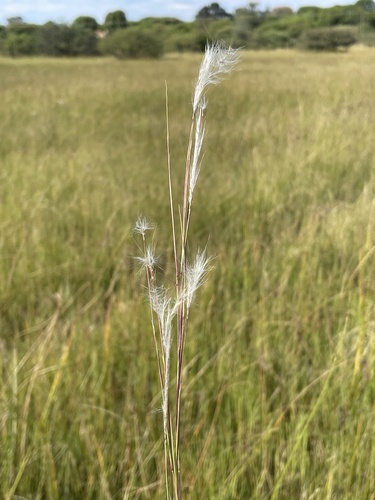
For grass vegetation, the most abundant species were Andropogon eucomus and Helictotrichon turgidulum.
- Taxon
- Andropogon eucomus and Helictotrichon turgidulum
 Anatherum eucomumTrisetopsis imberbise2
- Outcome
- most abundant speciese2
- Qualifier
- grass vegetatione2
Organisms pictured · Representative pictures of the matched species, not figures from the paper.
Verbatim
e0“This research is the first preliminary assessment of the vegetation structure and composition of six dambos within NNR”
e2“The most common tree species were Vitex doniana, Burkea africana, Syzygium cordatum and Annona senegalensis, while for grass vegetation the most abundant species were Andropogon eucomus and Helictotrichon turgidulum.”
Claim · model-written summary
According to the IVI, the most dominant tree and shrub species were V. doniana, Pseudolachnostylis maprouneifolia, A. senegalensis and S. cordatum.
- Taxon
- V. doniana, Pseudolachnostylis maprouneifolia, A. senegalensis and S. cordatum
 Pseudolachnostylis maprouneifoliaAnnona senegalensisSyzygium cordatumVitex donianae3
- Outcome
- most dominant tree and shrub speciese3
- Qualifier
- According to the IVIe3
Organisms pictured · Representative pictures of the matched species, not figures from the paper.

Verbatim
e0“This research is the first preliminary assessment of the vegetation structure and composition of six dambos within NNR”
e3“According to the IVI, the most dominant tree and shrub species were V. doniana, Pseudolachnostylis maprouneifolia, A. senegalensis and S. cordatum”
Claim · model-written summary
Homogeneity of dambo vegetation (Hill's N2 = 18.92) was low on average across all dambos.
Verbatim
e0“This research is the first preliminary assessment of the vegetation structure and composition of six dambos within NNR”
e4“Homogeneity (Hill's N2 = 18.92) and evenness (H = −4.27) were, on average, low in all dambos. Dambo 2 was the most heterogeneous (Hill's N2 = 18.21) while dambo 1 was the least heterogeneous (Hill's N2 = 5.71).”
Claim · model-written summary
Evenness of dambo vegetation (H = −4.27) was low on average across all dambos.
Verbatim
e0“This research is the first preliminary assessment of the vegetation structure and composition of six dambos within NNR”
e4“Homogeneity (Hill's N2 = 18.92) and evenness (H = −4.27) were, on average, low in all dambos. Dambo 2 was the most heterogeneous (Hill's N2 = 18.21) while dambo 1 was the least heterogeneous (Hill's N2 = 5.71).”
Claim · model-written summary
Dambo 2 was the most heterogeneous dambo (Hill's N2 = 18.21).
Verbatim
e0“This research is the first preliminary assessment of the vegetation structure and composition of six dambos within NNR”
e4“Homogeneity (Hill's N2 = 18.92) and evenness (H = −4.27) were, on average, low in all dambos. Dambo 2 was the most heterogeneous (Hill's N2 = 18.21) while dambo 1 was the least heterogeneous (Hill's N2 = 5.71).”
Claim · model-written summary
Dambo 1 was the least heterogeneous dambo (Hill's N2 = 5.71).
Verbatim
e0“This research is the first preliminary assessment of the vegetation structure and composition of six dambos within NNR”
e4“Homogeneity (Hill's N2 = 18.92) and evenness (H = −4.27) were, on average, low in all dambos. Dambo 2 was the most heterogeneous (Hill's N2 = 18.21) while dambo 1 was the least heterogeneous (Hill's N2 = 5.71).”
Claim · model-written summary
Dambo 6 was the most equitable dambo (H = −1.35).
Verbatim
e0“This research is the first preliminary assessment of the vegetation structure and composition of six dambos within NNR”
e5“Dambo 6 was most equitable (H = −1.35) whereas dambo 2 the least equitable (H = −3.72). Using species abundance and based on PCoA and cluster analysis, four main groups of dambos were identified based mainly on the water gradient, with data variation captured by the first three axes reaching almost 83%.”
Claim · model-written summary
Dambo 2 was the least equitable dambo (H = −3.72).
Verbatim
e0“This research is the first preliminary assessment of the vegetation structure and composition of six dambos within NNR”
e5“Dambo 6 was most equitable (H = −1.35) whereas dambo 2 the least equitable (H = −3.72). Using species abundance and based on PCoA and cluster analysis, four main groups of dambos were identified based mainly on the water gradient, with data variation captured by the first three axes reaching almost 83%.”
Claim · model-written summary
Four main groups of dambos were identified, based mainly on the water gradient.
Verbatim
e0“This research is the first preliminary assessment of the vegetation structure and composition of six dambos within NNR”
e5“Dambo 6 was most equitable (H = −1.35) whereas dambo 2 the least equitable (H = −3.72). Using species abundance and based on PCoA and cluster analysis, four main groups of dambos were identified based mainly on the water gradient, with data variation captured by the first three axes reaching almost 83%.”
Claim · model-written summary
The first three ordination axes captured almost 83% of the data variation.
Verbatim
e0“This research is the first preliminary assessment of the vegetation structure and composition of six dambos within NNR”
e5“Dambo 6 was most equitable (H = −1.35) whereas dambo 2 the least equitable (H = −3.72). Using species abundance and based on PCoA and cluster analysis, four main groups of dambos were identified based mainly on the water gradient, with data variation captured by the first three axes reaching almost 83%.”
Claim · model-written summary
No significant differences were found between species communities in the dambos (p = 0.42).
Verbatim
e0“This research is the first preliminary assessment of the vegetation structure and composition of six dambos within NNR”
e6“The p-value (0.42), suggested no significant differences between species communities in the dambos, and thus, human disturbances appear not to be enough to modify dambos microenvironment. Accordingly, the results suggest that human activities, at this level, do not necessarily affect the structure and diversity of dambos in the NNR.”
Claim · model-written summary
Human activities do not necessarily affect the structure and diversity of dambos in the NNR.
Verbatim
e0“This research is the first preliminary assessment of the vegetation structure and composition of six dambos within NNR”
e6“The p-value (0.42), suggested no significant differences between species communities in the dambos, and thus, human disturbances appear not to be enough to modify dambos microenvironment. Accordingly, the results suggest that human activities, at this level, do not necessarily affect the structure and diversity of dambos in the NNR.”
Claim · model-written summary
Six woody and herbaceous species (A. senegalensis, Combretum psidioides, Crossopteryx febrifuga, Protea nitida, P. maprouneifolia and S. cordatum) can be used as indicator dambo species in the NNR.
- Taxon
- A. senegalensis, Combretum psidioides, Crossopteryx febrifuga, Protea nitida, P. maprouneifolia and S. cordatum
 Crossopteryx febrifugaPseudolachnostylis maprouneifolia
 Protea nitidaAnnona senegalensisSyzygium cordatumCombretum psidioidese7
- Outcome
- indicator dambo speciese7
Organisms pictured · Representative pictures of the matched species, not figures from the paper.


Verbatim
e7“The results also suggest that the species A. senegalensis, Combretum psidioides, Crossopteryx febrifuga, Protea nitida, P. maprouneifolia and S. cordatum can be used as indicator dambo species in NNR, with high likelihood of occurrence.”