
Claim · model-written summary
Six woody and herbaceous species (A. senegalensis, Combretum psidioides, Crossopteryx febrifuga, Protea nitida, P. maprouneifolia and S. cordatum) can be used as indicator dambo species in the NNR.
- Taxon
- A. senegalensis, Combretum psidioides, Crossopteryx febrifuga, Protea nitida, P. maprouneifolia and S. cordatum
 Crossopteryx febrifuga
 Pseudolachnostylis maprouneifolia
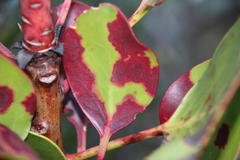
 Protea nitida
 Annona senegalensis
 Syzygium cordatumCombretum psidioidese7
- Outcome
- indicator dambo speciese7
Verbatim
e7“The results also suggest that the species A. senegalensis, Combretum psidioides, Crossopteryx febrifuga, Protea nitida, P. maprouneifolia and S. cordatum can be used as indicator dambo species in NNR, with high likelihood of occurrence.”
Title
Vegetation structure and effects of human use of the dambos ecosystem in northern Mozambique
Aires Afonso Mbanze; Amade Mário Martins; Rui Rivaes; et al. Global Ecology and Conservation 2019. doi:10.1016/j.gecco.2019.e00704
Other claims from this paper (14)
- Observation Dambo vegetation in the NNR comprised 110 woody and 73 grass species across the sampled transects.
- Observation The most common tree species in the dambos were Vitex doniana, Burkea africana, Syzygium cordatum and Annona senegalensis.
- Observation For grass vegetation, the most abundant species were Andropogon eucomus and Helictotrichon turgidulum.
- Observation According to the IVI, the most dominant tree and shrub species were V. doniana, Pseudolachnostylis maprouneifolia, A. senegalensis and S. cordatum.
- Observation Homogeneity of dambo vegetation (Hill's N2 = 18.92) was low on average across all dambos.
- Observation Evenness of dambo vegetation (H = −4.27) was low on average across all dambos.
- Observation Dambo 2 was the most heterogeneous dambo (Hill's N2 = 18.21).
- Observation Dambo 1 was the least heterogeneous dambo (Hill's N2 = 5.71).
- Observation Dambo 6 was the most equitable dambo (H = −1.35).
- Observation Dambo 2 was the least equitable dambo (H = −3.72).
- Observation Four main groups of dambos were identified, based mainly on the water gradient.
- Observation The first three ordination axes captured almost 83% of the data variation.
- Observation No significant differences were found between species communities in the dambos (p = 0.42).
- Association Human activities do not necessarily affect the structure and diversity of dambos in the NNR.
 Teratosphaeria proteae-arboreae