Abstract
The genus Cucurbita comprises many popular vegetable and ornamental plants, including pumpkins, squashes, and gourds, that are highly valued in China as well as in many other countries. During a survey conducted in Zhejiang province, Southeast China in 2016, severe symptoms of viral infection were observed on Cucurbita maxima Duch. ex Lam . Diseased plants showed symptoms such as stunting, mosaicking, Shoe string, blistering, yellowing, leaf deformation, and fruit distortion. Approximately, 50% of Cucurbita crops produced in Jinhua were diseased, causing an estimated yield loss of 35%. In this study, we developed a method using all known virus genomes from the NCBI database as a reference to map small RNAs to develop a diagnostic tool that could be used to diagnose virus diseases of C. maxima . 25 leaf samples from different symptomatic plants and 25 leaf samples from non-symptomatic plants were collected from the experimental field of Jihua National Agricultural Technology Garden for pathogen identification. Small RNAs from each set of three symptomatic and non-symptomatic samples were extracted and sequenced by Illumina sequencing. Twenty-four different viruses were detected in total. However, the majority of the small RNAs were from Zucchini yellow mosaic virus (ZYMV), Watermelon mosaic virus (WMV), and Cucumber mosaic virus (CMV). Mixed infections of these three viruses were diagnosed in leaf samples from diseased plants and confirmed by reverse transcription PCR (RT-PCR) using primers specific to these three viruses. Crude sap extract from symptomatic leaf samples was mechanically inoculated back into healthy C. maxima plants growing under greenhouse conditions. Inoculated plants developed the same disease symptoms as those observed in the diseased plants and a mixed infection of ZYMV, WMV, and CMV was detected again by RT-PCR, thus fulfilling Koch’s postulates. The diagnostic method developed in this study involves fewer bioinformatics processes than other diagnostic methods, does not require complex settings for bioinformatics parameters, provides a high level of sensitivity to rapidly diagnose plant samples with symptoms of virus diseases and can be performed cheaply. This method therefore has the potential to be widely applied as a diagnostic tool for viruses that have genome information in the NCBI database.
Abstract from the paper’s OpenAlex record; open copy licensed cc-by. Read at the source ↗
The text the model read, with the source record’s inline markup (italics, sub- and superscripts) rendered and its character entities decoded; quote offsets refer to the raw text.
Claims 10
Claim · model-written summary
Diseased Cucurbita maxima plants showed several growth, leaf and fruit symptoms.
- Taxon
- Cucurbita maxima Duch. ex Lam.
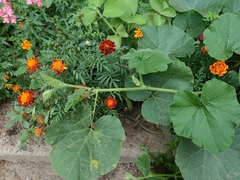 Cucurbita maximat0
- Outcome
- stunting, mosaicking, Shoe string, blistering, yellowing, leaf deformation, and fruit distortione0
Organisms pictured · Representative pictures of the matched species, not figures from the paper.

Verbatim
e0“Diseased plants showed symptoms such as stunting, mosaicking, Shoe string, blistering, yellowing, leaf deformation, and fruit distortion”
t0“Cucurbita maxima Duch. ex Lam.”
Claim · model-written summary
About half the Jinhua Cucurbita crop was diseased.
 Cucurbita
Organisms pictured · Representative pictures of the matched species, not figures from the paper.

Verbatim
e0“Approximately, 50% of Cucurbita crops produced in Jinhua were diseased”
Claim · model-written summary
Disease caused estimated yield loss of 35%.
- Taxon
- Cucurbita maxima Duch. ex Lam.Cucurbita maximat0
- Outcome
- yield losse0
- Value
- 35%e0
Organisms pictured · Representative pictures of the matched species, not figures from the paper.
Verbatim
e0“causing an estimated yield loss of 35%”
t0“Cucurbita maxima Duch. ex Lam.”
Claim · model-written summary
Small RNA sequencing detected 24 viruses in sampled Cucurbita leaves.
- Taxon
- Cucurbita maxima Duch. ex Lam.Cucurbita maximat0
- Outcome
- viruses were detectede0
- Value
- Twenty-foure0
Organisms pictured · Representative pictures of the matched species, not figures from the paper.
Verbatim
e0“Twenty-four different viruses were detected in total”
t0“Cucurbita maxima Duch. ex Lam.”
Claim · model-written summary
Most detected small RNAs were from ZYMV, WMV and CMV.
- Taxon
- Cucurbita maxima Duch. ex Lam.Cucurbita maximat0
- Interactor
- Zucchini yellow mosaic virus (ZYMV)
 Zucchini yellow mosaic viruse0pathogen
- Outcome
- majority of the small RNAse0
Organisms pictured · Representative pictures of the matched species, not figures from the paper.

Verbatim
e0“the majority of the small RNAs were from Zucchini yellow mosaic virus (ZYMV), Watermelon mosaic virus (WMV), and Cucumber mosaic virus (CMV)”
t0“Cucurbita maxima Duch. ex Lam.”
Claim · model-written summary
Mixed infection by three viruses was diagnosed and confirmed by RT-PCR in diseased leaves.
- Taxon
- Cucurbita maxima Duch. ex Lam.Cucurbita maximat0
- Outcome
- Mixed infections of these three virusese0
- Comparator
- reverse transcription PCR (RT-PCR)e0
Organisms pictured · Representative pictures of the matched species, not figures from the paper.
Verbatim
e0“Mixed infections of these three viruses were diagnosed in leaf samples from diseased plants and confirmed by reverse transcription PCR (RT-PCR)”
t0“Cucurbita maxima Duch. ex Lam.”
Claim · model-written summary
Sap inoculation reproduced disease symptoms and the mixed viral infection.
- Taxon
- Cucurbita maxima Duch. ex Lam.Cucurbita maximat0
- Treatment
- Inoculatede0
- Interactor
- ZYMVZucchini yellow mosaic viruse0pathogen
- Second interactor
- WMVe0pathogen
- Outcome
- same disease symptomse0
- Qualifier
- CMVe0
- Comparator
- diseased plantse0
Not reportedDirection
Organisms pictured · Representative pictures of the matched species, not figures from the paper.
Verbatim
e0“Inoculated plants developed the same disease symptoms as those observed in the diseased plants and a mixed infection of ZYMV, WMV, and CMV was detected again by RT-PCR”
t0“Cucurbita maxima Duch. ex Lam.”
Claim · model-written summary
The diagnostic method required fewer bioinformatics processes than alternatives.
- Taxon
- Cucurbita maxima Duch. ex Lam.Cucurbita maximat0
- Outcome
- bioinformatics processese0
- Direction
- fewere0
- Comparator
- other diagnostic methodse0
Organisms pictured · Representative pictures of the matched species, not figures from the paper.
Verbatim
e0“involves fewer bioinformatics processes than other diagnostic methods”
t0“Cucurbita maxima Duch. ex Lam.”
Claim · model-written summary
The diagnostic method did not require complex parameter settings.
- Taxon
- Cucurbita maxima Duch. ex Lam.Cucurbita maximat0
- Outcome
- complex settings for bioinformatics parameterse0
Not reportedComparatorValue
Organisms pictured · Representative pictures of the matched species, not figures from the paper.
Verbatim
e0“does not require complex settings for bioinformatics parameters”
t0“Cucurbita maxima Duch. ex Lam.”
Claim · model-written summary
The diagnostic method provided high sensitivity and rapid diagnosis at low cost.
- Taxon
- Cucurbita maxima Duch. ex Lam.Cucurbita maximat0
- Outcome
- high level of sensitivitye0
Not reportedComparatorValue
Organisms pictured · Representative pictures of the matched species, not figures from the paper.
Verbatim
e0“provides a high level of sensitivity to rapidly diagnose plant samples with symptoms of virus diseases and can be performed cheaply”
t0“Cucurbita maxima Duch. ex Lam.”
The same questions in other papers
inoculation · Zucchini yellow mosaic virus · Cucurbita maxima (winter squash)Results agree
1 paper in the same direction as this paper
- negative
Claims are grouped by organism, treatment and what was measured or targeted. A paper counts as positive when any of its claims in the group is positive.