Abstract
) were studied by using sand culture. By examining the characters of selected F. tataricum at seedling stage, the varieties of F. tataricum with low-P tolerance were screened out and their evaluation indices were assessed to provide theoretical basis for the breeding of F. tataricum with high P-efficiency and the infertile soil cultivation on the Loess Plateau. The results showed that under low-P stress, the shoots of all genotypes were more affected than roots, with the decline of shoot aboveground index, average root diameter, root surface area and root volume, whereas the length of main root was elongated. Root activity and soluble protein content were decreased. In contrast, other physiological and biochemical indicators were increased. Moreover, plant total phosphorus content and plant phosphorus accumulation reduced, but phosphorus use efficiency increased. The principal component analysis divided the 22 individual indicators into four mutually independent comprehensive indicators (cumulative contribution rate of 90.1%). Cluster analysis divided 14 kinds of F. tataricum into three categories: Low phosphorus tolerant, intermediate and phosphorus sensitive. In order to investigate the index of low-P tolerance of F. tataricum at seedling stage, the optimal regression equation was established with the comprehensive evaluation value of low-P tolerance (D value) as the dependent variable and the low-P tolerance index of each indicator as the independent variables. Seven indicators of root surface area, root length, plant height, aboveground dry mass, acid phosphatase, phosphorus accumulation and POD activity were examined, which could be used for the rapid identification of low-P tolerance of F. tataricum at seedling stage.
Abstract from the paper’s OpenAlex record, shown for indexing and research. Copyright remains with the authors or the publisher. Read at the source ↗
The text the model read, with the source record’s inline markup (italics, sub- and superscripts) rendered and its character entities decoded; quote offsets refer to the raw text.
Claims 10
Claim · model-written summary
Low phosphorus affected shoots more than roots.
- Taxon
- Fagopyrum tataricum
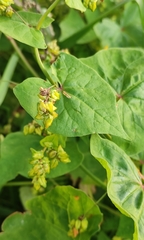 Fagopyrum tataricumt0
- Organ / stage
- shootse0
- Treatment
- low-P stresse0
- Outcome
- shoots of all genotypese0
- Direction
- more affectede0
Not reportedComparator
Organisms pictured · Representative pictures of the matched species, not figures from the paper.

Verbatim
t0“Fagopyrum tataricum”
e0“under low-P stress, the shoots of all genotypes were more affected than roots”
Claim · model-written summary
Low phosphorus reduced shoot aboveground index, average root diameter, root surface area and root volume.
- Taxon
- Fagopyrum tataricumFagopyrum tataricumt0
- Outcome
- shoot aboveground index, average root diameter, root surface area and root volumee0
- Direction
- declinee0
Not reportedTreatmentComparator
Organisms pictured · Representative pictures of the matched species, not figures from the paper.
Verbatim
t0“Fagopyrum tataricum”
e0“with the decline of shoot aboveground index, average root diameter, root surface area and root volume”
Claim · model-written summary
Low phosphorus elongated the main root.
- Taxon
- Fagopyrum tataricumFagopyrum tataricumt0
- Outcome
- length of main roote0
- Direction
- elongatede0
Not reportedTreatmentComparator
Organisms pictured · Representative pictures of the matched species, not figures from the paper.
Verbatim
t0“Fagopyrum tataricum”
e0“whereas the length of main root was elongated”
Claim · model-written summary
Root activity and soluble protein content decreased under low phosphorus.
- Taxon
- Fagopyrum tataricumFagopyrum tataricumt0
- Outcome
- Root activity and soluble protein contente0
- Direction
- decreasede0
Not reportedTreatmentComparator
Organisms pictured · Representative pictures of the matched species, not figures from the paper.
Verbatim
t0“Fagopyrum tataricum”
e0“Root activity and soluble protein content were decreased”
Claim · model-written summary
Other physiological and biochemical indicators increased.
- Taxon
- Fagopyrum tataricumFagopyrum tataricumt0
- Outcome
- other physiological and biochemical indicatorse0
- Direction
- increasede0
Not reportedTreatmentComparator
Organisms pictured · Representative pictures of the matched species, not figures from the paper.
Verbatim
t0“Fagopyrum tataricum”
e0“other physiological and biochemical indicators were increased”
Claim · model-written summary
Plant total phosphorus content and phosphorus accumulation decreased.
- Taxon
- Fagopyrum tataricumFagopyrum tataricumt0
- Outcome
- plant total phosphorus content and plant phosphorus accumulatione0
- Direction
- reducede0
Not reportedTreatmentComparator
Organisms pictured · Representative pictures of the matched species, not figures from the paper.
Verbatim
t0“Fagopyrum tataricum”
e0“plant total phosphorus content and plant phosphorus accumulation reduced”
Claim · model-written summary
Phosphorus use efficiency increased.
- Taxon
- Fagopyrum tataricumFagopyrum tataricumt0
- Outcome
- phosphorus use efficiencye0
- Direction
- increasede0
Not reportedTreatmentComparator
Organisms pictured · Representative pictures of the matched species, not figures from the paper.
Verbatim
t0“Fagopyrum tataricum”
e0“phosphorus use efficiency increased”
Claim · model-written summary
Principal component analysis reduced 22 indicators to four independent comprehensive indicators accounting for 90.1%.
- Taxon
- Fagopyrum tataricumFagopyrum tataricumt0
- Outcome
- four mutually independent comprehensive indicatorse0
- Value
- 90.1%e0
Organisms pictured · Representative pictures of the matched species, not figures from the paper.
Verbatim
t0“Fagopyrum tataricum”
e0“The principal component analysis divided the 22 individual indicators into four mutually independent comprehensive indicators (cumulative contribution rate of 90.1%)”
Claim · model-written summary
Cluster analysis classified 14 F. tataricum types into three phosphorus tolerance categories.
- Taxon
- Fagopyrum tataricumFagopyrum tataricumt0
- Outcome
- three categories: Low phosphorus tolerant, intermediate and phosphorus sensitivee0
- Value
- 14 kindse0
Organisms pictured · Representative pictures of the matched species, not figures from the paper.
Verbatim
t0“Fagopyrum tataricum”
e0“Cluster analysis divided 14 kinds of F. tataricum into three categories: Low phosphorus tolerant, intermediate and phosphorus sensitive”
Claim · model-written summary
Seven indicators were identified for rapid identification of low phosphorus tolerance at the seedling stage.
- Taxon
- Fagopyrum tataricumFagopyrum tataricumt0
- Organ / stage
- seedling stagee0
- Outcome
- rapid identification of low-P tolerancee0
- Value
- Seven indicatorse0
Organisms pictured · Representative pictures of the matched species, not figures from the paper.
Verbatim
t0“Fagopyrum tataricum”
e0“Seven indicators of root surface area, root length, plant height, aboveground dry mass, acid phosphatase, phosphorus accumulation and POD activity were examined, which could be used for the rapid identification of low-P tolerance of F. tataricum at seedling stage”