Abstract
Miridae (Hemiptera) of the tribe Dicyphini are important zoophytophagous predators use to control pest arthropods in vegetable crops. However, the risk that their herbivory may cause economic damage could hinder their application as useful biocontrol agents and may limit the likelihood they would meet regulatory requirements for importation. We conducted field cage studies to assess the predation capacity and tomato plant damage of three mirid species established in south USA, a known biocontrol agent (Nesidiocoris tenuis), and two native species (Macrolophus praeclarus and Engytatus modestus). All three species significantly reduced the number of whiteflies (Bemisia tabaci) on tomato plants compared to tomato plants without mirids. More damage, evaluated as the number of necrotic rings, was observed on tomato plants with E. modestus and N. tenuis compared to M. praeclarus. In our experiments that included sesame plants (Sesamum indicum) with tomato plants, mirid numbers increased despite a low number of prey, thus showing a benefit of the plant-feeding habit of these predators. USA’s established mirids may therefore prove to be immediately available biological agents for the management of present and future tomato pests.
Abstract from the paper’s OpenAlex record; open copy licensed cc-by. Read at the source ↗
The text the model read, with the source record’s inline markup (italics, sub- and superscripts) rendered and its character entities decoded; quote offsets refer to the raw text.
Claims 6
Claim · model-written summary
Nesidiocoris tenuis reduced whiteflies on tomato compared with no mirids.
- Taxon
- tomato
 Solanum lycopersicume0
- Treatment
- Nesidiocoris tenuise1
- Interactor
- Bemisia tabaci
 Bemisia tabacie0pest
- Second interactor
- Nesidiocoris tenuis
 Nesidiocoris tenuise1biocontrol_agent
- Outcome
- number of whiteflies (Bemisia tabaci)e0
- Direction
- reducede0
- Comparator
- tomato plants without miridse0
Organisms pictured · Representative pictures of the matched species, not figures from the paper.


Verbatim
e0“All three species significantly reduced the number of whiteflies (Bemisia tabaci) on tomato plants compared to tomato plants without mirids.”
e1“Nesidiocoris tenuis”
Claim · model-written summary
Macrolophus praeclarus reduced whiteflies on tomato compared with no mirids.
- Taxon
- tomatoSolanum lycopersicume0
- Treatment
- Macrolophus praeclaruse1
- Interactor
- Bemisia tabaciBemisia tabacie0pest
- Second interactor
- Macrolophus praeclarus
 Macrolophus praeclaruse1biocontrol_agent
- Outcome
- number of whiteflies (Bemisia tabaci)e0
- Direction
- reducede0
- Comparator
- tomato plants without miridse0
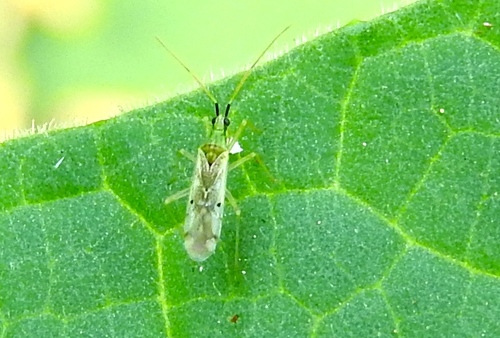
Organisms pictured · Representative pictures of the matched species, not figures from the paper.
Verbatim
e0“All three species significantly reduced the number of whiteflies (Bemisia tabaci) on tomato plants compared to tomato plants without mirids.”
e1“Macrolophus praeclarus”
Claim · model-written summary
Engytatus modestus reduced whiteflies on tomato compared with no mirids.
- Taxon
- tomatoSolanum lycopersicume0
- Treatment
- Engytatus modestuse1
- Interactor
- Bemisia tabaciBemisia tabacie0pest
- Second interactor
- Engytatus modestuse1biocontrol_agent
- Outcome
- number of whiteflies (Bemisia tabaci)e0
- Direction
- reducede0
- Comparator
- tomato plants without miridse0
Organisms pictured · Representative pictures of the matched species, not figures from the paper.
Verbatim
e0“All three species significantly reduced the number of whiteflies (Bemisia tabaci) on tomato plants compared to tomato plants without mirids.”
e1“Engytatus modestus”
Claim · model-written summary
E. modestus caused more tomato necrotic rings than M. praeclarus.
- Taxon
- tomatoSolanum lycopersicume0
- Treatment
- E. modestuse0
- Interactor
- E. modestuse0herbivore
- Outcome
- number of necrotic ringse0
- Direction
- Moree0
- Comparator
- M. praeclaruse0
Organisms pictured · Representative pictures of the matched species, not figures from the paper.
Verbatim
e0“More damage, evaluated as the number of necrotic rings, was observed on tomato plants with E. modestus and N. tenuis compared to M. praeclarus.”
Claim · model-written summary
N. tenuis caused more tomato necrotic rings than M. praeclarus.
- Taxon
- tomatoSolanum lycopersicume0
- Treatment
- N. tenuise0
- Interactor
- N. tenuisNesidiocoris tenuise0herbivore
- Outcome
- number of necrotic ringse0
- Direction
- Moree0
- Comparator
- M. praeclaruse0
Organisms pictured · Representative pictures of the matched species, not figures from the paper.
Verbatim
e0“More damage, evaluated as the number of necrotic rings, was observed on tomato plants with E. modestus and N. tenuis compared to M. praeclarus.”
Claim · model-written summary
Adding sesame alongside tomato increased mirid numbers despite scarce prey.
- Taxon
- sesame
 Sesamum indicume0
- Treatment
- sesame plants (Sesamum indicum) with tomato plantse0
- Interactor
- miride0biocontrol_agent
- Outcome
- mirid numberse0
- Direction
- increasede0
- Qualifier
- despite a low number of preye0
Not reportedComparator
Organisms pictured · Representative pictures of the matched species, not figures from the paper.

Verbatim
e0“In our experiments that included sesame plants (Sesamum indicum) with tomato plants, mirid numbers increased despite a low number of prey”
The same questions in other papers
Nesidiocoris tenuis · Bemisia tabaci · Solanum lycopersicum (tomato)Results agree
5 papers in the same direction as this paper
- positive
- positive
- positive
2 papers more in this group
See all 6 papers →Claims are grouped by organism, treatment and what was measured or targeted. A paper counts as positive when any of its claims in the group is positive.