Abstract
Abstract Aim In a context of successive fruit fly invasions (Tephritidae), this study investigated how the top invader, Bactrocera dorsalis , displaced established fruit fly populations. We focused, particularly, on how this invasion impacted the host range and climatic niche of each resident species. Location La Réunion, France, Indian Ocean. Methods We collected fruit from more than 100 plant species across the island, in cultivated and non‐cultivated areas at different altitudes in order to monitor the emergence of fruit flies. Fruit collection was conducted over two field campaigns: from 2001 to 2009, before the B. dorsalis invasion; and from 2018 to 2019, after the B. dorsalis invasion. We compared the distribution and host range of fruit fly species for the two periods. Results Our results confirmed the generalist character of B. dorsalis , with the infestation of 52 out of 112 of the fruit species collected in the field. After the B. dorsalis invasion, we observed a shift in the host range and spatial distribution of established tephritids. The host range of specialist species that only share a few host species with B. dorsalis did not change significantly. On the contrary, we observed a significant shift in diversity or proportion of host range and climatic niches for the generalist species, such as Bactrocera zonata , Ceratitis quilicii and Ceratitis capitata . Main conclusions We provide evidence of the competitive displacement induced by B . dorsalis on other established species. The coexistence between B . dorsalis and generalist Ceratitis species seems possible because they have different responses to climatic conditions or the capacity to exploit other host fruit species. In contrast, the coexistence of B . zonata with B . dorsalis seems to be compromised because both species have similar ecological requirements. This research provides useful information for managing invasions, particularly since understanding competitive displacements is essential for the identification of empty niches and for modelling potential species distribution.
Abstract from the paper’s OpenAlex record; open copy licensed cc-by. Read at the source ↗
The text the model read, with the source record’s inline markup (italics, sub- and superscripts) rendered and its character entities decoded; quote offsets refer to the raw text.
Claims 7
Claim · model-written summary
Bactrocera dorsalis infested 52 of 112 fruit species collected in the field.
- Taxon
- fruit speciese2
- Interactor
- B . dorsalis
 Bactrocera dorsalise2pest
- Outcome
- infestatione2
- Value
- 52 out of 112e2
Not reportedDirection
Organisms pictured · Representative pictures of the matched species, not figures from the paper.

Verbatim
e2“Our results confirmed the generalist character of B . dorsalis , with the infestation of 52 out of 112 of the fruit species collected in the field”
Claim · model-written summary
After the B. dorsalis invasion, the host range and spatial distribution of established tephritids shifted.
Verbatim
e2“Our results confirmed the generalist character of B . dorsalis , with the infestation of 52 out of 112 of the fruit species collected in the field”
e3“After the B . dorsalis invasion, we observed a shift in the host range and spatial distribution of established tephritids”
Claim · model-written summary
The host range of specialist species that share only a few host species with B. dorsalis did not change significantly.
Verbatim
e2“Our results confirmed the generalist character of B . dorsalis , with the infestation of 52 out of 112 of the fruit species collected in the field”
e4“The host range of specialist species that only share a few host species with B . dorsalis did not change significantly”
Claim · model-written summary
The diversity or proportion of host range and climatic niches shifted significantly for the generalist species Bactrocera zonata and Ceratitis quilicii.
- Taxon
- fruit speciese2
- Interactor
- Bactrocera zonata
 Bactrocera zonatae5pest
- Second interactor
- Ceratitis quilicii
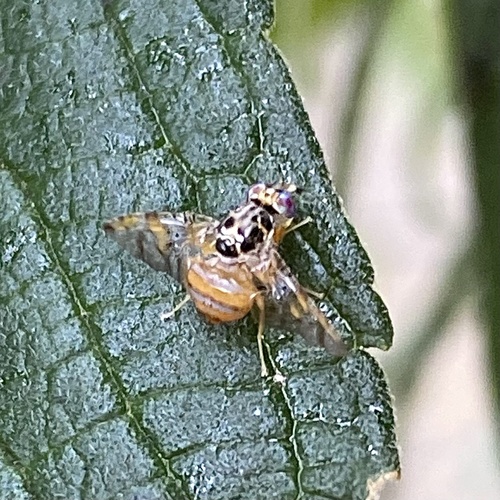
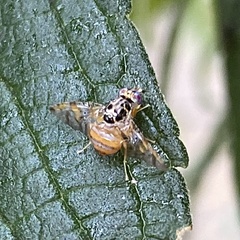 Ceratitis quiliciie5pest
- Outcome
- diversity or proportion of host range and climatic nichese5
- Direction
- shifte5
- Qualifier
- such as Bactrocera zonata, Ceratitis quilicii and Ceratitis capitatae5
Organisms pictured · Representative pictures of the matched species, not figures from the paper.

Verbatim
e2“Our results confirmed the generalist character of B . dorsalis , with the infestation of 52 out of 112 of the fruit species collected in the field”
e5“On the contrary, we observed a significant shift in diversity or proportion of host range and climatic niches for the generalist species, such as Bactrocera zonata , Ceratitis quilicii and Ceratitis capitata”
Claim · model-written summary
The results provide evidence of competitive displacement of other established species induced by B. dorsalis.
- Taxon
- fruit speciese2
- Interactor
- B . dorsalisBactrocera dorsalise6pest
- Outcome
- competitive displacemente6
Organisms pictured · Representative pictures of the matched species, not figures from the paper.
Verbatim
e2“Our results confirmed the generalist character of B . dorsalis , with the infestation of 52 out of 112 of the fruit species collected in the field”
e6“We provide evidence of the competitive displacement induced by B . dorsalis on other established species”
Claim · model-written summary
Coexistence of B. dorsalis and generalist Ceratitis species seems possible because they respond differently to climatic conditions or can exploit other host fruit species.
- Taxon
- fruit speciese2
- Interactor
- B . dorsalisBactrocera dorsalise7pest
- Second interactor
- generalist Ceratitis speciese7pest
- Outcome
- coexistence between B . dorsalis and generalist Ceratitis speciese7
- Qualifier
- different responses to climatic conditions or the capacity to exploit other host fruit speciese7
Organisms pictured · Representative pictures of the matched species, not figures from the paper.
Verbatim
e2“Our results confirmed the generalist character of B . dorsalis , with the infestation of 52 out of 112 of the fruit species collected in the field”
e7“The coexistence between B . dorsalis and generalist Ceratitis species seems possible because they have different responses to climatic conditions or the capacity to exploit other host fruit species”
Claim · model-written summary
Coexistence of B. zonata with B. dorsalis seems compromised because both species have similar ecological requirements.
- Taxon
- fruit speciese2
- Interactor
- B . zonataBactrocera zonatae5pest
- Second interactor
- B . dorsalisBactrocera dorsalise5pest
- Outcome
- coexistence of B . zonata with B . dorsalise5
- Qualifier
- similar ecological requirementse5
Organisms pictured · Representative pictures of the matched species, not figures from the paper.
Verbatim
e2“Our results confirmed the generalist character of B . dorsalis , with the infestation of 52 out of 112 of the fruit species collected in the field”
e5“In contrast, the coexistence of B . zonata with B . dorsalis seems to be compromised because both species have similar ecological requirements”