Abstract
Take-all disease is primarily caused by a soil-borne fungus Gaeumannomyces graminis var.tritici(Ggt).The disease common root rot is mainly caused by fungal pathogen Bipolaris sorokiniana(teleomorph Cochliobolus sativus).Both of them are important diseases of wheat(Triticum aestivum L.) worldwide.PgPGIP1,a polygalacturonase-inhibiting protein from Panax ginseng,can reduce the infection of some fungal phytopathogens through inhibiting the polygalacturonase activity of the pathogens.In this study,the full-length coding sequence of PgPGIP1 gene was synthesized,and the gene transformation vector pA25-PgPGIP1 was constructed.In the expression vector pA25-PgPGIP1,the PgPGIP1 gene can be expressed highly in monocot plants driving by maize ubiquitin promoter.Embryo callus of Yangmai 18 was bombarded by the gold particle containing pA25-PgPGIP1.The transgenic wheat plants from T0 to T4 generations were subjected to PCR,RT-PCR,and Q-RT-PCR assays.Results showed that the PgPGIP1 gene was indeed introduced into four transgenic wheat lines,and inherited from T0 to T4 generations and expressed.After inoculation with Ggt and B.sorokiniana,the disease evaluations showed that the four transgenic wheat lines expressing PgPGIP1 displayed an enhanced resistances to take-all and common root rot compared with untransformed Yangmai 18.
Abstract from the paper’s OpenAlex record, shown for indexing and research. Copyright remains with the authors or the publisher.
The text the model read, with the source record’s inline markup (italics, sub- and superscripts) rendered and its character entities decoded; quote offsets refer to the raw text.
Claims 4
Claim · model-written summary
PgPGIP1 was introduced into four wheat lines and inherited through T4.
- Taxon
- wheat
 Triticum aestivume0
- Material
- four transgenic wheat linese0
- Gene
- PgPGIP1e0
- Outcome
- inherited from T0 to T4 generationse0
Organisms pictured · Representative pictures of the matched species, not figures from the paper.

Verbatim
e0“the PgPGIP1 gene was indeed introduced into four transgenic wheat lines,and inherited from T0 to T4 generations and expressed.”
Claim · model-written summary
PgPGIP1 was expressed in four transgenic wheat lines.
- Taxon
- wheatTriticum aestivume0
- Material
- four transgenic wheat linese0
- Gene
- PgPGIP1e0
- Outcome
- expressede0
Organisms pictured · Representative pictures of the matched species, not figures from the paper.
Verbatim
e0“the PgPGIP1 gene was indeed introduced into four transgenic wheat lines,and inherited from T0 to T4 generations and expressed.”
Claim · model-written summary
PgPGIP1 wheat lines had enhanced take-all resistance versus untransformed Yangmai 18 after Ggt inoculation.
- Taxon
- wheatTriticum aestivume0
- Treatment
- inoculation with Ggte0
- Interactor
- Ggte0pathogen
- Gene
- PgPGIP1e0
- Outcome
- take-alle0
- Direction
- enhanced resistancese0
- Comparator
- untransformed Yangmai 18e0
Organisms pictured · Representative pictures of the matched species, not figures from the paper.
Verbatim
e0“After inoculation with Ggt and B.sorokiniana,the disease evaluations showed that the four transgenic wheat lines expressing PgPGIP1 displayed an enhanced resistances to take-all and common root rot compared with untransformed Yangmai 18.”
Claim · model-written summary
PgPGIP1 wheat lines had enhanced common root rot resistance versus untransformed Yangmai 18 after B. sorokiniana inoculation.
- Taxon
- wheatTriticum aestivume0
- Treatment
- B.sorokinianae0
- Interactor
- B.sorokiniana
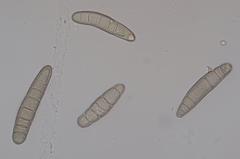 Bipolaris sorokinianae0pathogen
- Gene
- PgPGIP1e0
- Outcome
- common root rote0
- Direction
- enhanced resistancese0
- Comparator
- untransformed Yangmai 18e0
Organisms pictured · Representative pictures of the matched species, not figures from the paper.
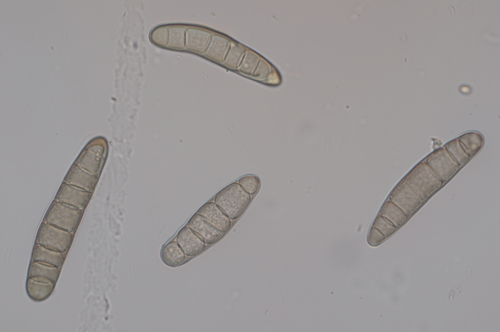
Verbatim
e0“After inoculation with Ggt and B.sorokiniana,the disease evaluations showed that the four transgenic wheat lines expressing PgPGIP1 displayed an enhanced resistances to take-all and common root rot compared with untransformed Yangmai 18.”
The same questions in other papers
Bipolaris sorokiniana · disease · Triticum aestivum (wheat)Positive and negative results
1 paper in the same direction as this paper · 2 in the opposite direction
- negative
- negative
- positive
Claims are grouped by organism, treatment and what was measured or targeted. A paper counts as positive when any of its claims in the group is positive.