Abstract
Abstract Background The medicinal plant Ficus carica L., inhabiting southwest regions of Asia, is known for its wide ethnopharmacological applications. In traditional medicine, it has been applied as a treatment of respiratory, gastrointestinal and cardiovascular disorders, among others. Recent studies confirmed antimicrobial and anticancer activities for the plant extract. To find out whether endophytes of F. carica contribute to its biological activities, endophytes of the aerial parts of the plant were isolated and examined for anticancer and antimicrobial effects. Results The isolated species were identified as Chaetomium globosum , Penicillium oxalicum, Alternaria alternata, Fusarium proliferatum and Aspergillus neoniger. An anticancer assay was carried out on the extracts of fungal strains against human umbilical vein endothelial cells (HUVEC), human immortalized myelogenous leukemia cell line (K-562) and human immortal cervical cancer cell line (HeLa). Results revealed antiproliferative effects for all endophytic strains against HUVEC and K-562 with GI 50 values ranging from 4.75 to 13.75 µg mL −1 as well as cytotoxicity against HeLa with CC 50 ranging from 8.25 to 18.75 µg mL −1 . The antimicrobial activity of the extracts was tested against several test strains in agar diffusion assay, and MIC values were determined by the broth microdilution method. All strain extracts exerted antibacterial and antifungal activities with highest antifungal effect observed for A. neoniger extract (MIC = 3.75 µg mL −1 ). Conclusions These results support the assumption that endophytes of F. carica contribute to the plant’s reported antimicrobial and anticancer activities and its corresponding applications in traditional medicine.
Abstract from the paper’s OpenAlex record; open copy licensed cc-by. Read at the source ↗
The text the model read, with the source record’s inline markup (italics, sub- and superscripts) rendered and its character entities decoded; quote offsets refer to the raw text.
Claims 7
Claim · model-written summary
The first three endophytes isolated from Ficus carica aerial parts were identified as Chaetomium globosum, Penicillium oxalicum and Alternaria alternata.
- Taxon
- Ficus carica
 Ficus caricat0
- Interactor
- Chaetomium globosum , Penicillium oxalicum, Alternaria alternata
 Alternaria alternata
 Chaetomium globosum
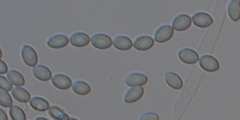 Penicillium oxalicume0symbiont
- Outcome
- isolated speciese0
Organisms pictured · Representative pictures of the matched species, not figures from the paper.


Verbatim
e0“The isolated species were identified as Chaetomium globosum , Penicillium oxalicum, Alternaria alternata”
t0“endophytes of Ficus carica”
Claim · model-written summary
Two further endophytes isolated from Ficus carica were identified as Fusarium proliferatum and Aspergillus neoniger.
- Taxon
- Ficus caricaFicus caricat0
- Interactor
- Fusarium proliferatum and Aspergillus neonigerFusarium proliferatum
 Aspergillus neonigere1symbiont
- Outcome
- isolated speciese0
Organisms pictured · Representative pictures of the matched species, not figures from the paper.

Verbatim
e0“The isolated species were identified as”
e1“Fusarium proliferatum and Aspergillus neoniger”
t0“endophytes of Ficus carica”
Claim · model-written summary
Extracts of all endophytic strains had antiproliferative effects against HUVEC and K-562 cells with GI50 values of 4.75 to 13.75 ug/mL.
- Taxon
- Ficus caricaFicus caricat0
- Treatment
- endophytic strainse0
- Outcome
- antiproliferative effectse0
- Value
- 4.75 to 13.75 µg mL −1e0
Not reportedComparatorDirection
Organisms pictured · Representative pictures of the matched species, not figures from the paper.
Verbatim
e0“antiproliferative effects for all endophytic strains against HUVEC and K-562 with GI 50 values ranging from 4.75 to 13.75 µg mL −1”
t0“endophytes of Ficus carica”
Claim · model-written summary
Extracts of the endophytic strains were cytotoxic against HeLa cells with CC50 values of 8.25 to 18.75 ug/mL.
- Taxon
- Ficus caricaFicus caricat0
- Treatment
- HeLae0
- Outcome
- cytotoxicitye0
- Value
- 8.25 to 18.75 µg mL −1e0
Not reportedComparatorDirection
Organisms pictured · Representative pictures of the matched species, not figures from the paper.
Verbatim
e0“cytotoxicity against HeLa with CC 50 ranging from 8.25 to 18.75 µg mL −1”
t0“endophytes of Ficus carica”
Claim · model-written summary
All endophyte strain extracts exerted antibacterial and antifungal activities.
- Taxon
- Ficus caricaFicus caricat0
- Outcome
- antibacterial and antifungal activitiese0
Organisms pictured · Representative pictures of the matched species, not figures from the paper.
Verbatim
e0“All strain extracts exerted antibacterial and antifungal activities”
t0“endophytes of Ficus carica”
Claim · model-written summary
The Aspergillus neoniger extract had the highest antifungal effect, with an MIC of 3.75 ug/mL.
- Taxon
- Ficus caricaFicus caricat0
- Interactor
- A. neonigerAspergillus neonigere0symbiont
- Outcome
- antifungal effecte0
- Direction
- higheste0
- Value
- 3.75 µg mL −1e0
Organisms pictured · Representative pictures of the matched species, not figures from the paper.
Verbatim
e0“highest antifungal effect observed for A. neoniger extract (MIC = 3.75 µg mL −1 )”
t0“endophytes of Ficus carica”
Claim · model-written summary
The results are taken to support the assumption that endophytes of F. carica contribute to the plant reported antimicrobial and anticancer activities.
- Taxon
- F. caricaFicus caricae0
- Interactor
- endophytese0symbiont
- Outcome
- antimicrobial and anticancer activitiese0
Organisms pictured · Representative pictures of the matched species, not figures from the paper.
Verbatim
e0“endophytes of F. carica contribute to the plant’s reported antimicrobial and anticancer activities”