Abstract
Chemical insecticides have many harmful effects, including as foodborne residues and environmental contaminants, as well as side effects on natural enemies and serious risks for human health. The use of plant-derived essential oils (EOs) as effective bio-agents has become an essential component of integrated pest management. In this study, the contact toxicity, deterrent, and repellent activities were evaluated for essential oils obtained from Mentha piperita, Mentha longifolia, Salvia officinalis, and Salvia rosmarinus, grown at high altitudes in the Taif region, KSA, on Aphis punicae. Furthermore, the toxicity of these EOs against the predator Coccinella undecimpunctata was estimated. A total of 17, 14, 16, and 26 compounds were identified in the EOs of M. piperita, M. longifolia, S. officinalis, and S. rosmarinus, respectively. They showed a variation in the major compounds: M. piperita (Carvone, 61.16%), M. longifolia (Pulegone, 48.6%), S. officinalis (Eucalyptol, 33.52%), and S. rosmarinus (α-pinene, 36.65%). A contact toxicity test on A. punicae imago and C. undecimpunctata larvae showed that LC50 were approximately four-fold greater for all tested EOs towards aphids compared to towards the predator, while the two species of Salvia sp. were more effective than the other two species of Mentha sp. The LC50 values on A. punicae ranged from 1.57 to 2.97 µg/mL, while on C. undecimpunctata larvae, they ranged from 5.96 to 10.33 µg/mL. Furthermore, the EOs of two species of Salvia sp. showed excellent repellence and deterrence against A. punicae. In conclusion, the tested EOs, especially those from Salvia sp., have been shown to be promising natural aphicides, repellent, and deterrent against A. punicae, and they are safe for important insect predators.
Abstract from the paper’s OpenAlex record; open copy licensed cc-by. Read at the source ↗
The text the model read, with the source record’s inline markup (italics, sub- and superscripts) rendered and its character entities decoded; quote offsets refer to the raw text.
Claims 13
Claim · model-written summary
Mentha piperita essential oil contained 17 identified compounds.
- Taxon
- M. piperita
 Mentha ×piperitae0
- Outcome
- compounds were identifiede0
- Value
- 17e0
Organisms pictured · Representative pictures of the matched species, not figures from the paper.

Verbatim
e0“A total of 17, 14, 16, and 26 compounds were identified in the EOs of M. piperita, M. longifolia, S. officinalis, and S. rosmarinus, respectively.”
Claim · model-written summary
Mentha longifolia essential oil contained 14 identified compounds.
- Taxon
- M. longifolia
 Mentha longifoliae0
- Outcome
- compounds were identifiede0
- Value
- 14e0
Organisms pictured · Representative pictures of the matched species, not figures from the paper.

Verbatim
e0“A total of 17, 14, 16, and 26 compounds were identified in the EOs of M. piperita, M. longifolia, S. officinalis, and S. rosmarinus, respectively.”
Claim · model-written summary
Salvia officinalis essential oil contained 16 identified compounds.
- Taxon
- S. officinalis
 Salvia officinalise0
- Outcome
- compounds were identifiede0
- Value
- 16e0
Organisms pictured · Representative pictures of the matched species, not figures from the paper.

Verbatim
e0“A total of 17, 14, 16, and 26 compounds were identified in the EOs of M. piperita, M. longifolia, S. officinalis, and S. rosmarinus, respectively.”
Claim · model-written summary
Salvia rosmarinus essential oil contained 26 identified compounds.
- Taxon
- S. rosmarinus
 Salvia rosmarinuse0
- Outcome
- compounds were identifiede0
- Value
- 26e0
Organisms pictured · Representative pictures of the matched species, not figures from the paper.

Verbatim
e0“A total of 17, 14, 16, and 26 compounds were identified in the EOs of M. piperita, M. longifolia, S. officinalis, and S. rosmarinus, respectively.”
Claim · model-written summary
Carvone was the major compound in Mentha piperita oil at 61.16%.
- Taxon
- M. piperitaMentha ×piperitae0
- Outcome
- Carvonee0
- Value
- 61.16%e0
Organisms pictured · Representative pictures of the matched species, not figures from the paper.
Verbatim
e0“M. piperita (Carvone, 61.16%)”
Claim · model-written summary
Pulegone was the major compound in Mentha longifolia oil at 48.6%.
- Taxon
- M. longifoliaMentha longifoliae0
- Outcome
- Pulegonee0
- Value
- 48.6%e0
Organisms pictured · Representative pictures of the matched species, not figures from the paper.
Verbatim
e0“M. longifolia (Pulegone, 48.6%)”
Claim · model-written summary
Eucalyptol was the major compound in Salvia officinalis oil at 33.52%.
- Taxon
- S. officinalisSalvia officinalise0
- Outcome
- Eucalyptole0
- Value
- 33.52%e0
Organisms pictured · Representative pictures of the matched species, not figures from the paper.
Verbatim
e0“S. officinalis (Eucalyptol, 33.52%)”
Claim · model-written summary
Alpha-pinene was the major compound in Salvia rosmarinus oil at 36.65%.
- Taxon
- S. rosmarinusSalvia rosmarinuse0
- Outcome
- α-pinenee0
- Value
- 36.65%e0
Organisms pictured · Representative pictures of the matched species, not figures from the paper.
Verbatim
e0“S. rosmarinus (α-pinene, 36.65%)”
Claim · model-written summary
Tested oils had approximately four-fold greater aphid LC50 than predator LC50, as stated.
Not reportedTaxon
Verbatim
e0“LC50 were approximately four-fold greater for all tested EOs towards aphids compared to towards the predator”
Claim · model-written summary
Salvia oils were more effective than Mentha oils in the contact toxicity test.
 Salvia
Organisms pictured · Representative pictures of the matched species, not figures from the paper.

Verbatim
e0“the two species of Salvia sp. were more effective than the other two species of Mentha sp.”
Claim · model-written summary
Aphid LC50 values for the oils ranged from 1.57 to 2.97 µg/mL.
Not reportedTaxon
Verbatim
e0“The LC50 values on A. punicae ranged from 1.57 to 2.97 µg/mL”
Claim · model-written summary
Predator larval LC50 values for the oils ranged from 5.96 to 10.33 µg/mL.
Not reportedTaxon
Verbatim
e0“on C. undecimpunctata larvae, they ranged from 5.96 to 10.33 µg/mL”
Claim · model-written summary
Salvia oils showed strong aphid repellence and deterrence.
- Interactor
- A. punicae
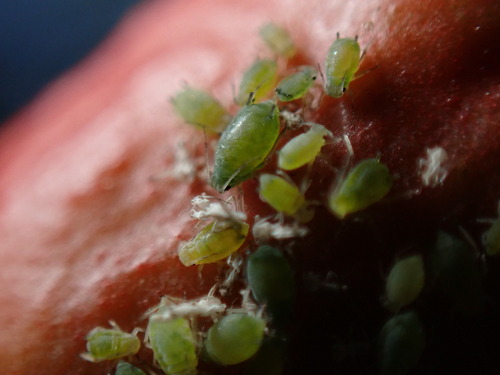
 Aphis punicaee0pest
- Outcome
- repellence and deterrencee0
Organisms pictured · Representative pictures of the matched species, not figures from the paper.
Verbatim
e0“the EOs of two species of Salvia sp. showed excellent repellence and deterrence against A. punicae.”