Abstract
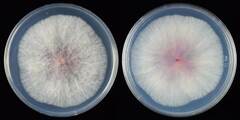
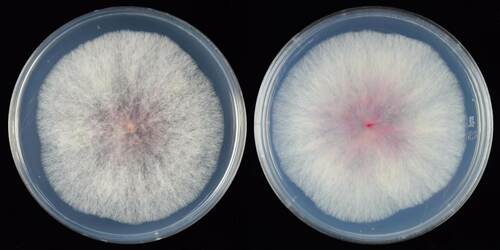
As an important cultivated germplasm, cultivar 'White' (Actinidia eriantha) is appreciated by kiwifruit breeders because of its long shelf life, richness in ascorbic acid and peelable skin. In May 2020, about 1% to 3% of cultivated 'White' plants displayed typical symptoms of flower rot at farms in Hefei (117°25'E, 31°86'N) and Lujiang (117°27'E, 31°48'N), Anhui Province of China (Fig.1a&b). The infected flowers were yellowish at first, gradually turned brown, withered and shrunk, and finally died without blossoming. Infected flowers were surface sterilized in 70% alcohol for 30 s and 1% NaOCl for 3 min, then washed with double distilled water (ddH2O) for 5 times, and finally incubated in potato dextrose agar at 25 ± 2°C in the dark. Twenty fungal isolates were obtained and their colonies showed slightly raised center with dense and cotton-like mycelium. Colonies from Hefei (HF1~HF9) appeared pale yellow (Fig.1c), and those from Lujiang (LJ1~LJ11) showed purplish-red on PDA (Fig.1d). Two types of colonies grown on oatmeal agar were flat with few aerial hyphae (Fig.1e&f). On carnation leaf agar (CLA), isolate of HF1 produced abundant slightly curved macroconidia with 3 to 6 septa, 4.3-5.5×20.7-42.5 µm in size (n=100) (Fig.1g&h), without microconidia and chlamydospores observed. By contrast, macroconidia derived from LJ1 isolate were straight to slightly curved with 3 to 5 septa, 4.0-6.58×21.70-71.10 µm (n=100) in size (Fig.1i); Its chlamydospores were globose to subglobose (5.1 to 9.5 µm) on CLA (Fig.1j). Pathogenicity tests were performed on A. eriantha cv. 'White' flowers. The conidia suspension (105 spore/ml, 30 μL/flower) derived from the HF1 and LJ1 were separately dripped on flowers (n=100). Control flowers were treated with ddH2O. Two-week post-inoculation, all inoculated flowers were turned brown and withered (Fig.1k&m), whereas no symptoms were observed on the controls (Fig.1l&n). This experiment was repeated three times. All isolated and re-isolated pathogens from diseased flowers were subjected to molecular identification. Different molecular markers, including internal transcribed spacers (ITS), translation elongation factor (TEF-1α), calmodulin (CaM), RNA polymerase II subunit 1 (RPB1) gene and RNA polymerase II largest subunit (RPB2) gene, were amplified and sequenced to validate species identification (White et al. 1990; O'Donnell, et al. 1998; O'Donnell, et al. 2012). Based on sequence analysis, the re-isolated strains were identical to the inoculated individuals. Sequences of HF1 and HF2 or LJ1 and LJ2 were deposited in GenBank under accession numbers OK310710 to OK310713 (ITS), OK334291 to OK334294 (TEF-1α), OK412973 to OK412976 (CaM), OK412977 to OK412980 (RPB1), and OK484317 to OK484320 (RPB2), respectively. The BLAST search showed that the sequences of HF1 and HF2 showed 99 to 100% identity with ITS (NR_164594), TEF-1α (MK289601), CaM (MK289698), RPB1 (HM347158), and RPB2 (MK289754) of Fusarium luffae isolates. The sequences of LJ1 and LJ2 also revealed 99 to 100% identity with ITS (NR_121320), TEF-1α (AF212452), RPB1 (JX171459), and RPB2 (MW233412) of F. asiaticum isolates. F. asiaticum species-specific primers were used to detect LJ isolates (Yin et al. 2009), and the correct fragments were amplified (Fig.1o). Phylogenetic trees were constructed based on the tandem nucleotide sequences. Thus, both morphological and molecular criteria supported identification of HF group as F. Luffae (Fig.2a) and LJ group as F. asiaticum (Fig.2b). Fusarium spp. causing flower rot on many hosts have been previously reported (W. Elmer, et al. 2019; Liu, et al. 2021), but this is the first report of F. luffae and F. asiaticum on 'White' kiwifruit in China.
Abstract from the paper’s OpenAlex record, shown for indexing and research. Copyright remains with the authors or the publisher. Read at the source ↗
The text the model read, with the source record’s inline markup (italics, sub- and superscripts) rendered and its character entities decoded; quote offsets refer to the raw text.
Claims 11
Claim · model-written summary
F. luffae isolate HF1 conidia caused brown, withered flowers two weeks after inoculation, whereas controls showed no symptoms.
- Taxon
- Actinidia eriantha
 Actinidia erianthae1
- Material
- 'White'e1
- Organ / stage
- flowerse3
- Treatment
- conidia suspensione2
- Interactor
- F. luffaeFusarium luffaee5pathogen
- Outcome
- brown and witherede3
- Comparator
- ddH2Oe4
Not reportedDirection
Organisms pictured · Representative pictures of the matched species, not figures from the paper.

Verbatim
e1“cultivar 'White' (Actinidia eriantha)”
e2“The conidia suspension (105 spore/ml, 30 μL/flower) derived from the HF1 and LJ1 were separately dripped on flowers (n=100)”
e3“Two-week post-inoculation, all inoculated flowers were turned brown and withered (Fig.1k&m), whereas no symptoms were observed on the controls (Fig.1l&n)”
e4“Control flowers were treated with ddH2O”
e5“this is the first report of F. luffae and F. asiaticum on 'White' kiwifruit in China”
Claim · model-written summary
F. asiaticum isolate LJ1 conidia caused brown, withered flowers two weeks after inoculation, whereas controls showed no symptoms.
- Taxon
- Actinidia erianthaActinidia erianthae1
- Material
- 'White'e1
- Organ / stage
- flowerse3
- Treatment
- conidia suspensione2
- Interactor
- F. asiaticum
 Fusarium asiaticume5pathogen
- Outcome
- brown and witherede3
- Comparator
- ddH2Oe4
Not reportedDirection
Organisms pictured · Representative pictures of the matched species, not figures from the paper.
Verbatim
e1“cultivar 'White' (Actinidia eriantha)”
e2“The conidia suspension (105 spore/ml, 30 μL/flower) derived from the HF1 and LJ1 were separately dripped on flowers (n=100)”
e3“Two-week post-inoculation, all inoculated flowers were turned brown and withered (Fig.1k&m), whereas no symptoms were observed on the controls (Fig.1l&n)”
e4“Control flowers were treated with ddH2O”
e5“this is the first report of F. luffae and F. asiaticum on 'White' kiwifruit in China”
Claim · model-written summary
F. luffae is reported for the first time as a cause of flower rot on White kiwifruit in China.
- Taxon
- 'White' kiwifruite5
- Interactor
- F. luffaeFusarium luffaee5pathogen
- Outcome
- first reporte5
Verbatim
e1“cultivar 'White' (Actinidia eriantha)”
e5“this is the first report of F. luffae and F. asiaticum on 'White' kiwifruit in China”
Claim · model-written summary
F. asiaticum is reported for the first time as a cause of flower rot on White kiwifruit in China.
- Taxon
- 'White' kiwifruite5
- Interactor
- F. asiaticumFusarium asiaticume5pathogen
- Outcome
- first reporte5
Organisms pictured · Representative pictures of the matched species, not figures from the paper.
Verbatim
e1“cultivar 'White' (Actinidia eriantha)”
e5“this is the first report of F. luffae and F. asiaticum on 'White' kiwifruit in China”
Claim · model-written summary
Morphological and molecular criteria identified the HF group as F. luffae.
- Taxon
- Actinidia erianthaActinidia erianthae1
- Interactor
- F. Luffaee6pathogen
- Outcome
- identificatione6
- Qualifier
- both morphological and molecular criteriae6
Organisms pictured · Representative pictures of the matched species, not figures from the paper.
Verbatim
e1“cultivar 'White' (Actinidia eriantha)”
e6“both morphological and molecular criteria supported identification of HF group as F. Luffae (Fig.2a) and LJ group as F. asiaticum (Fig.2b)”
Claim · model-written summary
Morphological and molecular criteria identified the LJ group as F. asiaticum.
- Taxon
- Actinidia erianthaActinidia erianthae1
- Interactor
- F. asiaticumFusarium asiaticume6pathogen
- Outcome
- identificatione6
- Qualifier
- both morphological and molecular criteriae6
Organisms pictured · Representative pictures of the matched species, not figures from the paper.
Verbatim
e1“cultivar 'White' (Actinidia eriantha)”
e6“both morphological and molecular criteria supported identification of HF group as F. Luffae (Fig.2a) and LJ group as F. asiaticum (Fig.2b)”
Claim · model-written summary
Isolate HF1 produced macroconidia 4.3-5.5×20.7-42.5 µm with 3 to 6 septa on carnation leaf agar.
- Taxon
- Actinidia erianthaActinidia erianthae1
- Interactor
- HF1Haloferacalesvirus HF1e7pathogen
- Outcome
- macroconidiae7
- Value
- 4.3-5.5×20.7-42.5 µme7
Organisms pictured · Representative pictures of the matched species, not figures from the paper.
Verbatim
e1“cultivar 'White' (Actinidia eriantha)”
e7“On carnation leaf agar (CLA), isolate of HF1 produced abundant slightly curved macroconidia with 3 to 6 septa, 4.3-5.5×20.7-42.5 µm in size (n=100)”
Claim · model-written summary
Isolate LJ1 produced straight to slightly curved macroconidia 4.0-6.58×21.70-71.10 µm with 3 to 5 septa.
- Taxon
- Actinidia erianthaActinidia erianthae1
- Interactor
- LJ1e6pathogen
- Outcome
- macroconidiae6
- Value
- 4.0-6.58×21.70-71.10 µme6
Organisms pictured · Representative pictures of the matched species, not figures from the paper.
Verbatim
e1“cultivar 'White' (Actinidia eriantha)”
e6“macroconidia derived from LJ1 isolate were straight to slightly curved with 3 to 5 septa, 4.0-6.58×21.70-71.10 µm (n=100) in size”
Claim · model-written summary
Chlamydospores of the LJ1 isolate were globose to subglobose, 5.1 to 9.5 µm.
- Taxon
- Actinidia erianthaActinidia erianthae1
- Outcome
- chlamydosporese6
- Value
- 5.1 to 9.5 µme6
Organisms pictured · Representative pictures of the matched species, not figures from the paper.
Verbatim
e1“cultivar 'White' (Actinidia eriantha)”
e6“Its chlamydospores were globose to subglobose (5.1 to 9.5 µm) on CLA”
Claim · model-written summary
HF1 and HF2 sequences showed 99 to 100% identity with the ITS sequence of F. luffae.
- Taxon
- Actinidia erianthaActinidia erianthae1
- Interactor
- F. luffaeFusarium luffaee5pathogen
- Outcome
- identitye6
- Value
- 99 to 100%e6
Organisms pictured · Representative pictures of the matched species, not figures from the paper.
Verbatim
e1“cultivar 'White' (Actinidia eriantha)”
e6“the sequences of HF1 and HF2 showed 99 to 100% identity with ITS (NR_164594)”
e5“this is the first report of F. luffae and F. asiaticum on 'White' kiwifruit in China”
Claim · model-written summary
LJ1 and LJ2 sequences showed 99 to 100% identity with the ITS sequence of F. asiaticum.
- Taxon
- Actinidia erianthaActinidia erianthae1
- Interactor
- F. asiaticumFusarium asiaticume5pathogen
- Outcome
- identitye6
- Value
- 99 to 100%e6
Organisms pictured · Representative pictures of the matched species, not figures from the paper.
Verbatim
e1“cultivar 'White' (Actinidia eriantha)”
e6“The sequences of LJ1 and LJ2 also revealed 99 to 100% identity with ITS (NR_121320)”
e5“this is the first report of F. luffae and F. asiaticum on 'White' kiwifruit in China”