Abstract
Dilution cultures of 30 samples of ground black pepper yielded an average of 39,000 colonies of fungi per g, with a range of 1,700 to 310,000 per g. Total numbers of colonies of bacteria from 11 samples averaged 194,000,000 per g, with a range from 8,300,000 to 704,000,000 per g. A variety of fungi grew from nearly all surface-disinfected whole peppercorns that were cultured. Thirteen samples of ground red pepper from the United States yielded an average of 1,600 colonies of storage fungi per g and an equal number of other fungi; five samples from India yielded an average of 78,900 colonies of storage fungi per g and 169,400 colonies of other fungi per g. Among the fungi from both black and red pepper were Aspergillus flavus and A. ochraceus, some isolates of which, when grown for 8 to 10 days on moist autoclaved corn and fed to white rats or to 2-day-old Pekin ducklings, were rapidly lethal to them. Aflatoxin B1 was isolated from one of the samples of corn on which A. flavus from black pepper was grown. Among the bacteria isolated from ground black pepper were Escherichia coli, E. freudii, Serratia sp., Klebsiella sp., Bacillus sp., Staphylococcus sp., and Streptococcus sp. No cultures of Shigella or Salmonella were found.
Abstract from the paper’s OpenAlex record, shown for indexing and research. Copyright remains with the authors or the publisher. Read at the source ↗
The text the model read, with the source record’s inline markup (italics, sub- and superscripts) rendered and its character entities decoded; quote offsets refer to the raw text.
Claims 13
Claim · model-written summary
Ground black pepper yielded an average of 39,000 fungal colonies per g, ranging from 1,700 to 310,000 per g.
Verbatim
e0“Dilution cultures of 30 samples of ground black pepper yielded an average of 39,000 colonies of fungi per g, with a range of 1,700 to 310,000 per g.”
Claim · model-written summary
Bacterial colonies in ground black pepper averaged 194,000,000 per g, ranging from 8,300,000 to 704,000,000 per g.
Verbatim
e0“Total numbers of colonies of bacteria from 11 samples averaged 194,000,000 per g, with a range from 8,300,000 to 704,000,000 per g.”
e1“samples of ground black pepper”
t0“Black and Red Pepper”
Claim · model-written summary
Fungi grew from nearly all cultured surface-disinfected whole peppercorns.
Verbatim
e0“A variety of fungi grew from nearly all surface-disinfected whole peppercorns that were cultured.”
Claim · model-written summary
US ground red pepper averaged 1,600 storage-fungal colonies per g.
- Taxon
- red pepper
 Capsicum annuum var. annuume0
- Outcome
- colonies of storage fungi per ge0
- Value
- 1,600 colonies of storage fungi per ge0
- Setting
- United Statese0
Organisms pictured · Representative pictures of the matched species, not figures from the paper.

Verbatim
e0“Thirteen samples of ground red pepper from the United States yielded an average of 1,600 colonies of storage fungi per g”
Claim · model-written summary
US ground red pepper yielded an equal number of other fungi.
- Taxon
- red pepperCapsicum annuum var. annuume0
- Outcome
- other fungie0
- Value
- an equal numbere0
- Setting
- United Statese0
Organisms pictured · Representative pictures of the matched species, not figures from the paper.
Verbatim
e0“Thirteen samples of ground red pepper from the United States yielded an average of 1,600 colonies of storage fungi per g and an equal number of other fungi”
Claim · model-written summary
Indian ground red pepper averaged 78,900 storage-fungal colonies per g.
- Taxon
- Red PepperCapsicum annuum var. annuumt0
- Outcome
- colonies of storage fungi per ge0
- Value
- 78,900 colonies of storage fungi per ge0
- Setting
- Indiae0
Organisms pictured · Representative pictures of the matched species, not figures from the paper.
Verbatim
e0“five samples from India yielded an average of 78,900 colonies of storage fungi per g”
t0“Red Pepper”
Claim · model-written summary
Indian ground red pepper averaged 169,400 colonies of other fungi per g.
- Taxon
- Red PepperCapsicum annuum var. annuumt0
- Outcome
- colonies of other fungi per ge0
- Value
- 169,400 colonies of other fungi per ge0
- Setting
- Indiae0
Organisms pictured · Representative pictures of the matched species, not figures from the paper.
Verbatim
e0“five samples from India yielded an average of 78,900 colonies of storage fungi per g and 169,400 colonies of other fungi per g”
t0“Red Pepper”
Claim · model-written summary
Aspergillus flavus occurred among fungi from black and red pepper.
- Taxon
- black and red peppere0
- Interactor
- Aspergillus flavus
 Aspergillus flavuse0other
- Outcome
- Aspergillus flavuse0
Organisms pictured · Representative pictures of the matched species, not figures from the paper.

Verbatim
e0“Among the fungi from both black and red pepper were Aspergillus flavus and A. ochraceus”
Claim · model-written summary
A. ochraceus occurred among fungi from black and red pepper.
- Taxon
- black and red peppere0
- Interactor
- A. ochraceus
 Aspergillus ochraceuse0other
- Outcome
- A. ochraceuse0
Organisms pictured · Representative pictures of the matched species, not figures from the paper.
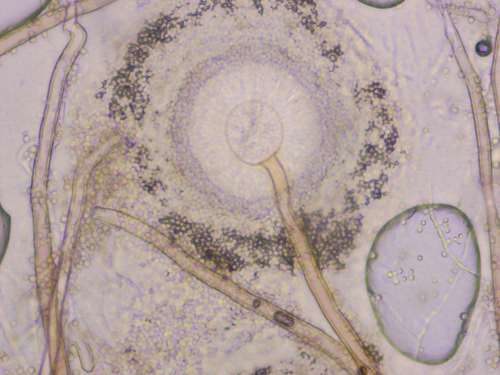
Verbatim
e0“Among the fungi from both black and red pepper were Aspergillus flavus and A. ochraceus”
Claim · model-written summary
Some pepper-derived Aspergillus isolates grown on corn were rapidly lethal to rats or ducklings.
Verbatim
e0“Among the fungi from both black and red pepper were Aspergillus flavus and A. ochraceus, some isolates of which, when grown for 8 to 10 days on moist autoclaved corn and fed to white rats or to 2-day-old Pekin ducklings, were rapidly lethal to them.”
Claim · model-written summary
Aflatoxin B1 was isolated from corn on which A. flavus from black pepper grew.
- Taxon
- black peppere0
- Interactor
- A. flavusAspergillus flavuse0other
- Outcome
- Aflatoxin B1 was isolatede0
Organisms pictured · Representative pictures of the matched species, not figures from the paper.
Verbatim
e0“Aflatoxin B1 was isolated from one of the samples of corn on which A. flavus from black pepper was grown.”
Claim · model-written summary
Several bacterial genera and species were isolated from black pepper.
Verbatim
e0“Among the bacteria isolated from ground black pepper were Escherichia coli, E. freudii, Serratia sp., Klebsiella sp., Bacillus sp., Staphylococcus sp., and Streptococcus sp.”
Claim · model-written summary
Neither Shigella nor Salmonella was cultured.
Verbatim
e0“No cultures of Shigella or Salmonella were found.”
t0“Black and Red Pepper”