Abstract
The pollen grains of Indian Alangium Lam. Show interesting morphological features. In the present paper, the pollen of four species, viz., Alangium alpinum (Clarke) Smith, A. barbatum (R. Br.) Baill, ex Kuntze, A. chinense (Lour.) Harm. and A. salvifolium (L.) Wangerin have been studied under light and scanning electron microscopes. Alangium alpinum distributed in the eastern Himalaya, has 3-4 colporate pollen with characteristic striate sculptured exine. Whereas, A. chinense is distributed throughout the Himalaya as well as the plains has regulate-reticulate sculptured exine with aperture similar to A. alpinum, A. barbatum is sporadic in Assam and has 3-colporate pollen with faint striate sculpturing. A. salvifolium happens to be the most widely distributed species extending from Himalayan foothills to extreme south of the Indian Peninsula as well as Andaman Island and has 3-6 porate-porate-brevicolporate apertures. Pollen grains of A. salvifolium subsp. Sundanum (Miq.) Bloembergen show gemmate-granulate sculpturing whereas, in A. salvifolium subsp. Salvifolium (L.) Wangerin the sculpturing is regulate-verrucate-gemmate-granulate. SEM studies reveal secondary ornamentation in A. alpinum, A. barbatum and A. salvifolium and interesting variations in the orientation of muri in case of A. chinense.
Abstract from the paper’s OpenAlex record, shown for indexing and research. Copyright remains with the authors or the publisher. Read at the source ↗
The text the model read, with the source record’s inline markup (italics, sub- and superscripts) rendered and its character entities decoded; quote offsets refer to the raw text.
Claims 9
Claim · model-written summary
Alangium alpinum has 3-4 colporate pollen and striate exine.
- Taxon
- Alangium alpinum
 Alangium alpinume0
- Outcome
- 3-4 colporate pollen with characteristic striate sculptured exinee0
- Setting
- eastern Himalayae0
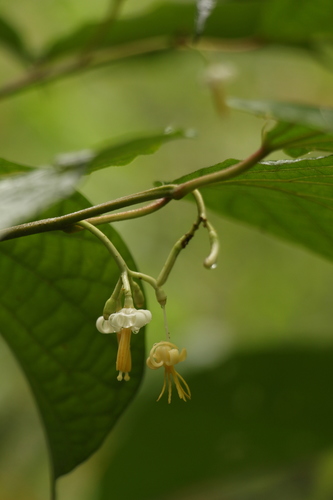
Organisms pictured · Representative pictures of the matched species, not figures from the paper.
Verbatim
e0“Alangium alpinum distributed in the eastern Himalaya, has 3-4 colporate pollen with characteristic striate sculptured exine”
Claim · model-written summary
A. chinense has reticulate exine and an aperture like A. alpinum.
- Taxon
- A. chinense
 Alangium chinensee0
- Outcome
- regulate-reticulate sculptured exine with aperture similar to A. alpinume0
- Setting
- throughout the Himalaya as well as the plainse0
Organisms pictured · Representative pictures of the matched species, not figures from the paper.

Verbatim
e0“A. chinense is distributed throughout the Himalaya as well as the plains has regulate-reticulate sculptured exine with aperture similar to A. alpinum”
Claim · model-written summary
A. barbatum has 3-colporate pollen and faint striate sculpture.
- Taxon
- A. barbatumAlangium barbatume0
- Outcome
- 3-colporate pollen with faint striate sculpturinge0
- Setting
- Assame0
Verbatim
e0“A. barbatum is sporadic in Assam and has 3-colporate pollen with faint striate sculpturing”
Claim · model-written summary
A. salvifolium has 3-6 porate-porate-brevicolporate apertures.
Verbatim
e0“A. salvifolium happens to be the most widely distributed species extending from Himalayan foothills to extreme south of the Indian Peninsula as well as Andaman Island and has 3-6 porate-porate-brevicolporate apertures”
Claim · model-written summary
A. salvifolium is the most widely distributed species in the study.
Verbatim
e0“A. salvifolium happens to be the most widely distributed species extending from Himalayan foothills to extreme south of the Indian Peninsula as well as Andaman Island”
Claim · model-written summary
The Sundanum subspecies has gemmate-granulate sculpturing.
Verbatim
e0“A. salvifolium subsp. Sundanum (Miq.) Bloembergen show gemmate-granulate sculpturing”
Claim · model-written summary
The Salvifolium subspecies has regulate-verrucate-gemmate-granulate sculpturing.
Verbatim
e0“A. salvifolium subsp. Salvifolium (L.) Wangerin the sculpturing is regulate-verrucate-gemmate-granulate”
Claim · model-written summary
SEM revealed secondary ornamentation in three Alangium species.
Verbatim
e0“SEM studies reveal secondary ornamentation in A. alpinum, A. barbatum and A. salvifolium”
Claim · model-written summary
SEM found variation in orientation of muri in A. chinense.
- Taxon
- A. chinenseAlangium chinensee0
- Outcome
- variations in the orientation of murie0
Organisms pictured · Representative pictures of the matched species, not figures from the paper.
Verbatim
e0“interesting variations in the orientation of muri in case of A. chinense”