Abstract
The support of trends in agriculture with limited or restricted use of pesticides is linked to the difficulty of protection against pathogenic and toxigenic fungi. Therefore, it is a great challenge to find alternatives to these dangerous fungi. These alternatives include using safe antifungal plant substances of medicinal or aromatic plants as components of botanical pesticides. Within 69 plant species, only 13 were selected as potentially of interest. However, the species Krameria lappacea, whose extraction yield (economic factor) achieved 17.6% and minimum inhibitory concentrations (MIC50) 0.11–1.24 mg mL−1, was found to be enormously advantageous. Extraordinary efficacy on a set of dangerous filamentous fungi, comparable to expensive essential oils or active phenolic compounds, was demonstrated. In the most effective extract fraction, two main substances from the group of neolignans, analogues of kramerixin, were detected by using GC-MS and LC-MS analysis, and their molecular structure was determined. The advantage of K. lappacea was discussed on the basis of the mode of action and chemical properties of the detected neolignans. K. lappacea could be a suitable source for environmentally friendly preparations, thanks to its high yield in simple extraction, excellent antifungal activity, broad antifungal spectrum, harmlessness, and assumed lower volatility of active compounds.
Abstract from the paper’s OpenAlex record; open copy licensed cc-by. Read at the source ↗
The text the model read, with the source record’s inline markup (italics, sub- and superscripts) rendered and its character entities decoded; quote offsets refer to the raw text.
Claims 7
Claim · model-written summary
Krameria lappacea achieved an extraction yield of 17.6%.
- Taxon
- Krameria lappacea
 Krameria lappaceae1
- Outcome
- extraction yielde1
- Value
- 17.6%e1
Organisms pictured · Representative pictures of the matched species, not figures from the paper.
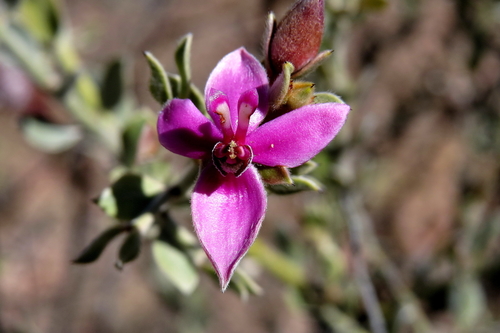
Verbatim
e1“the species Krameria lappacea, whose extraction yield (economic factor) achieved 17.6%”
Claim · model-written summary
The minimum inhibitory concentrations (MIC50) of the Krameria lappacea extract were 0.11–1.24 mg mL−1.
- Taxon
- Krameria lappaceaKrameria lappaceae1
- Outcome
- minimum inhibitory concentrations (MIC50)e2
- Value
- 0.11–1.24 mg mL−1e2
Organisms pictured · Representative pictures of the matched species, not figures from the paper.
Verbatim
e1“the species Krameria lappacea, whose extraction yield (economic factor) achieved 17.6%”
e2“minimum inhibitory concentrations (MIC50) 0.11–1.24 mg mL−1”
Claim · model-written summary
The Krameria lappacea extract showed extraordinary antifungal efficacy against filamentous fungi, comparable to essential oils or phenolic compounds.
- Taxon
- Krameria lappaceaKrameria lappaceae1
- Interactor
- filamentous fungie3pathogen
- Outcome
- efficacye3
- Comparator
- expensive essential oils or active phenolic compoundse3
Organisms pictured · Representative pictures of the matched species, not figures from the paper.
Verbatim
e1“the species Krameria lappacea, whose extraction yield (economic factor) achieved 17.6%”
e3“Extraordinary efficacy on a set of dangerous filamentous fungi, comparable to expensive essential oils or active phenolic compounds, was demonstrated”
Claim · model-written summary
Within 69 plant species screened, only 13 were selected as potentially of interest.
Verbatim
e4“Within 69 plant species, only 13 were selected as potentially of interest”
Claim · model-written summary
Krameria lappacea is a suitable source for environmentally friendly preparations.
- Taxon
- K. lappaceaKrameria lappaceae5
- Outcome
- suitable source for environmentally friendly preparationse5
Organisms pictured · Representative pictures of the matched species, not figures from the paper.
Verbatim
e5“K. lappacea could be a suitable source for environmentally friendly preparations”
Claim · model-written summary
The most effective extract fraction contained two main neolignans, analogues of kramerixin.
- Taxon
- Krameria lappaceaKrameria lappaceae1
- Outcome
- two main substances from the group of neolignanse6
- Qualifier
- In the most effective extract fractione6
Not reportedDirection
Organisms pictured · Representative pictures of the matched species, not figures from the paper.
Verbatim
e1“the species Krameria lappacea, whose extraction yield (economic factor) achieved 17.6%”
e6“In the most effective extract fraction, two main substances from the group of neolignans, analogues of kramerixin, were detected by using GC-MS and LC-MS analysis, and their molecular structure was determined”
Claim · model-written summary
The molecular structure of the neolignans in the extract was determined.
- Taxon
- Krameria lappaceaKrameria lappaceae1
- Outcome
- molecular structuree6
Not reportedDirection
Organisms pictured · Representative pictures of the matched species, not figures from the paper.
Verbatim
e1“the species Krameria lappacea, whose extraction yield (economic factor) achieved 17.6%”
e6“In the most effective extract fraction, two main substances from the group of neolignans, analogues of kramerixin, were detected by using GC-MS and LC-MS analysis, and their molecular structure was determined”