Abstract
Selectively planting native species could guide ecosystem development toward wetland restoration targets, once we understand how influential species function, alone and in combination. Knowing that Triglochin concinna (arrow grass, Juncaceae) accumulates N in its perennial roots, we asked how it would influence N dynamics on an excavated salt marsh plain at Tijuana Estuary, in southern California. We hypothesized that it would (a) accumulate N in roots and shoots, (b) reduce biomass of other marsh plain plants or, alternatively, (c) share N with neighbors as its litter decomposed and released N. We used 15 N stable isotope enrichment to quantify N transfer between Triglochin and the marsh plain’s seven-species halophyte assemblage in field and greenhouse experiments. We also examined the effect of Triglochin on individual marsh plain species’ biomass and N accumulation. Triglochin had low shoot biomass (0.96 ± 0.5 g m −2 in field plots and 17.64 ± 2.2 g m −2 in greenhouse pots), high root:shoot ratios (4.3 in the field and 2.0 in the greenhouse), and high tissue N content (1.9 ± 0.2% in the field and 1.7 ± 0.1% in the greenhouse). Two productive perennials, Sarcocornia pacifica (pickleweed) and Frankenia salina (alkali heath), outgrew Triglochin; yet these biomass dominants produced 44%–45% less shoot biomass in greenhouse pots with Triglochin than without. However, we did not find this reduction in the field where roots were unconfined. In the greenhouse, δ 15 N values were higher for species grown with 15 N-enriched Triglochin , indicating that this species made N available to its neighbors. The δ 15 N values for plants grown in the field exceeded background levels, also indicating that the marsh plain assemblage took up N released by Triglochin . We conclude that Triglochin can influence the restoration of salt marsh vegetation by accumulating N and releasing its tissue N to neighbors as leaves and roots decompose, while simultaneously reducing the biomass of neighbors. The seasonally deciduous Triglochin is low in shoot biomass, yet competitively superior in N uptake. Because this often-ignored species has limited tidal dispersal, we suggest restoration plantings, including tests of its ability to facilitate diversity where S. pacifica , the marsh plain dominant, might otherwise form monocultures.
Abstract from the paper’s OpenAlex record; open copy licensed cc-by. Read at the source ↗
The text the model read, with the source record’s inline markup (italics, sub- and superscripts) rendered and its character entities decoded; quote offsets refer to the raw text.
Claims 15
Claim · model-written summary
Triglochin had low shoot biomass in field plots.
- Taxon
- Triglochin concinna
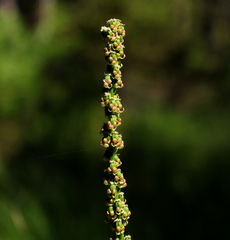 Triglochin concinnae1
- Outcome
- shoot biomasse0
- Value
- 0.96 ± 0.5 g m −2e0
- Setting
- field plotse0
Organisms pictured · Representative pictures of the matched species, not figures from the paper.

Verbatim
e0“Triglochin had low shoot biomass (0.96 ± 0.5 g m −2 in field plots”
e1“Triglochin concinna (arrow grass, Juncaceae)”
Claim · model-written summary
Triglochin had low shoot biomass in greenhouse pots.
- Taxon
- Triglochin concinnaTriglochin concinnae1
- Outcome
- shoot biomasse2
- Value
- 17.64 ± 2.2 g m −2e0
- Setting
- greenhouse potse0
Organisms pictured · Representative pictures of the matched species, not figures from the paper.
Verbatim
e0“17.64 ± 2.2 g m −2 in greenhouse pots”
e1“Triglochin concinna (arrow grass, Juncaceae)”
e2“low shoot biomass”
Claim · model-written summary
Triglochin had a high root:shoot ratio in the field.
- Taxon
- Triglochin concinnaTriglochin concinnae1
- Outcome
- root:shoot ratiose0
- Value
- 4.3e0
- Setting
- the fielde0
Organisms pictured · Representative pictures of the matched species, not figures from the paper.
Verbatim
e0“high root:shoot ratios (4.3 in the field”
e1“Triglochin concinna (arrow grass, Juncaceae)”
Claim · model-written summary
Triglochin had a high root:shoot ratio in the greenhouse.
- Taxon
- Triglochin concinnaTriglochin concinnae1
- Outcome
- root:shoot ratiose2
- Value
- 2.0e0
- Setting
- the greenhousee0
Organisms pictured · Representative pictures of the matched species, not figures from the paper.
Verbatim
e0“2.0 in the greenhouse”
e1“Triglochin concinna (arrow grass, Juncaceae)”
e2“high root:shoot ratios”
Claim · model-written summary
Triglochin had high tissue nitrogen content in the field.
- Taxon
- Triglochin concinnaTriglochin concinnae1
- Outcome
- tissue N contente0
- Value
- 1.9 ± 0.2%e0
- Setting
- the fielde0
Organisms pictured · Representative pictures of the matched species, not figures from the paper.
Verbatim
e0“high tissue N content (1.9 ± 0.2% in the field”
e1“Triglochin concinna (arrow grass, Juncaceae)”
Claim · model-written summary
Triglochin had high tissue nitrogen content in the greenhouse.
- Taxon
- Triglochin concinnaTriglochin concinnae1
- Outcome
- tissue N contente2
- Value
- 1.7 ± 0.1%e0
- Setting
- the greenhousee0
Organisms pictured · Representative pictures of the matched species, not figures from the paper.
Verbatim
e0“1.7 ± 0.1% in the greenhouse”
e1“Triglochin concinna (arrow grass, Juncaceae)”
e2“high tissue N content”
Claim · model-written summary
Sarcocornia pacifica outgrew Triglochin.
- Taxon
- Sarcocornia pacifica
 Salicornia pacificae0
- Interactor
- Triglochin
 Triglochine0other
- Outcome
- outgrewe0
- Direction
- outgrewe0
- Comparator
- Triglochine0
Organisms pictured · Representative pictures of the matched species, not figures from the paper.


Verbatim
e0“Sarcocornia pacifica (pickleweed) and Frankenia salina (alkali heath), outgrew Triglochin”
Claim · model-written summary
Frankenia salina outgrew Triglochin.
- Taxon
- Frankenia salina
 Frankenia salinae0
- Interactor
- TriglochinTriglochine0other
- Outcome
- outgrewe0
- Direction
- outgrewe0
- Comparator
- Triglochine0
Organisms pictured · Representative pictures of the matched species, not figures from the paper.

Verbatim
e0“Sarcocornia pacifica (pickleweed) and Frankenia salina (alkali heath), outgrew Triglochin”
Claim · model-written summary
Sarcocornia pacifica shoot biomass was 44%–45% lower with Triglochin in greenhouse pots.
- Taxon
- Sarcocornia pacificaSalicornia pacificae1
- Treatment
- with Triglochine0
- Interactor
- TriglochinTriglochine0other
- Outcome
- shoot biomasse0
- Direction
- lesse0
- Value
- 44%–45%e0
- Comparator
- withoute0
- Setting
- greenhouse potse0
Organisms pictured · Representative pictures of the matched species, not figures from the paper.
Verbatim
e0“these biomass dominants produced 44%–45% less shoot biomass in greenhouse pots with Triglochin than without”
e1“Sarcocornia pacifica (pickleweed)”
Claim · model-written summary
Frankenia salina shoot biomass was 44%–45% lower with Triglochin in greenhouse pots.
- Taxon
- Frankenia salinaFrankenia salinae1
- Treatment
- with Triglochine0
- Interactor
- TriglochinTriglochine0other
- Outcome
- shoot biomasse0
- Direction
- lesse0
- Value
- 44%–45%e0
- Comparator
- withoute0
- Setting
- greenhouse potse0
Organisms pictured · Representative pictures of the matched species, not figures from the paper.
Verbatim
e0“these biomass dominants produced 44%–45% less shoot biomass in greenhouse pots with Triglochin than without”
e1“Frankenia salina (alkali heath)”
Claim · model-written summary
The greenhouse biomass reduction was not found in field plots with unconfined roots.
- Taxon
- Sarcocornia pacificaSalicornia pacificae1
- Interactor
- TriglochinTriglochine2other
- Outcome
- this reductione0
- Setting
- the fielde0
Organisms pictured · Representative pictures of the matched species, not figures from the paper.
Verbatim
e0“we did not find this reduction in the field where roots were unconfined”
e1“Sarcocornia pacifica (pickleweed) and Frankenia salina (alkali heath)”
e2“with Triglochin than without”
Claim · model-written summary
Species grown with enriched Triglochin had higher nitrogen isotope values in greenhouse pots.
- Taxon
- halophytee1
- Treatment
- with 15 N-enriched Triglochine0
- Interactor
- TriglochinTriglochine0other
- Outcome
- δ 15 N valuese0
- Direction
- highere0
- Setting
- the greenhousee0
Not reportedComparator
Organisms pictured · Representative pictures of the matched species, not figures from the paper.
Verbatim
e0“In the greenhouse, δ 15 N values were higher for species grown with 15 N-enriched Triglochin”
e1“seven-species halophyte assemblage”
Claim · model-written summary
Field plants had isotope values exceeding background levels, indicating nitrogen uptake from Triglochin.
- Taxon
- plantsViridiplantaee0
- Interactor
- TriglochinTriglochine0other
- Outcome
- δ 15 N valuese0
- Direction
- exceedede0
- Comparator
- background levelse0
- Setting
- the fielde0
Organisms pictured · Representative pictures of the matched species, not figures from the paper.
Verbatim
e0“The δ 15 N values for plants grown in the field exceeded background levels, also indicating that the marsh plain assemblage took up N released by Triglochin”
Claim · model-written summary
Triglochin was competitively superior in nitrogen uptake.
- Taxon
- TriglochinTriglochine0
- Outcome
- N uptakee0
- Direction
- superiore0
Not reportedInteractorComparator
Organisms pictured · Representative pictures of the matched species, not figures from the paper.
Verbatim
e0“Triglochin is low in shoot biomass, yet competitively superior in N uptake”
Claim · model-written summary
The authors suggest restoration plantings of Triglochin, with tests of effects on diversity.
- Taxon
- Triglochin concinnaTriglochin concinnae1
- Outcome
- restoration plantingse0
Organisms pictured · Representative pictures of the matched species, not figures from the paper.
Verbatim
e0“we suggest restoration plantings, including tests of its ability to facilitate diversity”
e1“Triglochin concinna (arrow grass, Juncaceae)”