Abstract
Common root rot caused by Bipolaris sorokiniana infestation in wheat is one of the main reasons for yield reduction in wheat crops worldwide. The bacterium strain JK-25 used in the current investigation was isolated from wheat rhizosphere soil and was later identified as Bacillus halotolerans based on its morphological, physiological, biochemical, and molecular properties. The strain showed significant antagonism to B. sorokiniana, Fusarium oxysporum, Fusarium graminearum, and Rhizoctonia zeae. Inhibition of B. sorokiniana mycelial dry weight and spore germination rate by JK-25 fermentation supernatant reached 60% and 88%, respectively. The crude extract of JK-25 was found, by Matrix-assisted laser desorption ionization time-of-flight mass spectrometry (MALDI-TOF-MS), to contain the surfactin that exerted an inhibitory effect on B. sorokiniana. The disruption of mycelial cell membranes was observed under laser scanning confocal microscope (LSCM) after treatment of B. sorokiniana mycelium with the crude extract. The antioxidant enzyme activity of B. sorokiniana was significantly reduced and the oxidation product malondialdehyde (MDA) content increased after treatment with the crude extract. The incidence of root rot was significantly reduced in pot experiments with the addition of JK-25 culture fermentation supernatant, which had a significant biological control effect of 72.06%. Its ability to produce siderophores may help to promote wheat growth and the production of proteases and pectinases may also be part of the strain’s role in suppressing pathogens. These results demonstrate the excellent antagonistic effect of JK-25 against B. sorokiniana and suggest that this strain has great potential as a resource for biological control of wheat root rot strains.
Abstract from the paper’s OpenAlex record; open copy licensed cc-by. Read at the source ↗
The text the model read, with the source record’s inline markup (italics, sub- and superscripts) rendered and its character entities decoded; quote offsets refer to the raw text.
Claims 11
Claim · model-written summary
JK-25 was identified as Bacillus halotolerans.
- Taxon
- Bacillus halotoleransBacillus halotoleranse0
- Outcome
- identified as Bacillus halotoleranse0
- Setting
- wheat rhizosphere soile0
Verbatim
e0“The bacterium strain JK-25 used in the current investigation was isolated from wheat rhizosphere soil and was later identified as Bacillus halotolerans”
Claim · model-written summary
JK-25 antagonized four fungal pathogens.
- Taxon
- B. sorokiniana
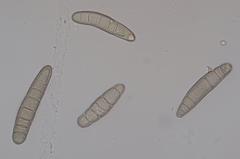 Bipolaris sorokinianae0
- Outcome
- significant antagonisme0
- Qualifier
- Fusarium oxysporum, Fusarium graminearum, and Rhizoctonia zeaee0
Organisms pictured · Representative pictures of the matched species, not figures from the paper.
Verbatim
e0“The strain showed significant antagonism to B. sorokiniana, Fusarium oxysporum, Fusarium graminearum, and Rhizoctonia zeae”
Claim · model-written summary
JK-25 fermentation supernatant inhibited B. sorokiniana mycelial dry weight by 60%.
- Taxon
- B. sorokinianaBipolaris sorokinianae0
- Treatment
- JK-25 fermentation supernatante0
- Outcome
- B. sorokiniana mycelial dry weighte0
- Direction
- Inhibitione0
- Value
- 60%e0
Not reportedComparator
Organisms pictured · Representative pictures of the matched species, not figures from the paper.
Verbatim
e0“Inhibition of B. sorokiniana mycelial dry weight and spore germination rate by JK-25 fermentation supernatant reached 60% and 88%, respectively”
Claim · model-written summary
JK-25 fermentation supernatant inhibited B. sorokiniana spore germination by 88%.
- Taxon
- B. sorokinianaBipolaris sorokinianae0
- Treatment
- JK-25 fermentation supernatante0
- Outcome
- spore germination ratee0
- Direction
- Inhibitione0
- Value
- 88%e0
Not reportedComparator
Organisms pictured · Representative pictures of the matched species, not figures from the paper.
Verbatim
e0“Inhibition of B. sorokiniana mycelial dry weight and spore germination rate by JK-25 fermentation supernatant reached 60% and 88%, respectively”
Claim · model-written summary
JK-25 crude extract contained surfactin, which inhibited B. sorokiniana.
- Taxon
- B. sorokinianaBipolaris sorokinianae0
- Compound
- surfactine0
- Outcome
- inhibitory effect on B. sorokinianae0
Organisms pictured · Representative pictures of the matched species, not figures from the paper.
Verbatim
e0“The crude extract of JK-25 was found, by Matrix-assisted laser desorption ionization time-of-flight mass spectrometry (MALDI-TOF-MS), to contain the surfactin that exerted an inhibitory effect on B. sorokiniana”
Claim · model-written summary
JK-25 crude extract disrupted B. sorokiniana mycelial membranes.
- Taxon
- B. sorokinianaBipolaris sorokinianae0
- Treatment
- crude extracte0
- Outcome
- disruption of mycelial cell membranese0
Not reportedComparatorDirection
Organisms pictured · Representative pictures of the matched species, not figures from the paper.
Verbatim
e0“The disruption of mycelial cell membranes was observed under laser scanning confocal microscope (LSCM) after treatment of B. sorokiniana mycelium with the crude extract”
Claim · model-written summary
Crude extract significantly reduced B. sorokiniana antioxidant enzyme activity.
- Taxon
- B. sorokinianaBipolaris sorokinianae0
- Treatment
- crude extracte0
- Outcome
- antioxidant enzyme activity of B. sorokinianae0
- Direction
- reducede0
Not reportedComparator
Organisms pictured · Representative pictures of the matched species, not figures from the paper.
Verbatim
e0“The antioxidant enzyme activity of B. sorokiniana was significantly reduced and the oxidation product malondialdehyde (MDA) content increased after treatment with the crude extract”
Claim · model-written summary
Crude extract increased B. sorokiniana malondialdehyde content.
- Taxon
- B. sorokinianaBipolaris sorokinianae0
- Treatment
- crude extracte0
- Outcome
- malondialdehyde (MDA) contente0
- Direction
- increasede0
Not reportedComparator
Organisms pictured · Representative pictures of the matched species, not figures from the paper.
Verbatim
e0“The antioxidant enzyme activity of B. sorokiniana was significantly reduced and the oxidation product malondialdehyde (MDA) content increased after treatment with the crude extract”
Claim · model-written summary
JK-25 fermentation supernatant significantly reduced wheat root rot incidence in pots, with 72.06% biological control.
- Taxon
- wheat
 Triticum aestivumt0
- Treatment
- JK-25 culture fermentation supernatante0
- Interactor
- Bipolaris sorokinianaBipolaris sorokinianat0pathogen
- Second interactor
- Bacillus halotolerans Jk-25Bacillus halotoleranst0biocontrol_agent
- Outcome
- incidence of root rote0
- Direction
- reducede0
- Value
- 72.06%e0
- Setting
- pot experimentse0
Not reportedComparator
Organisms pictured · Representative pictures of the matched species, not figures from the paper.

Verbatim
e0“The incidence of root rot was significantly reduced in pot experiments with the addition of JK-25 culture fermentation supernatant, which had a significant biological control effect of 72.06%”
t0“Bacillus halotolerans Jk-25 Mediates the Biocontrol of Wheat Common Root Rot Caused by Bipolaris sorokiniana”
Claim · model-written summary
JK-25 siderophore production may promote wheat growth.
- Taxon
- wheatTriticum aestivumt0
- Outcome
- wheat growthe0
- Qualifier
- produce siderophorese0
Organisms pictured · Representative pictures of the matched species, not figures from the paper.
Verbatim
e0“Its ability to produce siderophores may help to promote wheat growth”
t0“Wheat”
Claim · model-written summary
JK-25 protease and pectinase production may contribute to pathogen suppression.
Verbatim
e0“the production of proteases and pectinases may also be part of the strain’s role in suppressing pathogens”
The same questions in other papers
processing · Bipolaris sorokiniana · Triticum aestivum (wheat)Results agree
1 paper in the same direction as this paper
- positive
Claims are grouped by organism, treatment and what was measured or targeted. A paper counts as positive when any of its claims in the group is positive.