Abstract
Research on the chloroplast genome of parasitic plants is limited. In particular, the homology between the chloroplast genomes of parasitic and hyperparasitic plants has not been reported yet. In this study, three chloroplast genomes of Taxillus (Taxillus chinensis, Taxillus delavayi, and Taxillus thibetensis) and one chloroplast genome of Phacellaria (Phacellaria rigidula) were sequenced and analyzed, among which T. chinensis is the host of P. rigidula. The chloroplast genomes of the four species were 119,941–138,492 bp in length. Compared with the chloroplast genome of the autotrophic plant Nicotiana tabacum, all of the ndh genes, three ribosomal protein genes, three tRNA genes and the infA gene were lost in the three Taxillus species. Meanwhile, in P. rigidula, the trnV-UAC gene and the ycf15 gene were lost, and only one ndh gene (ndhB) existed. The results of homology analysis showed that the homology between P. rigidula and its host T. chinensis was low, indicating that P. rigidula grows on its host T. chinensis but they do not share the chloroplast genome. In addition, horizontal gene transfer was not found between P. rigidula and its host T. chinensis. Several candidate highly variable regions in the chloroplast genomes of Taxillus and Phacellaria species were selected for species identification study. Phylogenetic analysis revealed that the species of Taxillus and Scurrula were closely related and supported that Scurrula and Taxillus should be treated as congeneric, while species in Phacellaria had a close relationship with that in Viscum.
Abstract from the paper’s OpenAlex record; open copy licensed cc-by. Read at the source ↗
The text the model read, with the source record’s inline markup (italics, sub- and superscripts) rendered and its character entities decoded; quote offsets refer to the raw text.
Claims 13
Claim · model-written summary
Four chloroplast genomes ranged from 119,941 to 138,492 bp.
- Taxon
- Taxillus and Phacellaria
 TaxillusPhacellariat0
- Outcome
- chloroplast genomese0
- Value
- 119,941–138,492 bpe0
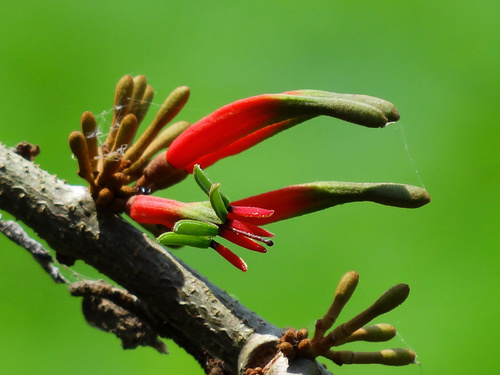
Organisms pictured · Representative pictures of the matched species, not figures from the paper.
Verbatim
e0“The chloroplast genomes of the four species were 119,941–138,492 bp in length”
t0“Taxillus and Phacellaria”
Claim · model-written summary
All ndh genes were lost in the three Taxillus species relative to Nicotiana tabacum.
Organisms pictured · Representative pictures of the matched species, not figures from the paper.
Verbatim
e0“Compared with the chloroplast genome of the autotrophic plant Nicotiana tabacum, all of the ndh genes, three ribosomal protein genes, three tRNA genes and the infA gene were lost in the three Taxillus species”
Claim · model-written summary
Three ribosomal protein genes were lost in Taxillus species.
Organisms pictured · Representative pictures of the matched species, not figures from the paper.
Verbatim
e0“three ribosomal protein genes, three tRNA genes and the infA gene were lost in the three Taxillus species”
Claim · model-written summary
Three tRNA genes were lost in Taxillus species.
Organisms pictured · Representative pictures of the matched species, not figures from the paper.
Verbatim
e0“three tRNA genes and the infA gene were lost in the three Taxillus species”
Claim · model-written summary
The infA gene was lost in Taxillus species.
Organisms pictured · Representative pictures of the matched species, not figures from the paper.
Verbatim
e0“the infA gene were lost in the three Taxillus species”
Claim · model-written summary
The trnV-UAC gene was lost in P. rigidula.
- Taxon
- P. rigidulaPhacellaria rigidulae0
- Gene
- trnV-UAC genee0
- Outcome
- trnV-UAC genee0
- Direction
- loste0
Verbatim
e0“in P. rigidula, the trnV-UAC gene and the ycf15 gene were lost”
Claim · model-written summary
The ycf15 gene was lost in P. rigidula.
- Taxon
- P. rigidulaPhacellaria rigidulae0
- Gene
- ycf15 genee0
- Outcome
- ycf15 genee0
- Direction
- loste0
Verbatim
e0“in P. rigidula, the trnV-UAC gene and the ycf15 gene were lost”
Claim · model-written summary
Only ndhB remained among ndh genes in P. rigidula.
- Taxon
- PhacellariaPhacellariat0
- Gene
- ndhBe0
- Outcome
- one ndh gene (ndhB) existede0
Verbatim
e0“only one ndh gene (ndhB) existed”
t0“Phacellaria”
Claim · model-written summary
P. rigidula and host T. chinensis had low chloroplast-genome homology.
- Taxon
- P. rigidulaPhacellaria rigidulae0
- Interactor
- T. chinensisTaxillus chinensise0host
- Outcome
- homologye0
- Direction
- lowe0
Verbatim
e0“the homology between P. rigidula and its host T. chinensis was low”
Claim · model-written summary
No horizontal gene transfer was found between P. rigidula and host T. chinensis.
- Taxon
- P. rigidulaPhacellaria rigidulae0
- Interactor
- T. chinensisTaxillus chinensise0host
- Outcome
- horizontal gene transfer was not founde0
Verbatim
e0“horizontal gene transfer was not found between P. rigidula and its host T. chinensis”
Claim · model-written summary
Candidate variable chloroplast regions were selected for species identification.
- Taxon
- Taxillus and PhacellariaTaxillusPhacellariae0
- Outcome
- candidate highly variable regionse0
- Value
- Severale0
Organisms pictured · Representative pictures of the matched species, not figures from the paper.
Verbatim
e0“Several candidate highly variable regions in the chloroplast genomes of Taxillus and Phacellaria species were selected for species identification study”
Claim · model-written summary
Taxillus and Scurrula were closely related, supporting congeneric treatment.
- Outcome
- closely relatede0
 Scurrula
Organisms pictured · Representative pictures of the matched species, not figures from the paper.

Verbatim
e0“species of Taxillus and Scurrula were closely related and supported that Scurrula and Taxillus should be treated as congeneric”
Claim · model-written summary
Phacellaria had a close phylogenetic relationship with Viscum.
- Taxon
- PhacellariaPhacellariae0
- Outcome
- close relationshipe0
 Viscum
Organisms pictured · Representative pictures of the matched species, not figures from the paper.

Verbatim
e0“species in Phacellaria had a close relationship with that in Viscum”