Abstract
Survival, herbage yield and nutrient use efficiency of ten tropical forage legumes were compared in pot trials using two soil types (red and yellow kandosols), widespread in Australia’s tropical rangelands, over a period of 22 months. Over this period, plants of Centrosema brasilianum cv. Oolloo, Desmodium virgatus, Macroptilium bracteatum (93.8%), Stylosanthes scabra, S. hamata (87.5%) and D. pubescens (68.8%) survived best. Arachis paraguariensis (37.5%), A. triseminalis, M. martii (25.0%) and C. pascuorum (18.8%) were less successful. The highest herbage yields were consistently produced by C. brasilianum, followed by M. bracteatum and the Stylosanthes cultivars. The annual species, C. pascuorum and M. martii gave high yields in the first 3 9-weekly harvests. The Stylosanthes cultivars produced most root nodules, followed by A. paraguariensis, C pascuorum, C. brasilianum and M. martii. D. pubescens, D. virgatus, M. martii, A. triseminalis and C. brasilianum had the highest nitrogen-use efficiencies, whilst C. brasilianum and the two Stylosanthes cultivars had the highest phosphorus-use efficiencies. All of the legumes increased the nitrogen content of the two soils significantly, especially S. hamata, A. paraguariensis, C. brasilianum, M. martii and M. bracteatum. Most of the legumes show promise for use in low-fertility tropical pastures, particularly C. brasilianum and M. bracteatum.
Abstract from the paper’s OpenAlex record, shown for indexing and research. Copyright remains with the authors or the publisher. Read at the source ↗
The text the model read, with the source record’s inline markup (italics, sub- and superscripts) rendered and its character entities decoded; quote offsets refer to the raw text.
Claims 19
Claim · model-written summary
Macroptilium bracteatum had 93.8% survival in the two-soil pot trials.
- Taxon
- Macroptilium bracteatum
 Macroptilium bracteatume1
- Outcome
- Survivale0
- Value
- 93.8%e1
- Setting
- pot trialse0
Organisms pictured · Representative pictures of the matched species, not figures from the paper.
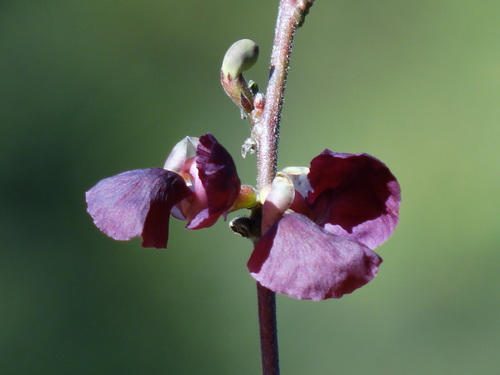
Verbatim
e0“Survival, herbage yield and nutrient use efficiency of ten tropical forage legumes were compared in pot trials using two soil types (red and yellow kandosols)”
e1“Over this period, plants of Centrosema brasilianum cv. Oolloo, Desmodium virgatus, Macroptilium bracteatum (93.8%), Stylosanthes scabra, S. hamata (87.5%) and D. pubescens (68.8%) survived best”
Claim · model-written summary
Stylosanthes hamata had 87.5% survival in the two-soil pot trials.
- Taxon
- S. hamata
 Stylosanthes hamatae1
- Outcome
- Survivale0
- Value
- 87.5%e1
- Setting
- pot trialse0
Organisms pictured · Representative pictures of the matched species, not figures from the paper.

Verbatim
e0“Survival, herbage yield and nutrient use efficiency of ten tropical forage legumes were compared in pot trials using two soil types (red and yellow kandosols)”
e1“Over this period, plants of Centrosema brasilianum cv. Oolloo, Desmodium virgatus, Macroptilium bracteatum (93.8%), Stylosanthes scabra, S. hamata (87.5%) and D. pubescens (68.8%) survived best”
Claim · model-written summary
Desmodium pubescens had 68.8% survival in the two-soil pot trials.
Verbatim
e0“Survival, herbage yield and nutrient use efficiency of ten tropical forage legumes were compared in pot trials using two soil types (red and yellow kandosols)”
e1“Over this period, plants of Centrosema brasilianum cv. Oolloo, Desmodium virgatus, Macroptilium bracteatum (93.8%), Stylosanthes scabra, S. hamata (87.5%) and D. pubescens (68.8%) survived best”
Claim · model-written summary
Arachis paraguariensis had 37.5% survival and was less successful.
- Taxon
- Arachis paraguariensis
 Arachis paraguariensise2
- Outcome
- Survivale0
- Direction
- less successfule2
- Value
- 37.5%e2
Organisms pictured · Representative pictures of the matched species, not figures from the paper.

Verbatim
e0“Survival, herbage yield and nutrient use efficiency of ten tropical forage legumes were compared in pot trials using two soil types (red and yellow kandosols)”
e2“Arachis paraguariensis (37.5%), A. triseminalis, M. martii (25.0%) and C. pascuorum (18.8%) were less successful”
Claim · model-written summary
Macroptilium martii had 25.0% survival and was less successful.
- Taxon
- M. martii
 Macroptilium martiie2
- Outcome
- Survivale0
- Direction
- less successfule2
- Value
- 25.0%e2
Organisms pictured · Representative pictures of the matched species, not figures from the paper.

Verbatim
e0“Survival, herbage yield and nutrient use efficiency of ten tropical forage legumes were compared in pot trials using two soil types (red and yellow kandosols)”
e2“Arachis paraguariensis (37.5%), A. triseminalis, M. martii (25.0%) and C. pascuorum (18.8%) were less successful”
Claim · model-written summary
Centrosema pascuorum had 18.8% survival and was less successful.
- Taxon
- C. pascuorum
 Centrosema pascuorume2
- Outcome
- Survivale0
- Direction
- less successfule2
- Value
- 18.8%e2
Organisms pictured · Representative pictures of the matched species, not figures from the paper.

Verbatim
e0“Survival, herbage yield and nutrient use efficiency of ten tropical forage legumes were compared in pot trials using two soil types (red and yellow kandosols)”
e2“Arachis paraguariensis (37.5%), A. triseminalis, M. martii (25.0%) and C. pascuorum (18.8%) were less successful”
Claim · model-written summary
Centrosema brasilianum, Desmodium virgatus and Stylosanthes scabra survived best.
Verbatim
e0“Survival, herbage yield and nutrient use efficiency of ten tropical forage legumes were compared in pot trials using two soil types (red and yellow kandosols)”
e1“Over this period, plants of Centrosema brasilianum cv. Oolloo, Desmodium virgatus, Macroptilium bracteatum (93.8%), Stylosanthes scabra, S. hamata (87.5%) and D. pubescens (68.8%) survived best”
Claim · model-written summary
Arachis triseminalis was less successful in survival.
Verbatim
e0“Survival, herbage yield and nutrient use efficiency of ten tropical forage legumes were compared in pot trials using two soil types (red and yellow kandosols)”
e2“Arachis paraguariensis (37.5%), A. triseminalis, M. martii (25.0%) and C. pascuorum (18.8%) were less successful”
Claim · model-written summary
Centrosema brasilianum gave the highest herbage yields.
- Taxon
- C. brasilianum
 Centrosema brasilianume3
- Outcome
- herbage yieldse3
- Direction
- higheste3
Organisms pictured · Representative pictures of the matched species, not figures from the paper.

Verbatim
e3“The highest herbage yields were consistently produced by C. brasilianum, followed by M. bracteatum and the Stylosanthes cultivars”
Claim · model-written summary
Macroptilium bracteatum ranked after C. brasilianum for herbage yield.
- Taxon
- M. bracteatumMacroptilium bracteatume3
- Outcome
- herbage yieldse3
- Direction
- followed bye3
Organisms pictured · Representative pictures of the matched species, not figures from the paper.
Verbatim
e3“The highest herbage yields were consistently produced by C. brasilianum, followed by M. bracteatum and the Stylosanthes cultivars”
Claim · model-written summary
Stylosanthes cultivars ranked after C. brasilianum for herbage yield.
Verbatim
e3“The highest herbage yields were consistently produced by C. brasilianum, followed by M. bracteatum and the Stylosanthes cultivars”
Claim · model-written summary
Centrosema pascuorum gave high yields in the first three harvests.
- Taxon
- C. pascuorumCentrosema pascuorume4
- Outcome
- yieldse4
- Qualifier
- in the first 3 9-weekly harvestse4
Organisms pictured · Representative pictures of the matched species, not figures from the paper.
Verbatim
e4“The annual species, C. pascuorum and M. martii gave high yields in the first 3 9-weekly harvests”
Claim · model-written summary
Macroptilium martii gave high yields in the first three harvests.
- Taxon
- M. martiiMacroptilium martiie4
- Outcome
- yieldse4
- Qualifier
- in the first 3 9-weekly harvestse4
Organisms pictured · Representative pictures of the matched species, not figures from the paper.
Verbatim
e4“The annual species, C. pascuorum and M. martii gave high yields in the first 3 9-weekly harvests”
Claim · model-written summary
Stylosanthes cultivars produced the most root nodules.
Verbatim
e0“Survival, herbage yield and nutrient use efficiency of ten tropical forage legumes were compared in pot trials using two soil types (red and yellow kandosols)”
e5“The Stylosanthes cultivars produced most root nodules, followed by A. paraguariensis, C pascuorum, C. brasilianum and M. martii”
Claim · model-written summary
A. paraguariensis, C. pascuorum, C. brasilianum and M. martii followed in root nodule production.
Verbatim
e0“Survival, herbage yield and nutrient use efficiency of ten tropical forage legumes were compared in pot trials using two soil types (red and yellow kandosols)”
e5“The Stylosanthes cultivars produced most root nodules, followed by A. paraguariensis, C pascuorum, C. brasilianum and M. martii”
Claim · model-written summary
D. pubescens, D. virgatus, M. martii, A. triseminalis and C. brasilianum had the highest nitrogen-use efficiencies.
Verbatim
e0“Survival, herbage yield and nutrient use efficiency of ten tropical forage legumes were compared in pot trials using two soil types (red and yellow kandosols)”
e6“D. pubescens, D. virgatus, M. martii, A. triseminalis and C. brasilianum had the highest nitrogen-use efficiencies, whilst C. brasilianum and the two Stylosanthes cultivars had the highest phosphorus-use efficiencies”
Claim · model-written summary
C. brasilianum and the two Stylosanthes cultivars had the highest phosphorus-use efficiencies.
Verbatim
e0“Survival, herbage yield and nutrient use efficiency of ten tropical forage legumes were compared in pot trials using two soil types (red and yellow kandosols)”
e6“D. pubescens, D. virgatus, M. martii, A. triseminalis and C. brasilianum had the highest nitrogen-use efficiencies, whilst C. brasilianum and the two Stylosanthes cultivars had the highest phosphorus-use efficiencies”
Claim · model-written summary
All legumes significantly increased the nitrogen content of the two soils.
Verbatim
e0“Survival, herbage yield and nutrient use efficiency of ten tropical forage legumes were compared in pot trials using two soil types (red and yellow kandosols)”
e7“All of the legumes increased the nitrogen content of the two soils significantly, especially S. hamata, A. paraguariensis, C. brasilianum, M. martii and M. bracteatum”
Claim · model-written summary
Most tropical forage legumes show promise for low-fertility tropical pastures, particularly C. brasilianum and M. bracteatum.
Verbatim
e0“Survival, herbage yield and nutrient use efficiency of ten tropical forage legumes were compared in pot trials using two soil types (red and yellow kandosols)”
e1“Most of the legumes show promise for use in low-fertility tropical pastures, particularly C. brasilianum and M. bracteatum”