Abstract
Plant-associated bacteria are essential partners in plant health and development. In addition to taking advantage of the rapid advances recently achieved in high-throughput sequencing approaches, studies on plant-microbiome interactions require experiments with culturable bacteria. A study on the rice root microbiome was recently initiated in Burkina Faso. As a follow up, the aim of the present study was to develop a collection of corresponding rice root-associated bacteria covering maximum diversity, to assess the diversity of the obtained isolates based on the culture medium used, and to describe the taxonomy, phenotype and abundance of selected isolates in the rice microbiome. More than 3,000 isolates were obtained using five culture media (TSA, NGN, NFb, PCAT, Baz). The 16S rRNA fragment sequencing of 1,013 selected isolates showed that our working collection covered four bacterial phyla (Proteobacteria, Firmicutes, Actinobacteria and Bacteroidetes) and represented 33% of the previously described diversity of the rice root microbiome at the order level. Phenotypic in vitro analysis of the plant growth promoting capacity of the isolates revealed an overall ammonium production and auxin biosynthesis capacity, while siderophore production and phosphate solubilisation were enriched in Burkholderia, Ralstonia, Acinetobacter and Pseudomonas species. Of 45 representative isolates screened for growth promotion on seedlings of two rice cultivars, five showed an ability to improve the growth of both cultivars, while five others were effective on only one cultivar. The best results were obtained with Pseudomonas taiwanensis ABIP 2315 and Azorhizobium caulinodans ABIP 1219, which increased seedling growth by 158% and 47%, respectively. Among the 14 best performing isolates, eight appeared to be abundant in the rice root microbiome dataset from previous study. The findings of this research contribute to the in vitro and in planta PGP capacities description of rice root-associated bacteria and their potential importance for plants by providing, for the first time, insight into their prevalence in the rice root microbiome.
Abstract from the paper’s OpenAlex record; open copy licensed cc-by. Read at the source ↗
The text the model read, with the source record’s inline markup (italics, sub- and superscripts) rendered and its character entities decoded; quote offsets refer to the raw text.
Claims 10
Claim · model-written summary
The rice root bacterial collection contained more than 3,000 isolates across five media.
- Taxon
- rice
 Oryza sativat0
- Outcome
- isolatese0
- Value
- More than 3,000 isolatese0
Organisms pictured · Representative pictures of the matched species, not figures from the paper.

Verbatim
e0“More than 3,000 isolates were obtained using five culture media (TSA, NGN, NFb, PCAT, Baz)”
t0“rice root-associated bacteria”
Claim · model-written summary
The selected isolates covered four bacterial phyla.
- Taxon
- riceOryza sativat0
- Outcome
- bacterial phylae0
- Value
- four bacterial phylae0
Organisms pictured · Representative pictures of the matched species, not figures from the paper.
Verbatim
e0“The 16S rRNA fragment sequencing of 1,013 selected isolates showed that our working collection covered four bacterial phyla (Proteobacteria, Firmicutes, Actinobacteria and Bacteroidetes)”
t0“rice root-associated bacteria”
Claim · model-written summary
The rice root bacterial collection represented 33% of previously described microbiome order-level diversity.
- Taxon
- riceOryza sativae0
- Outcome
- diversity of the rice root microbiomee0
- Value
- 33%e0
Organisms pictured · Representative pictures of the matched species, not figures from the paper.
Verbatim
e0“represented 33% of the previously described diversity of the rice root microbiome at the order level”
Claim · model-written summary
Rice root bacterial isolates generally produced ammonium and synthesized auxin in vitro.
- Taxon
- riceOryza sativat0
- Outcome
- ammonium production and auxin biosynthesis capacitye0
Organisms pictured · Representative pictures of the matched species, not figures from the paper.
Verbatim
e0“Phenotypic in vitro analysis of the plant growth promoting capacity of the isolates revealed an overall ammonium production and auxin biosynthesis capacity”
t0“rice root-associated bacteria”
Claim · model-written summary
Siderophore production and phosphate solubilisation were enriched in Burkholderia, Ralstonia, Acinetobacter and Pseudomonas species.
- Taxon
- riceOryza sativat0
- Interactor
- Burkholderia, Ralstonia, Acinetobacter and Pseudomonas species
 Pseudomonas
 Acinetobacter
 Burkholderia
 Ralstoniae0symbiont
- Outcome
- siderophore production and phosphate solubilisatione0
- Direction
- enrichede0
Organisms pictured · Representative pictures of the matched species, not figures from the paper.


Verbatim
e0“siderophore production and phosphate solubilisation were enriched in Burkholderia, Ralstonia, Acinetobacter and Pseudomonas species”
t0“rice root-associated bacteria”
Claim · model-written summary
Five of 45 bacterial isolates improved growth of both tested rice cultivars.
- Taxon
- riceOryza sativae0
- Treatment
- representative isolatese0
- Outcome
- growth of both cultivarse0
- Direction
- improvee0
- Value
- fivee0
Not reportedComparator
Organisms pictured · Representative pictures of the matched species, not figures from the paper.
Verbatim
e0“Of 45 representative isolates screened for growth promotion on seedlings of two rice cultivars, five showed an ability to improve the growth of both cultivars”
Claim · model-written summary
Five additional isolates promoted growth of only one of the two rice cultivars.
- Taxon
- riceOryza sativae1
- Treatment
- five otherse0
- Outcome
- effective on only one cultivare0
- Value
- fivee0
Not reportedComparatorDirection
Organisms pictured · Representative pictures of the matched species, not figures from the paper.
Verbatim
e0“while five others were effective on only one cultivar”
e1“seedlings of two rice cultivars”
Claim · model-written summary
Pseudomonas taiwanensis ABIP 2315 increased rice seedling growth by 158%.
- Taxon
- riceOryza sativat0
- Treatment
- Pseudomonas taiwanensis ABIP 2315e0
- Interactor
- Pseudomonas taiwanensis ABIP 2315Pseudomonas taiwanensise0symbiont
- Outcome
- seedling growthe0
- Direction
- increasede0
- Value
- 158%e0
Not reportedComparator
Organisms pictured · Representative pictures of the matched species, not figures from the paper.
Verbatim
e0“The best results were obtained with Pseudomonas taiwanensis ABIP 2315 and Azorhizobium caulinodans ABIP 1219, which increased seedling growth by 158% and 47%, respectively”
t0“rice root-associated bacteria”
Claim · model-written summary
Azorhizobium caulinodans ABIP 1219 increased rice seedling growth by 47%.
- Taxon
- riceOryza sativat0
- Treatment
- Azorhizobium caulinodans ABIP 1219e0
- Interactor
- Azorhizobium caulinodans ABIP 1219
 Azorhizobium caulinodanse0symbiont
- Outcome
- seedling growthe0
- Direction
- increasede0
- Value
- 47%e0
Not reportedComparator
Organisms pictured · Representative pictures of the matched species, not figures from the paper.
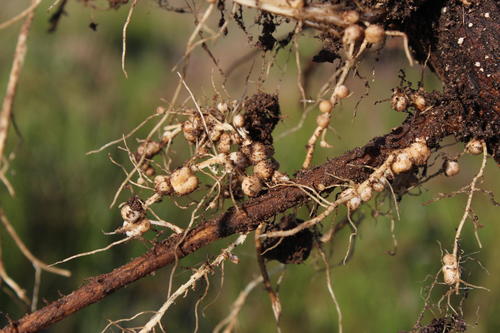
Verbatim
e0“The best results were obtained with Pseudomonas taiwanensis ABIP 2315 and Azorhizobium caulinodans ABIP 1219, which increased seedling growth by 158% and 47%, respectively”
t0“rice root-associated bacteria”
Claim · model-written summary
Eight of the 14 best-performing isolates were abundant in the prior rice root microbiome dataset.
- Taxon
- riceOryza sativae0
- Outcome
- abundant in the rice root microbiome datasete0
- Value
- eighte0
- Qualifier
- 14 best performing isolatese0
Organisms pictured · Representative pictures of the matched species, not figures from the paper.
Verbatim
e0“Among the 14 best performing isolates, eight appeared to be abundant in the rice root microbiome dataset from previous study”
The same questions in other papers
Azorhizobium caulinodans · growth · Oryza sativa (rice)Results agree
1 paper in the same direction as this paper
- positive
Claims are grouped by organism, treatment and what was measured or targeted. A paper counts as positive when any of its claims in the group is positive.