Abstract
In an effort to mitigate the environmental impact of chemical fertilizers while promoting soil sustainability, this study investigated the potential of rhizosphere-associated microorganisms to augment nutrient uptake and growth in melon crops.Soil samples were procured from three distinct melon fields and subjected to serial dilution techniques for microbial isolation on Nutrient Agar (NA) and Potato Dextrose Agar (PDA) media.Subsequent screening identified select isolates with capabilities for nitrogen fixation, phosphorus and potassium solubilization, indole-3-acetic acid (IAA) production, and antagonism against pathogens.Two bacterial isolates, designated BS 1A and BK 1, and one fungal isolate, FW 2B, were earmarked for their plant growth-promoting microorganism (PGPM) potential.Sequence analysis revealed homology of BS 1A with Pseudochrobactrum sp., BK 1 with Bacillus cereus, and FW 2B with Trametes polyzona.A greenhouse experiment employing a completely randomized design evaluated the effects of these isolates on melon growth.Control treatments included a positive control (C+), receiving the recommended dosage of NPK fertilizer, and a negative control (C-), devoid of both NPK and microbial treatments.The application of B. cereus, Pseudochrobactrum sp., and T. polyzona was observed to significantly elevate plant biomass and nutrient acquisition, with B. cereus demonstrating the most pronounced effect, rivalling that of chemical fertilization.The results of this study highlight the potential of utilizing select soil microorganisms as biostimulants, which could play a significant role in increasing the productivity of melon crops, thereby supporting the advancement of sustainable agricultural methodologies.
Abstract from the paper’s OpenAlex record; open copy licensed cc-by. Read at the source ↗
The text the model read, with the source record’s inline markup (italics, sub- and superscripts) rendered and its character entities decoded; quote offsets refer to the raw text.
Claims 10
Claim · model-written summary
Selected isolates showed nitrogen fixation, phosphorus and potassium solubilization capabilities.
- Outcome
- nitrogen fixation, phosphorus and potassium solubilizatione0
Not reportedTaxon
Verbatim
e0“Subsequent screening identified select isolates with capabilities for nitrogen fixation, phosphorus and potassium solubilization, indole-3-acetic acid (IAA) production, and antagonism against pathogens.”
Claim · model-written summary
Selected isolates showed IAA production and antagonism against pathogens.
- Interactor
- pathogense0pathogen
- Outcome
- indole-3-acetic acid (IAA) production, and antagonism against pathogense0
Not reportedTaxon
Verbatim
e0“Subsequent screening identified select isolates with capabilities for nitrogen fixation, phosphorus and potassium solubilization, indole-3-acetic acid (IAA) production, and antagonism against pathogens.”
Claim · model-written summary
Sequence analysis identified BS 1A homology with Pseudochrobactrum sp.
- Taxon
- Pseudochrobactrum sp.Pseudochrobactrume0
- Material
- BS 1Ae0
- Outcome
- homologye0
Verbatim
e0“Sequence analysis revealed homology of BS 1A with Pseudochrobactrum sp., BK 1 with Bacillus cereus, and FW 2B with Trametes polyzona.”
Claim · model-written summary
Sequence analysis identified BK 1 homology with Bacillus cereus.
- Taxon
- Bacillus cereus
 Bacillus cereuse0
- Material
- BK 1e0
- Outcome
- homologye0
Organisms pictured · Representative pictures of the matched species, not figures from the paper.

Verbatim
e0“Sequence analysis revealed homology of BS 1A with Pseudochrobactrum sp., BK 1 with Bacillus cereus, and FW 2B with Trametes polyzona.”
Claim · model-written summary
Sequence analysis identified FW 2B homology with Trametes polyzona.
- Taxon
- Trametes polyzona
 Trametes polyzonae0
- Material
- FW 2Be0
- Outcome
- homologye0
Organisms pictured · Representative pictures of the matched species, not figures from the paper.
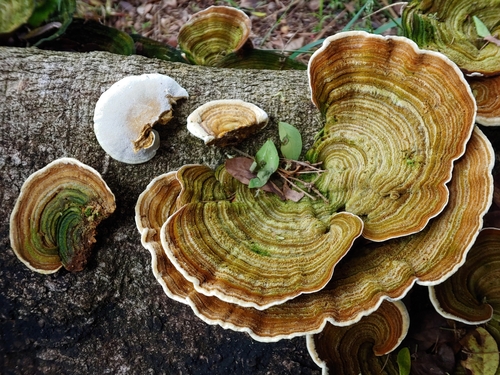
Verbatim
e0“Sequence analysis revealed homology of BS 1A with Pseudochrobactrum sp., BK 1 with Bacillus cereus, and FW 2B with Trametes polyzona.”
Claim · model-written summary
B. cereus application significantly elevated melon biomass and nutrient acquisition.
- Taxon
- melon
 Cucumis meloe1
- Treatment
- B. cereuse0
- Interactor
- B. cereusBacillus cereuse0other
- Outcome
- plant biomass and nutrient acquisitione0
- Direction
- elevatee0
- Setting
- greenhousee1
Not reportedComparator
Organisms pictured · Representative pictures of the matched species, not figures from the paper.

Verbatim
e0“The application of B. cereus, Pseudochrobactrum sp., and T. polyzona was observed to significantly elevate plant biomass and nutrient acquisition, with B. cereus demonstrating the most pronounced effect, rivalling that of chemical fertilization.”
e1“A greenhouse experiment employing a completely randomized design evaluated the effects of these isolates on melon growth.”
Claim · model-written summary
Pseudochrobactrum sp. application significantly elevated melon biomass and nutrient acquisition.
- Taxon
- melonCucumis meloe1
- Treatment
- Pseudochrobactrum sp.e0
- Interactor
- Pseudochrobactrum sp.Pseudochrobactrume0other
- Outcome
- plant biomass and nutrient acquisitione0
- Direction
- elevatee0
- Setting
- greenhousee1
Not reportedComparator
Organisms pictured · Representative pictures of the matched species, not figures from the paper.
Verbatim
e0“The application of B. cereus, Pseudochrobactrum sp., and T. polyzona was observed to significantly elevate plant biomass and nutrient acquisition, with B. cereus demonstrating the most pronounced effect, rivalling that of chemical fertilization.”
e1“A greenhouse experiment employing a completely randomized design evaluated the effects of these isolates on melon growth.”
Claim · model-written summary
T. polyzona application significantly elevated melon biomass and nutrient acquisition.
- Taxon
- melonCucumis meloe1
- Treatment
- T. polyzonae0
- Interactor
- T. polyzonaTrametes polyzonae0other
- Outcome
- plant biomass and nutrient acquisitione0
- Direction
- elevatee0
- Setting
- greenhousee1
Not reportedComparator
Organisms pictured · Representative pictures of the matched species, not figures from the paper.
Verbatim
e0“The application of B. cereus, Pseudochrobactrum sp., and T. polyzona was observed to significantly elevate plant biomass and nutrient acquisition, with B. cereus demonstrating the most pronounced effect, rivalling that of chemical fertilization.”
e1“A greenhouse experiment employing a completely randomized design evaluated the effects of these isolates on melon growth.”
Claim · model-written summary
B. cereus had the most pronounced melon growth-promoting effect, rivalling chemical fertilization.
- Taxon
- melonCucumis meloe1
- Treatment
- B. cereuse0
- Interactor
- B. cereusBacillus cereuse0other
- Outcome
- most pronounced effecte0
- Direction
- most pronouncede0
- Comparator
- chemical fertilizatione0
- Setting
- greenhousee1
Organisms pictured · Representative pictures of the matched species, not figures from the paper.
Verbatim
e0“with B. cereus demonstrating the most pronounced effect, rivalling that of chemical fertilization.”
e1“A greenhouse experiment employing a completely randomized design evaluated the effects of these isolates on melon growth.”
Claim · model-written summary
The authors conclude that selected soil microorganisms could act as biostimulants to increase melon productivity.
- Taxon
- melonCucumis meloe0
- Outcome
- utilizing select soil microorganisms as biostimulantse0
- Qualifier
- coulde0
Organisms pictured · Representative pictures of the matched species, not figures from the paper.
Verbatim
e0“The results of this study highlight the potential of utilizing select soil microorganisms as biostimulants, which could play a significant role in increasing the productivity of melon crops, thereby supporting the advancement of sustainable agricultural methodologies.”