Abstract
Maize (Zea mays) is the third most significant cereal crop in Pakistan. It plays a crucial role in the local diet and serves as a vital component in livestock fodder and poultry feed. Moreover, it has gained commercial importance in the food industry, contributing to the production of items such as corn oil, cornflakes, popcorn, and Rafhan. Its yield is severely affected by insect pests. Therefore, this study investigated the insect pest infestation and associated yield losses in maize crops in Maina, District Malakand. The experiment recorded the percentage of plant infestation by insect pests and quantified the resultant losses. Maize stem borer (Chilo partelus) exhibited a significant infestation of 23.50 %, followed by maize aphid (Rhopalosiphum maidis) at 15 % during the tasseling stage. Shootfly (Atherigona soccata) showed early-stage infestation with 9 %, and maize jassid (Zygenia sp) appeared with a population of 2 jassids/sweep net. Armyworm (Mythimna unipuncta) was also identified as a pest with 7.1 % plant infestation. The cumulative grain losses due to these pests were calculated as 1112 kg/ha. Maize cultivation in Pakistan holds significant economic importance, contributing to various sectors, and sustaining local diets. In this context, effective pest management strategies are crucial for optimizing maize yields. The study provides valuable insights into the dynamics of insect pest infestation and emphasizes the need for proactive measures to mitigate yield losses in maize cultivation. © 2018 The Author(s)
Abstract from the paper’s OpenAlex record; open copy licensed cc-by-nc. Read at the source ↗
The text the model read, with the source record’s inline markup (italics, sub- and superscripts) rendered and its character entities decoded; quote offsets refer to the raw text.
Claims 6
Claim · model-written summary
Maize stem borer infestation was 23.50%.
 Zea mays
Organisms pictured · Representative pictures of the matched species, not figures from the paper.

Verbatim
e0“Maize stem borer (Chilo partelus) exhibited a significant infestation of 23.50 %”
t0“maize crop”
Claim · model-written summary
Maize aphid infestation was 15% during tasseling.
- Organ / stage
- tasseling stagee0
- Interactor
- Rhopalosiphum maidis
 Rhopalosiphum maidise0pest
- Outcome
- maize aphide0
- Value
- 15 %e0
Organisms pictured · Representative pictures of the matched species, not figures from the paper.
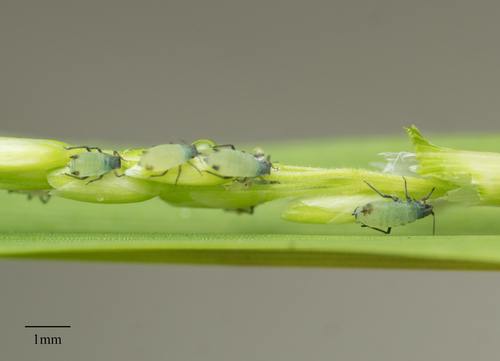
Verbatim
e0“maize aphid (Rhopalosiphum maidis) at 15 % during the tasseling stage”
t0“maize crop”
Claim · model-written summary
Shootfly infestation was 9% at an early stage.
- Organ / stage
- early-stagee0
- Interactor
- Atherigona soccata
 Atherigona soccatae0pest
- Outcome
- infestatione0
- Value
- 9 %e0
Organisms pictured · Representative pictures of the matched species, not figures from the paper.

Verbatim
e0“Shootfly (Atherigona soccata) showed early-stage infestation with 9 %”
t0“maize crop”
Claim · model-written summary
Maize jassid abundance was 2 jassids per sweep net.
Organisms pictured · Representative pictures of the matched species, not figures from the paper.
Verbatim
e0“maize jassid (Zygenia sp) appeared with a population of 2 jassids/sweep net”
t0“maize crop”
Claim · model-written summary
Armyworm infestation affected 7.1% of maize plants.
- Interactor
- Mythimna unipuncta
 Mythimna unipunctae0pest
- Outcome
- plant infestatione0
- Value
- 7.1 %e0
Organisms pictured · Representative pictures of the matched species, not figures from the paper.

Verbatim
e0“Armyworm (Mythimna unipuncta) was also identified as a pest with 7.1 % plant infestation”
t0“maize crop”
Claim · model-written summary
Cumulative maize grain loss from the pests was 1112 kg/ha.
Not reportedInteractorInteractor role
Organisms pictured · Representative pictures of the matched species, not figures from the paper.
Verbatim
e0“The cumulative grain losses due to these pests were calculated as 1112 kg/ha”
t0“maize crop”