Abstract
ABSTRACT Plants have developed defense mechanisms against herbivory, including stinging trichomes. Unlike smaller trichomes, which deter insects, the larger, biomineralized, stinging trichomes in Urticaceae defend plants from mammals. The trichome tip breaks off, pierces the skin, and injects irritants, causing an immediate sensation of pain. The herbivore will cease consuming the plant. Some herbivores process and consume nettles. Volcanoes National Park (VNP) in Rwanda provides habitat for several large folivores, including the endangered mountain gorilla ( Gorilla beringei beringei ). VNP mountain gorillas feed on stinging nettle species, including Laportea alatipes , Urtica massaica , and Girardinia bullosa . We investigated the link between the importance (proportion) of these stinging nettles in the diet of gorilla groups ranging in the southwest of VNP and their level of defense through assessing trichome density, length, and glandular base length from each plant organ of 15 specimens per nettle species, which were photographed with a scale ruler under a digital microscope. We also videotaped 12 mountain gorillas consuming L. alatipes to examine adapted feeding techniques to cope with stinging trichomes. We found that L. alatipes , which is consumed most frequently of the three study nettles, had a significantly higher stinging trichome density compared to U. massaica and G. bullosa . However, the length of stinging trichomes and glandular bases containing irritating secretions were significantly smaller in L. alatipes and U. massaica than in G. bullosa , from which gorillas almost exclusively avoid consuming aboveground organs covered with long trichomes. This suggests that larger stinging trichomes and secretory glandular bases offer a more effective defense against mountain gorillas than increased trichome density. The trichome density of L. alatipes tended to be higher on top leaves and stem sections, which are consumed by gorillas more frequently compared to lower parts. Plants have evolved in an intricate way to adapt to herbivores' attacks.
Abstract from the paper’s OpenAlex record; open copy licensed cc-by. Read at the source ↗
The text the model read, with the source record’s inline markup (italics, sub- and superscripts) rendered and its character entities decoded; quote offsets refer to the raw text.
Claims 6
Claim · model-written summary
Laportea alatipes, most frequently consumed, had higher trichome density than the two other nettles.
- Taxon
- L. alatipesLaportea alatipese0
- Outcome
- stinging trichome densitye0
- Direction
- highere0
- Comparator
- U. massaica and G. bullosae0
 Gorilla
Organisms pictured · Representative pictures of the matched species, not figures from the paper.

Verbatim
e0“L. alatipes , which is consumed most frequently of the three study nettles, had a significantly higher stinging trichome density compared to U. massaica and G. bullosa .”
e1“VNP mountain gorillas feed on stinging nettle species”
Claim · model-written summary
L. alatipes and U. massaica had shorter stinging trichomes than G. bullosa.
Verbatim
e0“the length of stinging trichomes and glandular bases containing irritating secretions were significantly smaller in L. alatipes and U. massaica than in G. bullosa”
Claim · model-written summary
L. alatipes and U. massaica had smaller glandular bases than G. bullosa.
Verbatim
e0“the length of stinging trichomes and glandular bases containing irritating secretions were significantly smaller in L. alatipes and U. massaica than in G. bullosa”
Claim · model-written summary
Gorillas almost exclusively avoided aboveground organs of G. bullosa with long trichomes.
- Taxon
- G. bullosa
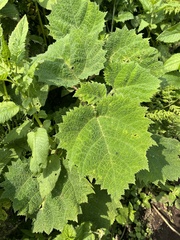 Girardinia bullosae0
- Organ / stage
- aboveground organse0
- Outcome
- avoid consuming aboveground organse0
- Direction
- avoide0
Organisms pictured · Representative pictures of the matched species, not figures from the paper.
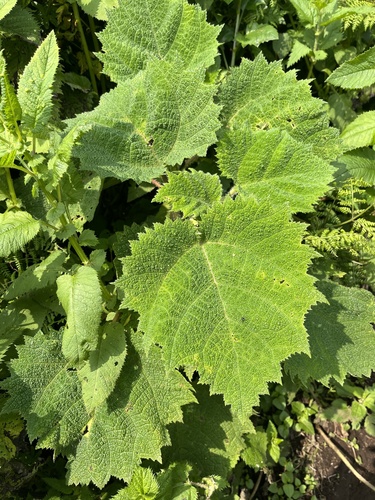
Verbatim
e0“G. bullosa , from which gorillas almost exclusively avoid consuming aboveground organs covered with long trichomes.”
Claim · model-written summary
Authors infer that larger trichomes and glandular bases defend nettles more effectively against gorillas than high density.
- Taxon
- stinging nettle species
 Urtica dioicae1
- Organ / stage
- stinging trichomes and secretory glandular basese0
- Interactor
- mountain gorillas
 Gorilla beringeie0herbivore
- Outcome
- more effective defense against mountain gorillase0
Organisms pictured · Representative pictures of the matched species, not figures from the paper.


Verbatim
e0“This suggests that larger stinging trichomes and secretory glandular bases offer a more effective defense against mountain gorillas than increased trichome density.”
e1“stinging nettle species”
Claim · model-written summary
L. alatipes trichome density tended to be higher on top leaves and stem sections, which gorillas consumed more.
- Taxon
- L. alatipesLaportea alatipese0
- Organ / stage
- top leaves and stem sectionse0
- Outcome
- trichome densitye0
- Direction
- highere0
- Comparator
- lower partse0
Organisms pictured · Representative pictures of the matched species, not figures from the paper.
Verbatim
e0“The trichome density of L. alatipes tended to be higher on top leaves and stem sections, which are consumed by gorillas more frequently compared to lower parts.”