Abstract
Spot blotch disease of wheat caused by Bipolaris sorokiniana is one of the most concerning diseases of wheat, significantly constraining production over the last four decades. An estimated 25 million hectares of wheat grain are affected by spot blotch, particularly in humid and high temperature regions. The study was conducted at Agriculture and Forestry University, Rampur, Chitwan, in 2023 with the objective to characterize the morphological traits of B. sorokiniana and manage the disease using botanicals under laboratory conditions. The research included a field survey of ten locations in Chitwan to identify the severity of spot blotch disease using double digit scoring, morphological variations of B. sorokiniana conidia isolated from those locations, and in vitro management of the pathogen using botanical extracts (at 15 % concentration). The study revealed that the disease was most severe at Bijaynagar, Bharatpur-16, which recorded the highest number of spots per leaf (23) and the largest spot area (0.170 cm2). Isolate of B. sorokiniana from Bijaynagar has highest radial mycelium growth (8.62 cm). Among nine botanical extracts, garlic clove and neem extract effectively inhibited pathogen mycelial growth by 63.22% and 61.15 %, respectively. The study helped to identify severely affected locations in the Chitwan district along with potential efficient management options of B. sorokiniana.
Abstract from the paper’s OpenAlex record, shown for indexing and research. Copyright remains with the authors or the publisher. Read at the source ↗
The text the model read, with the source record’s inline markup (italics, sub- and superscripts) rendered and its character entities decoded; quote offsets refer to the raw text.
Claims 5
Claim · model-written summary
Spot blotch at Bijaynagar had the highest number of spots per leaf (23).
- Taxon
- wheat
 Triticum aestivumt0
- Interactor
- Bipolaris sorokiniana
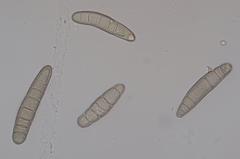 Bipolaris sorokinianat0pathogen
- Outcome
- number of spots per leafe0
- Direction
- higheste0
- Value
- 23e0
- Setting
- Bijaynagar, Bharatpur-16e0
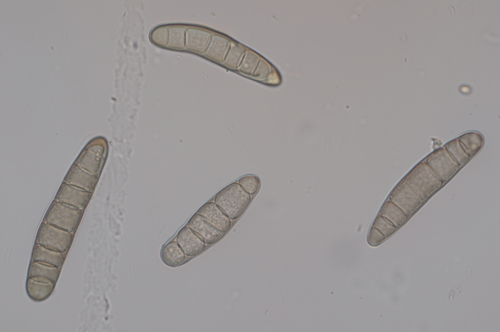
Organisms pictured · Representative pictures of the matched species, not figures from the paper.

Verbatim
e0“The study revealed that the disease was most severe at Bijaynagar, Bharatpur-16, which recorded the highest number of spots per leaf (23) and the largest spot area (0.170 cm2).”
t0“Bipolaris sorokiniana Causing Spot Blotch of Wheat”
Claim · model-written summary
Spot blotch at Bijaynagar had the largest spot area (0.170 cm2).
- Taxon
- wheatTriticum aestivumt0
- Interactor
- Bipolaris sorokinianaBipolaris sorokinianat0pathogen
- Outcome
- spot areae0
- Direction
- largeste0
- Value
- 0.170 cm2e0
- Setting
- Bijaynagar, Bharatpur-16e0
Organisms pictured · Representative pictures of the matched species, not figures from the paper.
Verbatim
e0“The study revealed that the disease was most severe at Bijaynagar, Bharatpur-16, which recorded the highest number of spots per leaf (23) and the largest spot area (0.170 cm2).”
t0“Bipolaris sorokiniana Causing Spot Blotch of Wheat”
Claim · model-written summary
The Bijaynagar isolate had the highest B. sorokiniana radial mycelium growth at 8.62 cm.
- Taxon
- wheatTriticum aestivumt0
- Interactor
- B. sorokinianaBipolaris sorokinianae0pathogen
- Outcome
- radial mycelium growthe0
- Direction
- higheste0
- Value
- 8.62 cme0
- Setting
- Bijaynagare0
Organisms pictured · Representative pictures of the matched species, not figures from the paper.
Verbatim
e0“Isolate of B. sorokiniana from Bijaynagar has highest radial mycelium growth (8.62 cm).”
t0“Wheat”
Claim · model-written summary
garlic clove inhibited pathogen mycelial growth by 63.22% in vitro.
- Taxon
- wheatTriticum aestivumt0
- Treatment
- garlic clovee0
- Interactor
- Bipolaris sorokinianaBipolaris sorokinianat0pathogen
- Outcome
- pathogen mycelial growthe0
- Direction
- inhibitede0
- Value
- 63.22%e0
Not reportedComparator
Organisms pictured · Representative pictures of the matched species, not figures from the paper.
Verbatim
e0“Among nine botanical extracts, garlic clove and neem extract effectively inhibited pathogen mycelial growth by 63.22% and 61.15 %, respectively.”
t0“Bipolaris sorokiniana Causing Spot Blotch of Wheat”
Claim · model-written summary
neem extract inhibited pathogen mycelial growth by 61.15 % in vitro.
- Taxon
- wheatTriticum aestivumt0
- Treatment
- neem extracte0
- Interactor
- Bipolaris sorokinianaBipolaris sorokinianat0pathogen
- Outcome
- pathogen mycelial growthe0
- Direction
- inhibitede0
- Value
- 61.15 %e0
Not reportedComparator
Organisms pictured · Representative pictures of the matched species, not figures from the paper.
Verbatim
e0“Among nine botanical extracts, garlic clove and neem extract effectively inhibited pathogen mycelial growth by 63.22% and 61.15 %, respectively.”
t0“Bipolaris sorokiniana Causing Spot Blotch of Wheat”
The same questions in other papers
Azadirachta indica · Bipolaris sorokiniana · Triticum aestivum (wheat)Results agree
1 paper in the same direction as this paper
- positive
Allium sativum · Bipolaris sorokiniana · Triticum aestivum (wheat)Results agree
2 papers in the same direction as this paper
- positive
- positive
Syzygium aromaticum · Bipolaris sorokiniana · Triticum aestivum (wheat)Results agree
2 papers in the same direction as this paper
- positive
- positive
botanical · Bipolaris sorokiniana · Triticum aestivum (wheat)Positive and negative results
8 papers in the same direction as this paper · 1 in the opposite direction
- negative
- positive
- positive
6 papers more in this group
See all 10 papers →Claims are grouped by organism, treatment and what was measured or targeted. A paper counts as positive when any of its claims in the group is positive.