Abstract
The demand of natural rubber has increased continuously with the increase in population and living standards of the human being. Rubber plantations are also a major resource of timber and fuel wood. In order to meet the continuous increase in demand for latex, timber and fuel wood, the productivity of rubber plantations should be increased. Whilst producing high yielding clones for improved latex and timber yield per tree which is a long-term process in perennial crops, planting density could be adjusted to obtain high productivity in rubber plantations. The present level of planting density of rubber in Sri Lanka has been decided on the experiments conducted with the genotypes which are not in common use at the moment. Also, the optimum density should vary with different socio-economic conditions. Therefore, the present study was aimed to identify the suitable planting density for the recently developed and commonly used genotypes of rubber. This paper is focused to assess the timber production of rubber with respect to high density planting. The experiment was set up in Ratnapura district of Sri Lanka in 1992. Rubber was planted in three high densities, i.e., 600, 700 and 800 trees per hectare, with the presently recommended level of 500 trees per hectare. Also, three genotypes (clones) i.e., RRIC 100, RRIC 110 and RRIC 121 were incorporated with the statistical design of split plot where the planting densities were laid as the main plots whilst clones were in the sub plots. Five trees in each sub plot were selected randomly and were used for the measurements of total tree height (TH), crown height (CH), thickness of the untapped bark (BT) and tree diameter at breast height at 11 years after planting (11 YAP). Thereafter, stem volumes were determined using Newton’s formula. Both TH and CH did not vary significantly among planting densities tested. Though not statistically significant, there was a marginal decrease in tree diameter with the increase in planting density. Irrespective of the clone used, BT and mean merchantable timber volume per tree decreased significantly with increase in planting density. Nevertheless, this decline was compensated by increased number of trees in high densities resulting in comparable levels of merchantable volume per hectare among different densities. Total stem volume per tree remained same among four densities tested with that total stem volume per hectare increased significantly with the increase in planting density. Therefore, higher densities are more useful in the industries of fuel wood, pulp, MDF boards etc. Among the clones tested, the clone RRIC 121 outperformed in growth and timber production. The clone RRIC 110 was infected with Corynespora leaf disease hence showed poor performance in all densities. Despite the increase in total timber production with the increase in planting density, overall financial viability of different densities is to be assessed considering all cost components and valuing both timber and latex produced before making any firm recommendation.
Abstract from the paper’s OpenAlex record, shown for indexing and research. Copyright remains with the authors or the publisher. Read at the source ↗
The text the model read, with the source record’s inline markup (italics, sub- and superscripts) rendered and its character entities decoded; quote offsets refer to the raw text.
Claims 9
Claim · model-written summary
Tree height and crown height did not vary significantly among planting densities.
- Taxon
- Hevea brasiliensis
 Hevea brasiliensist0
- Treatment
- planting densitiese2
- Outcome
- TH and CHe2
- Direction
- did not varye2
- Comparator
- 500 trees per hectaree1
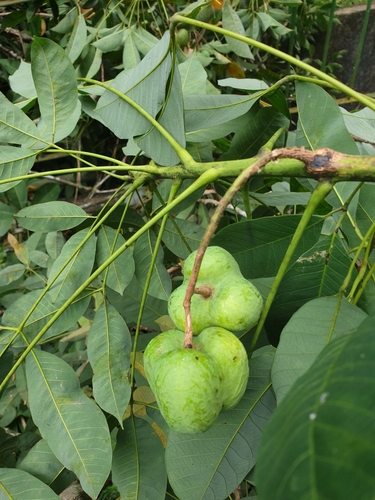
Organisms pictured · Representative pictures of the matched species, not figures from the paper.
Verbatim
t0“Hevea brasiliensis”
e1“Rubber was planted in three high densities, i.e., 600, 700 and 800 trees per hectare, with the presently recommended level of 500 trees per hectare”
e2“Both TH and CH did not vary significantly among planting densities tested”
Claim · model-written summary
Tree diameter showed a marginal, non-significant decrease with increasing planting density.
- Taxon
- Hevea brasiliensisHevea brasiliensist0
- Treatment
- planting densitye3
- Outcome
- tree diametere3
- Direction
- decreasee3
- Comparator
- 500 trees per hectaree1
Organisms pictured · Representative pictures of the matched species, not figures from the paper.
Verbatim
t0“Hevea brasiliensis”
e1“Rubber was planted in three high densities, i.e., 600, 700 and 800 trees per hectare, with the presently recommended level of 500 trees per hectare”
e3“Though not statistically significant, there was a marginal decrease in tree diameter with the increase in planting density”
Claim · model-written summary
Bark thickness and mean merchantable timber volume per tree decreased significantly with increasing planting density.
- Taxon
- Hevea brasiliensisHevea brasiliensist0
- Treatment
- planting densitye4
- Outcome
- BT and mean merchantable timber volume per treee4
- Direction
- decreasede4
- Comparator
- 500 trees per hectaree1
Organisms pictured · Representative pictures of the matched species, not figures from the paper.
Verbatim
t0“Hevea brasiliensis”
e1“Rubber was planted in three high densities, i.e., 600, 700 and 800 trees per hectare, with the presently recommended level of 500 trees per hectare”
e4“Irrespective of the clone used, BT and mean merchantable timber volume per tree decreased significantly with increase in planting density”
Claim · model-written summary
Merchantable volume per hectare was comparable among planting densities.
- Taxon
- Hevea brasiliensisHevea brasiliensist0
- Treatment
- different densitiese5
- Outcome
- merchantable volume per hectaree5
- Direction
- comparablee5
- Comparator
- 500 trees per hectaree1
Organisms pictured · Representative pictures of the matched species, not figures from the paper.
Verbatim
t0“Hevea brasiliensis”
e1“Rubber was planted in three high densities, i.e., 600, 700 and 800 trees per hectare, with the presently recommended level of 500 trees per hectare”
e5“resulting in comparable levels of merchantable volume per hectare among different densities”
Claim · model-written summary
Total stem volume per tree remained the same among the four planting densities.
- Taxon
- Hevea brasiliensisHevea brasiliensist0
- Treatment
- four densities testede6
- Outcome
- Total stem volume per treee6
- Direction
- remained samee6
- Comparator
- 500 trees per hectaree1
Organisms pictured · Representative pictures of the matched species, not figures from the paper.
Verbatim
t0“Hevea brasiliensis”
e1“Rubber was planted in three high densities, i.e., 600, 700 and 800 trees per hectare, with the presently recommended level of 500 trees per hectare”
e6“Total stem volume per tree remained same among four densities tested with that total stem volume per hectare increased significantly with the increase in planting density”
Claim · model-written summary
Total stem volume per hectare increased significantly with planting density.
- Taxon
- Hevea brasiliensisHevea brasiliensist0
- Treatment
- planting densitye6
- Outcome
- total stem volume per hectaree6
- Direction
- increasede6
- Comparator
- 500 trees per hectaree1
Organisms pictured · Representative pictures of the matched species, not figures from the paper.
Verbatim
t0“Hevea brasiliensis”
e1“Rubber was planted in three high densities, i.e., 600, 700 and 800 trees per hectare, with the presently recommended level of 500 trees per hectare”
e6“Total stem volume per tree remained same among four densities tested with that total stem volume per hectare increased significantly with the increase in planting density”
Claim · model-written summary
Clone RRIC 121 outperformed the other tested clones in growth and timber production.
- Taxon
- Hevea brasiliensisHevea brasiliensist0
- Material
- RRIC 121e7
- Outcome
- growth and timber productione7
- Direction
- outperformede7
- Comparator
- clones testede7
Organisms pictured · Representative pictures of the matched species, not figures from the paper.
Verbatim
t0“Hevea brasiliensis”
e7“Among the clones tested, the clone RRIC 121 outperformed in growth and timber production”
Claim · model-written summary
Clone RRIC 110, infected with Corynespora leaf disease, performed poorly in all densities.
- Taxon
- Hevea brasiliensisHevea brasiliensist0
- Material
- RRIC 110e0
- Interactor
- Corynespora
 Corynesporae0pathogen
- Outcome
- performancee0
- Qualifier
- in all densitiese0
Organisms pictured · Representative pictures of the matched species, not figures from the paper.

Verbatim
t0“Hevea brasiliensis”
e0“The clone RRIC 110 was infected with Corynespora leaf disease hence showed poor performance in all densities”
Claim · model-written summary
Higher planting densities are more useful for the fuel wood, pulp and MDF board industries.
- Taxon
- Hevea brasiliensisHevea brasiliensist0
- Outcome
- higher densitiese0
- Qualifier
- more useful in the industries of fuel wood, pulp, MDF boardse0
Organisms pictured · Representative pictures of the matched species, not figures from the paper.
Verbatim
t0“Hevea brasiliensis”
e0“Therefore, higher densities are more useful in the industries of fuel wood, pulp, MDF boards etc”