Abstract
ABSTRACT Rice brown spot (RBS), mainly caused by Bipolaris oryzae , is an emerging threat to rice production across Africa, particularly within lowland rice ecosystems that dominate the region. Despite its growing impact, knowledge of the environmental factors influencing RBS occurrence remains limited. This study aimed to elucidate the influence of meteorological variables on RBS prevalence in Côte d'Ivoire, spanning three major agro‐ecological zones. Field surveys were conducted in 99 farmer‐managed fields during both the rainy and dry seasons from 2021 to 2022, and average RBS severity was calculated across different stands within each field. Parameters assessed included air temperature, relative humidity, wind speed, soil moisture, solar radiation, and rainfall. Linear regression analyses were used to identify main drivers, and regression models were developed to project future risk maps under SSP2‐4.5 (moderate) and SSP5‐8.5 (high) climate scenarios. Key drivers were identified: air temperatures above 27°C and wind speeds exceeding 1 m/s were associated with decreased disease prevalence, whereas relative humidity above 80%, wet bulb and dew point temperatures between 23°C and 27°C, and soil moisture and wetness in the range of 0.4–0.7 significantly promoted RBS development. Results revealed a yearly increase in RBS severity, ranging from 2.47 to 3.46 (on a 0–5 scale), with consistently higher prevalence during the rainy seasons. Predictive modelling based on these variables suggests a likely expansion and intensification of RBS risk for the future. Under a high‐emission scenario, RBS severity could reach 4.9 by the late 21st century, while the moderate scenario projects a peak severity of 4.33 between 2060 and 2080. These findings underscore the pivotal role of climate in shaping RBS risk and highlight the urgent need for climate‐adaptive disease management strategies to sustain rice production in Africa.
Abstract from the paper’s OpenAlex record, shown for indexing and research. Copyright remains with the authors or the publisher. Read at the source ↗
The text the model read, with the source record’s inline markup (italics, sub- and superscripts) rendered and its character entities decoded; quote offsets refer to the raw text.
Claims 11
Claim · model-written summary
Air temperatures above 27 C were associated with decreased rice brown spot prevalence.
- Taxon
- Rice
 Oryza sativae0
- Treatment
- air temperatures above 27°Ce1
- Interactor
- Bipolaris oryzae
 Bipolaris oryzaee0pathogen
- Outcome
- disease prevalencee1
- Direction
- decreasede1
Organisms pictured · Representative pictures of the matched species, not figures from the paper.

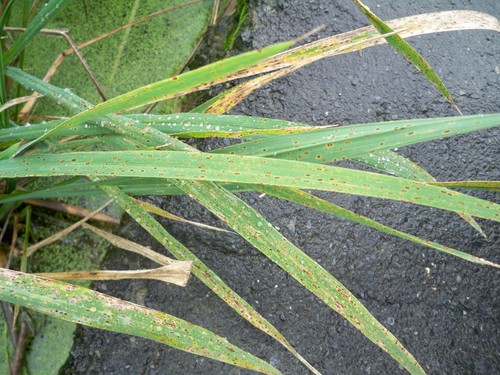
Verbatim
e0“Rice brown spot (RBS), mainly caused by Bipolaris oryzae”
e1“air temperatures above 27°C and wind speeds exceeding 1 m/s were associated with decreased disease prevalence”
Claim · model-written summary
Wind speeds exceeding 1 m/s were associated with decreased rice brown spot prevalence.
- Taxon
- RiceOryza sativae0
- Treatment
- wind speeds exceeding 1 m/se1
- Interactor
- Bipolaris oryzaeBipolaris oryzaee0pathogen
- Outcome
- disease prevalencee1
- Direction
- decreasede1
Organisms pictured · Representative pictures of the matched species, not figures from the paper.
Verbatim
e0“Rice brown spot (RBS), mainly caused by Bipolaris oryzae”
e1“air temperatures above 27°C and wind speeds exceeding 1 m/s were associated with decreased disease prevalence”
Claim · model-written summary
Relative humidity above 80% significantly promoted rice brown spot development.
- Taxon
- RiceOryza sativae0
- Treatment
- relative humidity above 80%e1
- Interactor
- Bipolaris oryzaeBipolaris oryzaee0pathogen
- Outcome
- RBS developmente2
- Direction
- promotede2
Organisms pictured · Representative pictures of the matched species, not figures from the paper.
Verbatim
e0“Rice brown spot (RBS), mainly caused by Bipolaris oryzae”
e1“relative humidity above 80%”
e2“significantly promoted RBS development”
Claim · model-written summary
Wet bulb and dew point temperatures between 23 C and 27 C significantly promoted rice brown spot development.
- Taxon
- RiceOryza sativae0
- Treatment
- wet bulb and dew point temperatures between 23°C and 27°Ce1
- Interactor
- Bipolaris oryzaeBipolaris oryzaee0pathogen
- Outcome
- RBS developmente2
- Direction
- promotede2
Organisms pictured · Representative pictures of the matched species, not figures from the paper.
Verbatim
e0“Rice brown spot (RBS), mainly caused by Bipolaris oryzae”
e1“wet bulb and dew point temperatures between 23°C and 27°C”
e2“significantly promoted RBS development”
Claim · model-written summary
Soil moisture and wetness in the range of 0.4-0.7 significantly promoted rice brown spot development.
- Taxon
- RiceOryza sativae0
- Treatment
- soil moisture and wetness in the range of 0.4–0.7e1
- Interactor
- Bipolaris oryzaeBipolaris oryzaee0pathogen
- Outcome
- RBS developmente2
- Direction
- promotede2
Organisms pictured · Representative pictures of the matched species, not figures from the paper.
Verbatim
e0“Rice brown spot (RBS), mainly caused by Bipolaris oryzae”
e1“soil moisture and wetness in the range of 0.4–0.7”
e2“significantly promoted RBS development”
Claim · model-written summary
Rice brown spot severity increased yearly, ranging from 2.47 to 3.46 on a 0-5 scale.
- Taxon
- RiceOryza sativae0
- Outcome
- RBS severitye1
- Value
- 2.47 to 3.46e1
- Qualifier
- on a 0–5 scalee1
Organisms pictured · Representative pictures of the matched species, not figures from the paper.
Verbatim
e0“Rice brown spot (RBS), mainly caused by Bipolaris oryzae”
e1“a yearly increase in RBS severity, ranging from 2.47 to 3.46 (on a 0–5 scale)”
Claim · model-written summary
Rice brown spot prevalence was consistently higher during the rainy seasons.
- Taxon
- RiceOryza sativae0
- Treatment
- rainy seasonse1
- Interactor
- Bipolaris oryzaeBipolaris oryzaee0pathogen
- Outcome
- prevalencee1
- Direction
- highere1
Organisms pictured · Representative pictures of the matched species, not figures from the paper.
Verbatim
e0“Rice brown spot (RBS), mainly caused by Bipolaris oryzae”
e1“consistently higher prevalence during the rainy seasons”
Claim · model-written summary
Predictive modelling suggests a likely expansion and intensification of rice brown spot risk in the future.
- Taxon
- RiceOryza sativae0
- Outcome
- RBS riske1
Organisms pictured · Representative pictures of the matched species, not figures from the paper.
Verbatim
e0“Rice brown spot (RBS), mainly caused by Bipolaris oryzae”
e1“Predictive modelling based on these variables suggests a likely expansion and intensification of RBS risk for the future”
Claim · model-written summary
Under a high-emission scenario, rice brown spot severity could reach 4.9 by the late 21st century.
- Taxon
- RiceOryza sativae0
- Outcome
- RBS severitye1
- Value
- 4.9e1
- Qualifier
- Under a high‐emission scenarioe1
Organisms pictured · Representative pictures of the matched species, not figures from the paper.
Verbatim
e0“Rice brown spot (RBS), mainly caused by Bipolaris oryzae”
e1“Under a high‐emission scenario, RBS severity could reach 4.9 by the late 21st century”
Claim · model-written summary
Under the moderate scenario, rice brown spot is projected to peak at severity 4.33 between 2060 and 2080.
- Taxon
- RiceOryza sativae0
- Outcome
- peak severitye1
- Value
- 4.33e1
- Qualifier
- between 2060 and 2080e1
Organisms pictured · Representative pictures of the matched species, not figures from the paper.
Verbatim
e0“Rice brown spot (RBS), mainly caused by Bipolaris oryzae”
e1“the moderate scenario projects a peak severity of 4.33 between 2060 and 2080”
Claim · model-written summary
The authors conclude there is an urgent need for climate-adaptive disease management strategies to sustain rice production in Africa.
- Taxon
- riceOryza sativae1
- Outcome
- climate‐adaptive disease management strategiese1
Organisms pictured · Representative pictures of the matched species, not figures from the paper.
Verbatim
e1“urgent need for climate‐adaptive disease management strategies to sustain rice production in Africa”