Claim · model-written summary
Soil moisture and wetness in the range of 0.4-0.7 significantly promoted rice brown spot development.
- Taxon
- Rice
 Oryza sativae0
- Treatment
- soil moisture and wetness in the range of 0.4–0.7e1
- Interactor
- Bipolaris oryzae
 Bipolaris oryzaee0pathogen
- Outcome
- RBS developmente2
- Direction
- promotede2
Not reportedMaterialGeneCompoundOrgan / stageSecond interactorSecond interactor roleComparatorSettingValueQualifier
Organisms pictured · Representative pictures of the matched species, not figures from the paper.

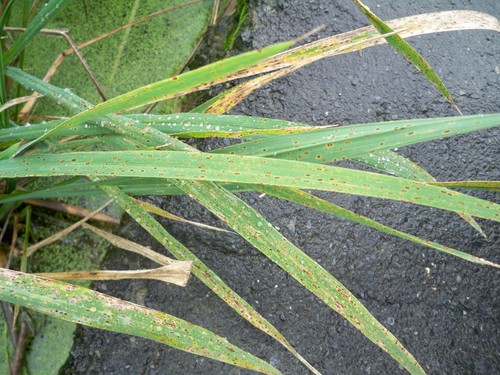
Verbatim
e0“Rice brown spot (RBS), mainly caused by Bipolaris oryzae”
e1“soil moisture and wetness in the range of 0.4–0.7”
e2“significantly promoted RBS development”
Title
Forecasting the Rising Threat: How Climate Change Could Amplify Rice Brown Spot in Côte d'Ivoire
Jean Fabrice Adanve; Brahima Kone; Rachidatou Sikirou; et al. Journal of Phytopathology 2026. doi:10.1111/jph.70218
Other claims from this paper (10)
- Association Air temperatures above 27 C were associated with decreased rice brown spot prevalence.
- Association Wind speeds exceeding 1 m/s were associated with decreased rice brown spot prevalence.
- Association Relative humidity above 80% significantly promoted rice brown spot development.
- Association Wet bulb and dew point temperatures between 23 C and 27 C significantly promoted rice brown spot development.
- Observation Rice brown spot severity increased yearly, ranging from 2.47 to 3.46 on a 0-5 scale.
- Association Rice brown spot prevalence was consistently higher during the rainy seasons.
- Observation Predictive modelling suggests a likely expansion and intensification of rice brown spot risk in the future.
- Observation Under a high-emission scenario, rice brown spot severity could reach 4.9 by the late 21st century.
- Observation Under the moderate scenario, rice brown spot is projected to peak at severity 4.33 between 2060 and 2080.
- Recommendation The authors conclude there is an urgent need for climate-adaptive disease management strategies to sustain rice production in Africa.