Abstract
Large-scale open-pit coal mining can create pronounced environmental gradients around mine sites. These gradients are often accompanied by coal-dust dispersion and elevated heavy-metal loads in surrounding soils, which may alter physiological and ecological processes of vegetation. As a key indicator of plant carbon balance, non-structural carbohydrates (NSC) provide valuable insights into plant adaptive strategies to mining-associated disturbances through their spatial distribution patterns. In this study, three typical desert shrubs, including Haloxylon ammodendron, Nitraria tangutorum, and Reaumuria songarica, were investigated in the Zhundong open-pit coal mining area of Xinjiang, China. Sampling transects were established in four directions, each comprising seven distance gradients, to collect branch and leaf samples for the analysis of NSC and its components, soluble sugars (SS), and starch (ST). The results revealed significant species- and organ-specific patterns in NSC dynamics. Variability was generally higher in branches than in leaves for NSC, SS, and ST, with R. songarica exhibiting the lowest overall variability. Spatially, NSC in branches and leaves exhibited pronounced species- and organ-specific differentiation along both directional and distance gradients. Branch NSC peaked upwind (N) in H. ammodendron and downwind (SE1; southeast transect 1) in R. songarica, reflecting their divergent adaptive strategies to heterogeneous mining environments. Furthermore, N. tangutorum consistently displayed higher NSC and component concentrations in both organs compared to the other species, while leaves universally contained higher concentrations than branches. Redundancy analysis and hierarchical partitioning identified the primary environmental predictors of NSC variation (based on the measured soil-derived variables) as heavy metals (Cr) for H. ammodendron, soil pH and nitrogen for N. tangutorum, and water and nutrient availability for R. songarica. Overall, branch NSC was mainly associated with heavy metals, whereas leaf NSC was more closely associated with water and nitrogen, exhibiting particular sensitivity to nitrogen availability. Importantly, this study elucidates the species- and organ-specific carbon allocation strategies of desert shrubs across mining-associated soil environmental gradients, providing physiological and ecological insights for vegetation restoration and ecological rehabilitation in arid open-pit mining regions.
Abstract from the paper’s OpenAlex record; open copy licensed cc-by-nc-nd. Read at the source ↗
The text the model read, with the source record’s inline markup (italics, sub- and superscripts) rendered and its character entities decoded; quote offsets refer to the raw text.
Claims 9
Claim · model-written summary
Nitraria tangutorum showed consistently higher NSC and component concentrations in both organs than the other species.
- Taxon
- Nitraria tangutorum
 Nitraria tangutorume0
- Organ / stage
- both organse3
- Outcome
- NSC and component concentrationse3
- Direction
- highere3
- Comparator
- the other speciese3
Organisms pictured · Representative pictures of the matched species, not figures from the paper.
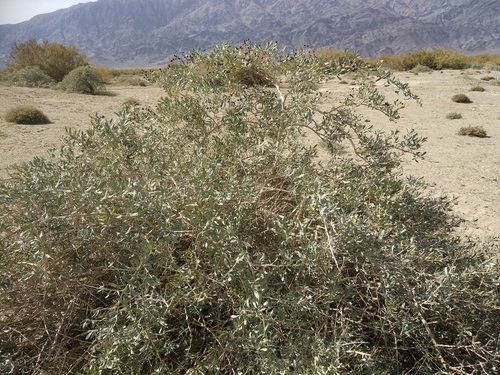
Verbatim
e0“three typical desert shrubs, including Haloxylon ammodendron, Nitraria tangutorum, and Reaumuria songarica, were investigated in the Zhundong open-pit coal mining area of Xinjiang, China”
e3“Furthermore, N. tangutorum consistently displayed higher NSC and component concentrations in both organs compared to the other species, while leaves universally contained higher concentrations than branches”
Claim · model-written summary
Leaves universally contained higher NSC and component concentrations than branches.
Verbatim
e0“three typical desert shrubs, including Haloxylon ammodendron, Nitraria tangutorum, and Reaumuria songarica, were investigated in the Zhundong open-pit coal mining area of Xinjiang, China”
e3“Furthermore, N. tangutorum consistently displayed higher NSC and component concentrations in both organs compared to the other species, while leaves universally contained higher concentrations than branches”
Claim · model-written summary
NSC variability was generally higher in branches than in leaves for NSC, SS and ST.
Verbatim
e0“three typical desert shrubs, including Haloxylon ammodendron, Nitraria tangutorum, and Reaumuria songarica, were investigated in the Zhundong open-pit coal mining area of Xinjiang, China”
e1“Variability was generally higher in branches than in leaves for NSC, SS, and ST, with R. songarica exhibiting the lowest overall variability”
Claim · model-written summary
Reaumuria songarica exhibited the lowest overall variability.
- Taxon
- Reaumuria songarica
 Reaumuria songaricae0
- Outcome
- overall variabilitye1
- Direction
- loweste1
- Setting
- Zhundong open-pit coal mining area of Xinjiang, Chinae0
Organisms pictured · Representative pictures of the matched species, not figures from the paper.
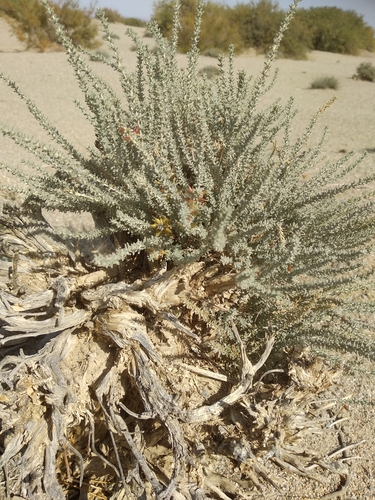
Verbatim
e0“three typical desert shrubs, including Haloxylon ammodendron, Nitraria tangutorum, and Reaumuria songarica, were investigated in the Zhundong open-pit coal mining area of Xinjiang, China”
e1“Variability was generally higher in branches than in leaves for NSC, SS, and ST, with R. songarica exhibiting the lowest overall variability”
Claim · model-written summary
NSC variation in Haloxylon ammodendron was identified with heavy metals (Cr) as the primary environmental predictor.
- Taxon
- Haloxylon ammodendron
 Haloxylon ammodendrone0
- Compound
- heavy metals (Cr)e4
- Outcome
- NSC variatione4
Not reportedDirection
Organisms pictured · Representative pictures of the matched species, not figures from the paper.

Verbatim
e0“three typical desert shrubs, including Haloxylon ammodendron, Nitraria tangutorum, and Reaumuria songarica, were investigated in the Zhundong open-pit coal mining area of Xinjiang, China”
e4“Redundancy analysis and hierarchical partitioning identified the primary environmental predictors of NSC variation (based on the measured soil-derived variables) as heavy metals (Cr) for H. ammodendron, soil pH and nitrogen for N. tangutorum, and water and nutrient availability for R. songarica”
Claim · model-written summary
NSC variation in Nitraria tangutorum was identified with soil pH and nitrogen as the primary environmental predictors.
- Taxon
- Nitraria tangutorumNitraria tangutorume0
- Compound
- soil pH and nitrogene4
- Outcome
- NSC variatione4
Not reportedDirection
Organisms pictured · Representative pictures of the matched species, not figures from the paper.
Verbatim
e0“three typical desert shrubs, including Haloxylon ammodendron, Nitraria tangutorum, and Reaumuria songarica, were investigated in the Zhundong open-pit coal mining area of Xinjiang, China”
e4“Redundancy analysis and hierarchical partitioning identified the primary environmental predictors of NSC variation (based on the measured soil-derived variables) as heavy metals (Cr) for H. ammodendron, soil pH and nitrogen for N. tangutorum, and water and nutrient availability for R. songarica”
Claim · model-written summary
NSC variation in Reaumuria songarica was identified with water and nutrient availability as the primary environmental predictor.
- Taxon
- Reaumuria songaricaReaumuria songaricae0
- Compound
- water and nutrient availabilitye4
- Outcome
- NSC variatione4
Not reportedDirection
Organisms pictured · Representative pictures of the matched species, not figures from the paper.
Verbatim
e0“three typical desert shrubs, including Haloxylon ammodendron, Nitraria tangutorum, and Reaumuria songarica, were investigated in the Zhundong open-pit coal mining area of Xinjiang, China”
e4“Redundancy analysis and hierarchical partitioning identified the primary environmental predictors of NSC variation (based on the measured soil-derived variables) as heavy metals (Cr) for H. ammodendron, soil pH and nitrogen for N. tangutorum, and water and nutrient availability for R. songarica”
Claim · model-written summary
Branch NSC was mainly associated with heavy metals.
Not reportedDirection
Verbatim
e0“three typical desert shrubs, including Haloxylon ammodendron, Nitraria tangutorum, and Reaumuria songarica, were investigated in the Zhundong open-pit coal mining area of Xinjiang, China”
e5“Overall, branch NSC was mainly associated with heavy metals, whereas leaf NSC was more closely associated with water and nitrogen, exhibiting particular sensitivity to nitrogen availability”
Claim · model-written summary
Leaf NSC was more closely associated with water and nitrogen and was particularly sensitive to nitrogen availability.
Not reportedDirection
Verbatim
e0“three typical desert shrubs, including Haloxylon ammodendron, Nitraria tangutorum, and Reaumuria songarica, were investigated in the Zhundong open-pit coal mining area of Xinjiang, China”
e5“Overall, branch NSC was mainly associated with heavy metals, whereas leaf NSC was more closely associated with water and nitrogen, exhibiting particular sensitivity to nitrogen availability”