Abstract
The use of medicinal plants remains an essential practice in sub-Saharan Africa, where they constitute a major therapeutic and socio-cultural resource objective of the study was to investigate medicinal plants used for doping in the city of Bobo-Dioulasso. Methods: To do this, a semi-structured ethnobotanical survey was first conducted among traditional practitioners. Phytochemical compositions of the plants were analyzed using spectrophotometry. Finally, the acute toxicity of the doping plants was studied by administering a single dose of 5000 mg/kg body weight to NRMI mice, which were observed for 14 days. Results: A total of 50 traditional practitioners and herbalists were interviewed and 25 plants species belonging to 17 botanical families were identified. Based on the frequency of citation, the species Martynia annua Lin (Martyniaceae), Securidaca longepedunculata Fresen (Polygalaceae), and Leptadenia hastata (Pesr.) Decne (Asclepiadaceae) were selected for further study. The leaves (55.13%) and root bark (21.79%) were the most used parts. The phytochemical study revealed the presence of phenolic compounds such as polyphenols, total flavonoids and tannins. The extracts exhibited antioxidant activity. The toxicity test of hydroethanolic extracts of M. annua and L. hastata species in mice established an LD50 indicates no toxicity. Conclusions: This study showed that, in addition to using medicinal plants for healing, the local population also uses them for other purposes. Keywords: Ethnobotany, Performance-enhancing plants, Phytochemistry, Safety, Burkina Faso
Abstract from the paper’s OpenAlex record; open copy licensed cc-by-nc. Read at the source ↗
The text the model read, with the source record’s inline markup (italics, sub- and superscripts) rendered and its character entities decoded; quote offsets refer to the raw text.
Claims 6
Claim · model-written summary
The survey identified 25 plant species from 17 families.
- Taxon
- plantsViridiplantaee0
- Outcome
- plants speciese0
- Value
- 25e0
- Setting
- Bobo-Dioulassoe1
Verbatim
e0“25 plants species belonging to 17 botanical families were identified.”
e1“medicinal plants used for doping in the city of Bobo-Dioulasso”
Claim · model-written summary
Martynia annua, Securidaca longepedunculata and Leptadenia hastata were selected by citation frequency.
- Taxon
- Martynia annua Lin
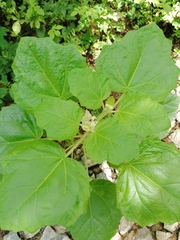 Martynia annuae0
- Outcome
- selected for further studye0
- Qualifier
- frequency of citatione0
Organisms pictured · Representative pictures of the matched species, not figures from the paper.

Verbatim
e0“Based on the frequency of citation, the species Martynia annua Lin (Martyniaceae), Securidaca longepedunculata Fresen (Polygalaceae), and Leptadenia hastata (Pesr.) Decne (Asclepiadaceae) were selected for further study.”
Claim · model-written summary
Leaves were the most used plant part at 55.13%.
Verbatim
e0“The leaves (55.13%) and root bark (21.79%) were the most used parts.”
e1“medicinal plants used for doping”
Claim · model-written summary
Root bark accounted for 21.79% of used plant parts.
Verbatim
e0“The leaves (55.13%) and root bark (21.79%) were the most used parts.”
e1“medicinal plants used for doping”
Claim · model-written summary
Plant extracts contained polyphenols, flavonoids and tannins.
Verbatim
e0“The phytochemical study revealed the presence of phenolic compounds such as polyphenols, total flavonoids and tannins.”
e1“medicinal plants used for doping”
Claim · model-written summary
Plant extracts showed antioxidant activity.
Verbatim
e0“The extracts exhibited antioxidant activity.”
e1“medicinal plants used for doping”