Claim · model-written summary
Cultivated thyme leaves had lower gland density.
- Taxon
- Thymus pallidus and Thymus satureioides
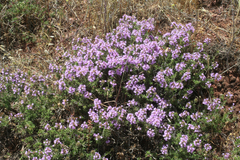 Thymus saturejoidesThymus pallidust0
- Organ / stage
- leavese0
- Outcome
- gland densitye0
- Direction
- decreasee0
Not reportedTreatmentComparator
Verbatim
t0“Thymus pallidus and Thymus satureioides”
e0“the scanning electron microscopy analysis of the leaves has also showed a decrease in the gland density”
Title
Salah eddine El-Bakkal; Safia Zeroual; Mohammad Elouazkiti; et al. Journal of Essential Oil Bearing Plants 2020. doi:10.1080/0972060x.2019.1708216
Other claims from this paper (14)
- Intervention effect Cultivated thyme had slightly lower essential oil yield than wild thyme.
- Observation Oil analysis identified 32 compounds representing over 98.4% of total oils.
- Observation Wild T. pallidus oil contained γ-terpinene at 20.23-21.49 %.
- Observation Wild T. pallidus oil contained borneol at 12.33-12.39 %.
- Observation Wild T. pallidus oil contained α-phellandrene at 11.63-12.58 %.
- Observation Cultivated T. pallidus oil contained γ-terpinene at 17.27-17.32 %.
- Observation Cultivated T. pallidus oil contained borneol at 12.39-8.3 %.
- Observation Cultivated T. pallidus oil contained camphene at 10.67-10.97 %.
- Observation Cultivated T. pallidus oil contained α-phellandrene at 10.57-10.71 %.
- Observation Wild and cultivated T. satureioides oils had carvacrol at 26.07-26.18 %.
- Observation Wild and cultivated T. satureioides oils had borneol at 17.25-20.67 %.
- Intervention effect Cultivation did not highly affect thyme oil antioxidant activity.
- Intervention effect Cultivation did not affect essential oil antimicrobial activity for both species.
- Recommendation The authors suggest cultivation as a sustainable use alternative for the threatened thyme species.