Claim · model-written summary
The higher infestation of group b trees may be explained by host specificity and changes in nitrogen levels.
- Taxon
- Quercus robur
 Quercus robure0
- Interactor
- A. quercicola
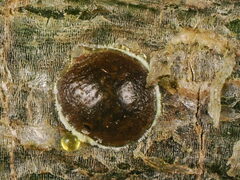 Asterodiaspis quercicolae1pest
- Outcome
- higher infestatione1
- Qualifier
- host specificity and changes in these trees' nitrogen levelse1
Verbatim
e0“three groups of adult Quercus robur L. trees”
e1“A possible explanation for the higher infestation of A. quercicola on the trees in group b is given in terms of their host specificity and changes in these trees' nitrogen levels”
Title
L. van Rensburg; G.H.J. Krüger; B. Ubbink; et al. South African Journal of Botany 1997. doi:10.1016/s0254-6299(15)30688-8
Other claims from this paper (8)
- Association The intermediate group of Quercus robur trees was more severely infested with Asterolecanium quercicola.
- Association Net photosynthesis of Quercus robur showed a significant correlation with photon flux density in all three groups.
- Association Net photosynthesis correlated more positively with pre-dawn leaf water potential in moderately and severely water-stressed Quercus robur trees.
- Association Stomatal conductance of Quercus robur showed little correlation with ψpd values.
- Association Stomatal conductance of Quercus robur in groups b and c showed a significantly higher sensitivity to relative ambient humidity.
- Association A close coupling exists between net photosynthesis, ψpd, RH, FTm and S in Quercus robur.
- Association Proline accumulated in group c Quercus robur trees but not in group b trees.
- Association Polyphenolic concentrations were significantly higher in group b than in group c Quercus robur trees.