Claim · model-written summary
Whole-tree harvesting raised the cover of Vaccinium myrtillus.
- Taxon
- Vaccinium myrtillus
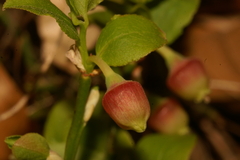 Vaccinium myrtilluse4
- Treatment
- whole-tree harvestinge4
- Outcome
- coverse4
- Direction
- highere4
Not reportedMaterialGeneCompoundOrgan / stageInteractorInteractor roleSecond interactorSecond interactor roleComparatorSettingValueQualifier
Organisms pictured · Representative pictures of the matched species, not figures from the paper.

Verbatim
t0“Ground Vegetation in Coniferous Forests”
e4“generally lower after whole-tree harvesting, while the covers of epigeic lichens and Vaccinium myrtillus were higher”
Title
Influence of Harvesting Intensity of Logging Residues on Ground Vegetation in Coniferous Forests
Bengt A. Olsson; Hakan Staaf Journal of Applied Ecology 1995. doi:10.2307/2404659
Other claims from this paper (14)
- Observation Successional changes in ground vegetation were related to the first principal components.
- Observation Residue treatments were related to principal components of the second or lower order.
- Intervention effect Whole-tree harvesting generally lowered the cover of most vascular plant species, notably herbs and graminoids.
- Intervention effect Whole-tree harvesting raised the cover of epigeic lichens.
- Intervention effect Bryophytes were mostly indifferent to logging residue treatment in cover.
- Intervention effect Pleurozium schreberi had a lower cover in plots without logging residues.
- Observation Overall differences in ground vegetation between treatments were small, resembling natural soil fertility gradients.
- Intervention effect Woody debris weakly suppressed the cover of Deschampsia flexuosa, only on the first study occasion.
- Intervention effect Woody debris weakly suppressed the cover of Luzula pilosa, only on the first study occasion.
- Mechanism The major influence of logging residues left on site on ground vegetation is suggested to relate to their nutrient contribution.
- Observation The impact of residue treatment tended to decrease over time.
- Observation Long-term treatment differences in species cover are suggested to be small, especially in forests developing dense canopies.
- Mechanism Repeated whole-tree harvesting may produce more drastic vegetation effects by reducing soil nutrient availability, which cannot be excluded.
- Observation Treatment-related differences in species cover were noted at all sites, 8 and 16 years after harvest.