Claim · model-written summary
Field surveys in 2006 and 2007 did not find O. longipes outside New Jersey in the United States.
- Interactor
- Oidium longipes
 Golovinomyces longipest0pathogen
- Outcome
- did not detect ite0
- Setting
- outside New Jersey in the United Statese0
 Petunia
Not reportedMaterialGeneCompoundOrgan / stageSecond interactorSecond interactor roleTreatmentComparatorDirectionValueQualifier
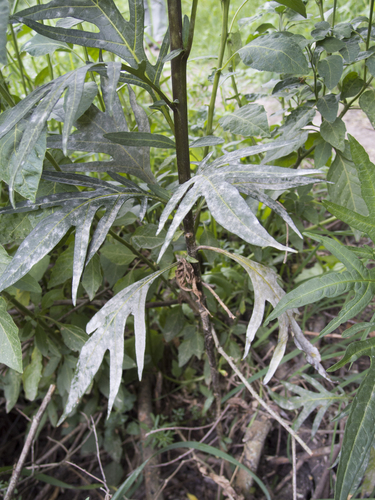
Organisms pictured · Representative pictures of the matched species, not figures from the paper.

Verbatim
e0“field surveys conducted in 2006 and 2007 did not detect it outside New Jersey in the United States”
t0“Oidium longipes, A New Powdery Mildew Fungus on Petunia”
Title
Levente Kiss; Tünde Jankovics; Gábor M. Kovács; et al. Plant Disease 2008. doi:10.1094/pdis-92-5-0818
Other claims from this paper (7)
- Observation Oidium longipes caused rapidly spreading disease on greenhouse petunia in New Jersey.
- Observation Oidium longipes was found on petunia in Hungary and Austria.
- Observation Petunia-derived O. longipes heavily infected tobacco cv. Xanthi.
- Observation Tested tomato and eggplant cultivars were moderately susceptible to O. longipes.
- Observation Powdery mildew on petunias from New York and Indiana was caused by Podosphaera xanthii.
- Observation Most examined European petunias with powdery mildew carried P. xanthii or Golovinomyces orontii.
- Observation One petunia plant or leaf could carry O. longipes, O. neolycopersici, G. orontii, and P. xanthii concurrently.