Claim · model-written summary
Cheyenne had a lower asymptotic natural enemy to aphid ratio than the other cultivars.
- Taxon
- pecan
 Carya illinoinensise1
- Material
- ‘Cheyenne’e0
- Interactor
- Monellia caryella (Fitch)
 Monellia caryellae2pest
- Outcome
- natural enemy to aphid ratioe0
- Direction
- lowere0
- Comparator
- the other cultivarse0
Not reportedGeneCompoundOrgan / stageSecond interactorSecond interactor roleTreatmentSettingValueQualifier
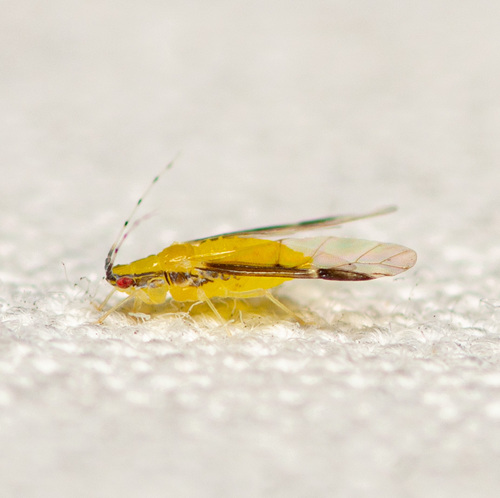
Organisms pictured · Representative pictures of the matched species, not figures from the paper.

Verbatim
e0“The asymptote reached on ‘Cheyenne’ had a lower natural enemy to aphid ratio than that on the other cultivars”
e1“pecan, Carya illinoinensis (Koch)”
e2“blackmargined aphid, Monellia caryella (Fitch)”
Title
Jessica Marie Honaker OakTrust (Texas A&M University Libraries) 2009
Other claims from this paper (14)
- Observation Aphid phenology was similar among pecan cultivars.
- Observation Cheyenne supported more aphids than Kiowa or Pawnee.
- Association Honeydew production correlated positively with aphid density.
- Observation Honeydew per aphid differed only between Cheyenne and Pawnee in 2006.
- Observation Natural enemies per aphid varied in statistical significance across both seasons.
- Observation Natural enemy densities rose during initial outbreak stages on all cultivars in 2006.
- Mechanism Honeydew appears to attract natural enemies.
- Observation Cheyenne was the least efficient cultivar in this defense mechanism.
- Observation Adult aphid feeding drained 761,197 – 900,312kcal per hectare on Cheyenne.
- Observation Adult aphid feeding drained 266,397 – 237,709kcal per hectare on Kiowa.
- Observation Adult aphid feeding drained 138,790 – 134,223kcal per hectare on Pawnee.
- Observation Calculated nut loss was 14 – 16kg for Cheyenne.
- Observation Calculated nut loss was 4 – 5kg for Kiowa.
- Observation Calculated nut loss was 2kg for Pawnee.